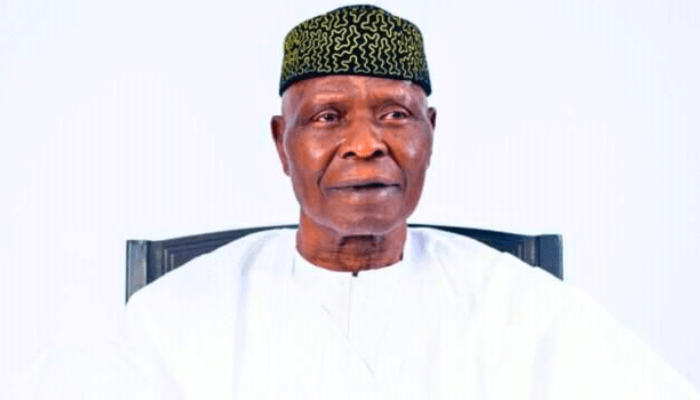
Chief Cornelius Olatunji Adebayo, a towering figure in Nigeria’s political and intellectual history, has passed away. He died in the early hours of Wednesday, June 25, in Abuja, at the age of 84.
The news of his death was confirmed by the family in a statement signed by Oluwasegun Adebayo, which read in part: “With profound sadness but gratitude to God, we announce the passing of our father and grandfather, Chief Cornelius Olatunji Adebayo.”
Read also: Kwara, Nasarawa farmers get 12.5m seedlings for tree planting
Born on February 24 1941 in the historic town of Igbaja, Kwara State, Adebayo’s life was defined by public service, moral courage and unshakable principles. He was a distinguished academic, an accomplished politician, a principled democrat and a mentor to generations of Nigerians across divides.

Educated at All Saints Anglican School, Oke-Onigbin; Provincial Secondary School, Ilorin; and Barewa College, Zaria, Adebayo went on to study at Ahmadu Bello University and the University of Ghana, Legon. His academic journey culminated in a teaching role at the University of Ife (now Obafemi Awolowo University), where he became a lecturer in 1969, and later, head of the English Department at Kwara State College of Technology in 1973.
Read also: Kwara supports defrauded pilgrims with $500 each
He was appointed Kwara State commissioner for education in 1975 and later served as commissioner for information and economic development. His tenure is still remembered for sweeping reforms that elevated the quality and reach of public education in the state.
In 1979, Adebayo was elected senator under the platform of the Unity Party of Nigeria (UPN) during Nigeria’s Second Republic. In 1983, he became governor of Kwara State, though his tenure was cut short by the military coup of December that year.
A man of strong democratic convictions, Adebayo was a key member of the National Democratic Coalition (NADECO), the pro-democracy movement that challenged the military regime following the annulment of the June 12, 1993 presidential election. When offered a ministerial role by the Sani Abacha junta, he famously declined. His refusal led to state harassment, including arrest and questioning over a 1995 bombing in Ilorin. Eventually, he was forced into brief exile in Canada in 1996.

Read also: Kwara flags off community support initiative
In 2003, president Olusegun Obasanjo appointed him minister of communications, a post he held until 2006. In that capacity, he helped steer Nigeria through a critical period in telecommunications development. He championed incentives for service providers and pushed for infrastructural expansion, while also warning against short-term profiteering in the growing mobile phone sector.
Respected across party lines for his intellect, integrity and soft-spoken wisdom, Adebayo was a beacon of moderation in a volatile political landscape. He remained committed to the ideals of justice, equity and democratic governance till the end of his life.
He is survived by his children, grandchildren, and a legacy of courage, learning and selfless service.
Funeral arrangements will be announced by the family in due course.