Across the world, the drive to cut carbon emissions has triggered a sweeping shift toward renewable energy. It’s a necessary response to the climate crisis. But in Africa, the push for a green transition raises a harder question: how do we embrace cleaner energy without slowing development, deepening poverty, or ignoring the continent’s unique challenges?
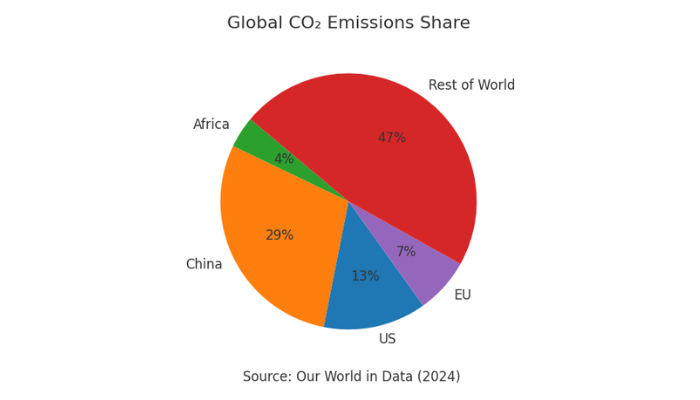
Africa accounts for less than 4 percent of global emissions. Yet it faces growing pressure to adopt the same energy transition paths as wealthier nations. The reality is that Africa isn’t starting from the same baseline. Nearly 600 million people on the continent still lack access to electricity.
“It means strengthening transmission infrastructure, supporting local energy industries, and focusing on affordability and access.”
That’s not a statistic; it’s a daily hardship. Telling communities without reliable lighting or clean cooking fuels to skip fossil fuels and go straight to solar and wind may sound inspiring, but it overlooks the practical and economic hurdles they face.

Read also: Africa’s energy investment seen strong with CapEx estimated at $43bn in 2025
Yes, renewables are crucial. Africa has abundant sun, wind, and hydropower potential. But they aren’t yet sufficient to power the economies of the future. Solar can’t run factories through the night. Wind can’t guarantee supply during still seasons. Batteries remain too costly and limited to fill the gap. And in the meantime, industries, hospitals, schools, and homes need stable power now, not decades from now.
The idea that Africa must leapfrog fossil fuels altogether while others built their economies on them rings hollow. Europe and North America burnt coal and oil for centuries. China still consumes more coal than the rest of the world combined.
Yet African countries are urged to “go green” with minimal emissions and underdeveloped infrastructure.
That’s not a rejection of climate responsibility. Africa is already grappling with climate impacts, floods, droughts, and crop failures. But sustainability isn’t just about emissions. It’s about building resilient economies, reducing inequality, and expanding opportunity. A reliable energy supply is central to that.

Transitional fuels like natural gas can help. Gas is cleaner than coal or diesel and can support industrial growth while renewables scale up. Ignoring that path would be short-sighted. Pragmatism, not idealism, should guide Africa’s energy strategy.
What is needed is flexibility for African governments to define energy transitions that match their realities. That means investment in renewables and transitional fuels. It means strengthening transmission infrastructure, supporting local energy industries, and focusing on affordability and access.
Read also: Gas turbine leaders gather to discuss Africa’s sustainable power future
It also requires fairness. Countries leading the global decarbonisation push must match their words with action: more green finance, more support for African-led energy solutions, and fewer one-size-fits-all prescriptions. Right now, most green investment in Africa flows to a handful of countries. That’s not a serious strategy for an inclusive transition.
Africa’s energy future can be low-carbon. But it must also be reliable, affordable, and built for growth. This transition shouldn’t copy the paths of Europe or the U.S. It should reflect Africa’s starting point, its people, and its ambitions.
Because true sustainability means leaving no one behind, not in darkness and not in poverty.
Olugbenga Olaoye is a seasoned professional with extensive experience in the oil and gas industry. He is a PhD candidate specialising in energy economics and holds a Master’s degree in Public Service from the Clinton School of Public Service, USA. He writes from Fort Worth, Texas.