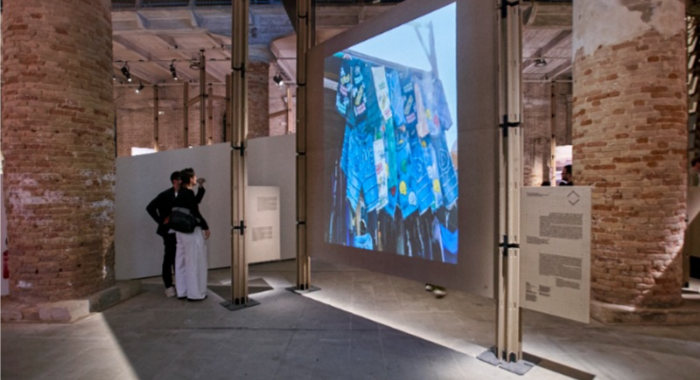
Over 20 years after Lagos became the focus of Rem Koolha, a visiting Architecture professor, the city’s informal markets are currently being celebrated in far away Italy courtesy of installation by by Tosin Oshinowo.
Moreover, the installation, which was inspired by the visiting professor’s articulation of the dynamics of Lagos, also won award at the Venice Architecture Biennale, in Italy.
In a theme focusing the creative design of three of many commercial displays of the city, the installation titled Alternative Urbanism: The Self-Organized Markets of Lagos, by Oshinowo is currently showing at Venice Architecture Biennale.
Significantly, Oshinowo’s installation has won award as one of two Special Mentions, alongside Elephant Chapel by Boonserm Premthada.

The award winning installation has its inspiration to over two decades ago, according to a tribute linked to the work. Oshinowo shared her story about how Professor Koolhaas, who is also the founder of OMA, inspired her installation.
“In 2001, as a young architecture student, I came across his Harvard Cities project covering Lagos,” Oshinowo shared her story at the Venice Biennale award ceremony. “This was the first time I had seen my city viewed through this lens, and I have remained spellbound. In the lead-up to this exhibition, we had many conversations concerning this work, and I am deeply honoured to have his essay contribution to the project.” She noted that Prof Koolhaas’ effort then sowed a seed of which germinated fruits that keep “changing our perspectives on how we think and design our cities for the future.”
Currently showing till November, inside Corderie, Arsenale of the Venice Architecture Biennale, the installation explores and celebrates market formats, operating as factories processing ‘waste’ or ‘end-of-life’ items from the global north and showcases the inherent and ingenious circularity.
Oshinowo’s curatorial note stated that the three markets captured in the installation include Ladipo Market, Mushin; Computer Village, in Ikeja; and Katangua, Agege. “Ladipo Market specialises in second-hand cars and parts; Computer Village in new and used computers and electronics; and Katangua in second-hand clothing and shoes,” the curatorial note from Oshinowo Studio stated. “All three resonate with communal intelligence, highlighting their alternative urbanism that contributes sparingly to global carbon emissions and brings genuine circularity to bear on everyday consumerism.”
Further on the curatorial direction of the installation, Oshinowo said that the mission about circularity inspired her studio. She explained how her thoughts on circularity led her team into research of the uniqueness of the Lagos markets. She noted that Lagos markets boasts of “an industry that repairs, recycles and regenerates consumer necessities to an extraordinary level.”

For the Venice Architecture Biennale jury, the installation deserved the Special Mention Award, particularly for the waste processing factor, among other qualities.
“Tosin Oshinowo’s Alternative Urbanism: The Self-Organized Markets of Lagos offers a glimpse to markets of processing waste of industrialized economy,” the jury stated in a motivation speech that produced the award.
“The documentation is a promising initiative for further research and knowledge production about markets in Africa and the importance of markets as prototypes for innovation. These markets are keynotes in a robust ecosystem that merits study because of its adaptive circularity.”
The description of the installation disclosed details such as being 3-meter-high and 3-meter-wide walls to create a sense of enclosure. And from the inner walls are immersive videos that project each market. Also, the outer sides of the walls, have data and three maps, crafted in Kantangua market from recycled denim, depicting each location. The maps illustrate the different zones that shape the marketplace, the essential elements supporting their functions, and the movement of people and goods through the space.
Supporters and sponsors of the installation that include corporate groups and individuals are based in Nigeria. The list include A.G. Leventis Foundation, Kavita Chellaram/Ko Gallery, Tafeta Gallery, OAB Foundation, CAP PLC Nigeria, Iron Capital, Sencillo Lagos, Yvonne Fasinro, Lekan Akinyanmi, Niyi Adenubi and Victor Ehikhamenor as supporters and sponsors. Others include: Ministry of Art, Culture, Tourism and the Creative Economy, FCT, Abuja, Office of the Special Adviser, GIS & Urban Development, Lagos State, Harvard University, Loeb Fellowship, Graduate School of Design, Andrew Eseibo, Amanda Iheme, Olanrewaju Ali and Nengii Nelson.
Oshinowo Studio is founded in Nigeria in 2013, and now boasts of an extensive international portfolio, which includes housing, culture and large-scale humanitarian projects. The studio’s ethos is rooted in the intersection of human-centred design, culture and climate. Established in West Africa and shaped by Yoruba culture, Oshinowo’s perspective on design calibrates regional approaches to global social and environmental challenges.
Oshinowo Studio is a member of the Royal Institute of British. The founder is a 2025 Harvard University Loeb Fellow and the curator of the 2023 Sharjah Architecture Triennial.
Curated by Carlo Ratti, the 19th Venice Architecture Biennale themed ‘Intelligence – Natural Artificial Collective’ runs until November 23, 2025.