A recent revelation from the World Bank at its flagship event, Jobs – The Path to Prosperity, held during the ongoing IMF/World Bank Spring Meetings in Washington, paints a bleak picture for Nigeria and its peers: an estimated 1.2 billion young people are expected to enter the global workforce over the next decade, yet only 420 million jobs are likely to be created. This leaves a staggering shortfall—only 35 percent of these individuals will find employment, while the rest may turn to entrepreneurship, which rarely leads them out of poverty.
The problem is compounded by the nature of these entrepreneurial pursuits. Many are clustered in low-productivity, service-based activities. The World Bank’s 2024 National Development Update (NDU) for Nigeria notes, “there has been a gradual employment shift from agriculture to services, yet many of the new jobs are in low-productivity service sub-sectors.” These kinds of jobs may keep people busy, but they won’t lift them out of poverty or stimulate broad-based economic growth. The danger, the report warns, is that Nigeria’s much-discussed demographic dividend could become a demographic burden.
The Economist’s January 2025 Africa Gap Report paints an even more sobering backdrop. In 1990, Africa accounted for just 14 percent of the world’s poor. By 2030, it is projected to account for over 80 percent of the world’s poorest people. This trajectory is not just alarming—it’s a call to action.

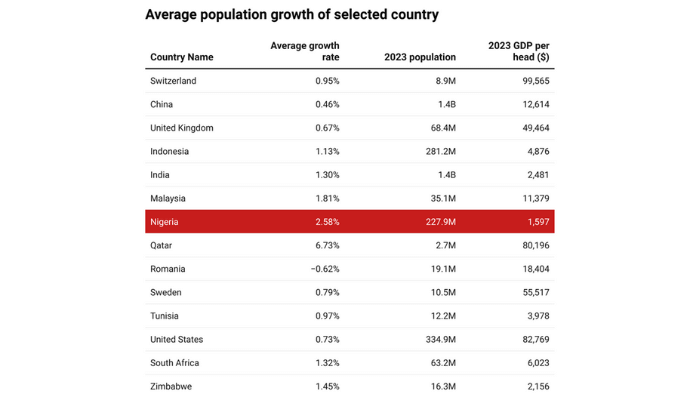
At the core of this alarming trend lies Africa’s rapid population growth. Over the past 30 years, the population across the continent’s 54 countries has doubled to 1.5 billion. The United Nations predicts it will double again by 2070. If countries like Nigeria do not take decisive steps to manage fertility rates, they risk amplifying existing challenges rather than unlocking new opportunities.
Sub-Saharan Africa’s working-age population is expanding rapidly, while populations elsewhere are stagnating or shrinking. Bridgewater Associates notes that the region will account for a quarter of the world’s working-age population within decades and will surpass China in the number of working-age individuals in just 10 years. Similarly, the World Bank projects that Nigeria will see an increase of over 12 million in its 15-24-year-old population within the next decade.
On the surface, this growing workforce could offer a sizable demographic dividend. A high ratio of working-age individuals to dependents (those too young or old to work) is often seen as a path to economic growth. Yet, without productive jobs to absorb this influx, the demographic dividend could turn into a demographic disaster.
A self-created problem
The reality is stark: unchecked population growth is fuelling a surge in youth population numbers. This challenge has been recognised for decades. As far back as 1996, high population growth was flagged as a threat to Nigeria’s development. Hence, the reason they recommended a population growth rate of 2 percent or less, instead of over 3 percent which was prevailing at the time. Yet, both leaders and the populace seem largely oblivious to the magnitude of this self-inflicted problem.
As Daron Acemoglu and James Robinson describe in Why Nations Fail, critical junctures in history often provide nations with opportunities to pivot toward shared prosperity. For African countries, the end of colonialism was one such moment. However, instead of building inclusive political and economic institutions, most post-independence leaders perpetuated the exploitative systems left by colonial rulers, widening the development gap between Africa and the rest of the world.

The case of Nigeria
Kingsley Moghalu, a former Deputy Governor of the Central Bank of Nigeria, has been vocal about the dangers of population growth outpacing economic expansion. He argues that large, economically unproductive populations only serve to increase poverty. According to him, “China could not have become a global economic power if it did not control its population. At the current rate, by 2030 most of the world’s poorest people will live in Nigeria and the Democratic Republic of Congo.”
Moghalu compares Nigeria’s situation to Japan, the world’s third-largest economy, with a population of 125 million and a birth rate of 1.3 percent. Japan’s Prime Minister recently described their declining birth rate as a “doomsday scenario.” Nigeria, by contrast, has a birth rate of 5.3 percent and a population of 216 million, with 133 million multidimensionally poor. While young Japanese are reluctant to have children, young Nigerians are over-procreating, perpetuating intergenerational poverty.
As Moghalu aptly put it, “A country whose population grows faster than its economic growth rate is in a rat race to more poverty.”
Missed opportunities
Nigeria has long recognised the dangers of rapid population growth but has failed to act. Under General Sani Abacha’s regime, the Vision 2010 document outlined ambitious economic targets, including reducing the population growth rate from 2.83 percent to below 2 percent by 2010. Strategies to achieve this included public education, expanded family planning, and enforcing compulsory education to discourage early marriages.
Yet, these recommendations were largely ignored. As Daniel Obi notes in his book Lost Vision, the failure to implement population management strategies reflects a deeper issue of governance and accountability.
The cost of inaction
High fertility rates have far-reaching consequences beyond poverty. According to The Economist, sub-Saharan Africa’s domestic savings rate from 2010 to 2021 was just 19 percent, compared to 37 percent in East Asia. This low savings rate limits investment and drives up borrowing costs. The demographic explanation is simple: when there are more mouths to feed, there is less money to save.
This vicious cycle of low savings and high population growth undermines economic stability and discourages investment. Until this cycle is broken, Africa’s leaders will continue to struggle with high debt levels and limited resources for development.
Lessons from Botswana
African leaders could learn from Seretse Khama, Botswana’s first president. Khama abandoned a privileged life in England to lead Botswana’s anticolonial struggle. However, he did not seek to entrench traditional institutions; instead, he modernised them to align with the demands of the contemporary world.
Botswana’s success is no accident. Even during colonial rule, Khama and other chiefs resisted extractive policies and preserved modern institutions. His commitment to shared prosperity and good governance set Botswana apart from most African nations.
Today, Botswana boasts a GDP per capita that rivals global benchmarks. Over the past 60 years, the GDP per capita of Botswana, Mauritius, and the Seychelles has grown steadily, keeping pace with global trends. As Acemoglu and Robinson observed, “Khama was an extraordinary man, uninterested in personal wealth and dedicated to building his country. Most other African countries have not been so fortunate.”
Moving forward
Kingsley Moghalu offers a clear roadmap: education is central to population management and economic growth. “Nigeria’s government must confront its population crisis,” he argues, warning against the misguided notion that a large population equates to global influence. “Only a skilled, economically productive population is useful.”
With 18 million Nigerian children out of school, the government must prioritise education, enforce compulsory schooling, and expand family planning initiatives. Africa’s leaders must adopt a long-term perspective, creating policies that benefit the majority rather than a small elite.
The urgency cannot be overstated. As The Economist warns, “By 2030, most of the world’s poorest people will live in Africa.” Without decisive action, Africa risks being trapped in a cycle of poverty, unable to harness its demographic potential.
African nations must learn from the past and emulate leaders like Seretse Khama, who prioritised national development over personal gain. The time for complacency has long passed; Africa’s future depends on bold, transformative leadership.