It is little wonder that the spate of killings across Nigeria shows no signs of abating—despite repeated assurances from the government. In 2023 alone, the economic cost of violence was estimated at 11.99 percent of Nigeria’s total GDP, according to the Institute for Economics & Peace (IEP). To put it plainly: with a GDP of $363.85 billion in 2023, the cost of violence stood at $43.63 billion—nearly $1 out of every $8 the nation produced. For every $8.34 Nigeria generated in 2023, $1 was wiped out by insecurity.
President Bola Tinubu recently declared a state of emergency in Rivers State following the sabotage of the Trans Niger Pipeline—a critical infrastructure tied to Nigeria’s primary source of foreign exchange. Yet, despite widespread and prolonged bloodshed in the North-East, North-Central, and North-West, no such declaration has been made in those regions. The message, it would seem, is that the value of crude oil exceeds the value of human life.
Yemi Kale, former Statistician-General and now Group Chief Economist at Afreximbank, put it—though he was speaking on economic reforms and how the government always failed to respond to anticipated crises. “In many cases, the disruption is not an unanticipated external shock beyond the government’s control.” That statement is very germane to the current crisis in the country.
Governors raise the alarm

In Borno State, Governor Babagana Zulum raised the alarm over mounting security threats. “It is unfortunate that the renewed Boko Haram attacks and kidnappings in many communities, almost on a daily basis without confrontation, signalled that Borno State is losing ground,” He said.
Similarly, in Plateau State, Governor Caleb Mutfwang issued a bold and sobering broadcast over the persistent killings in the state. “Let us be clear: this is not random violence. This is not an isolated conflict between farmers and herders. What we are witnessing is a systematic and premeditated campaign; one that seeks to displace, destabilise, and instil terror and fear on our people and communities.”
“We are also activating community-based response systems. I urge traditional leaders and youth associations to reactivate local vigilante groups and organise night patrols in coordination with the security agencies. We must protect our communities while upholding the rule of law,” He added.
This, in essence, is an admission that communities must now take security into their own hands. When self-defence becomes state policy, the social contract between the government and the governed has already been broken.
A nation in fear: Insights from the ground

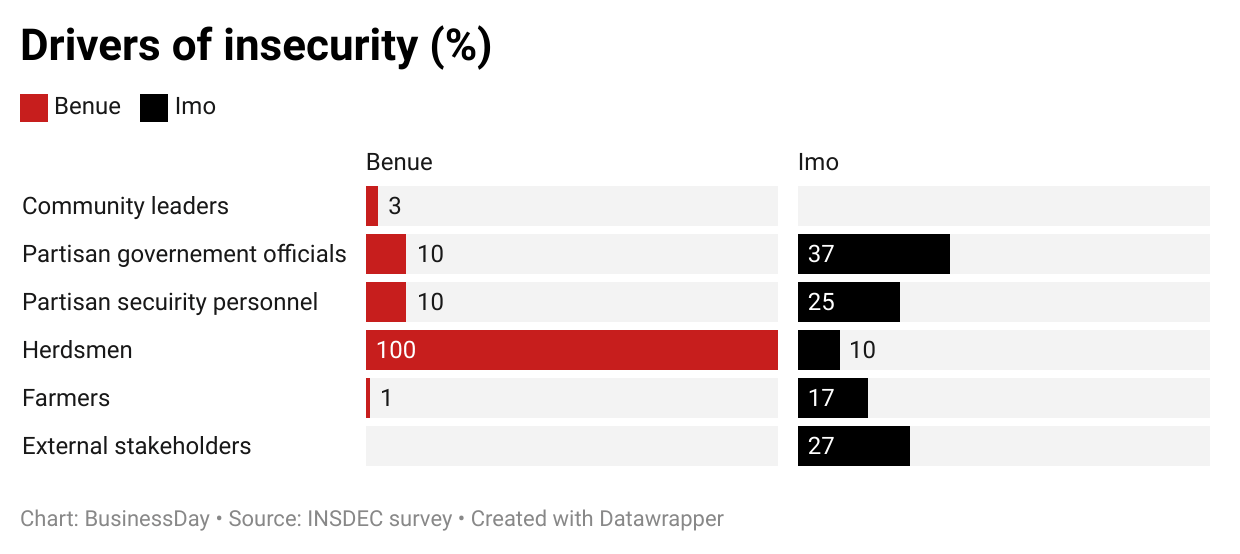
A recent study by the Initiative for Social Economic Development Communication (INSDEC), titled “Unravelling Nigeria’s Insecurity Crisis”, paints a bleak portrait. In Benue State, 100 percent of residents surveyed identified herdsmen as the primary source of insecurity. In Imo State, 89 percent of respondents blamed partisan actors—government officials, compromised security personnel, and external political interests.
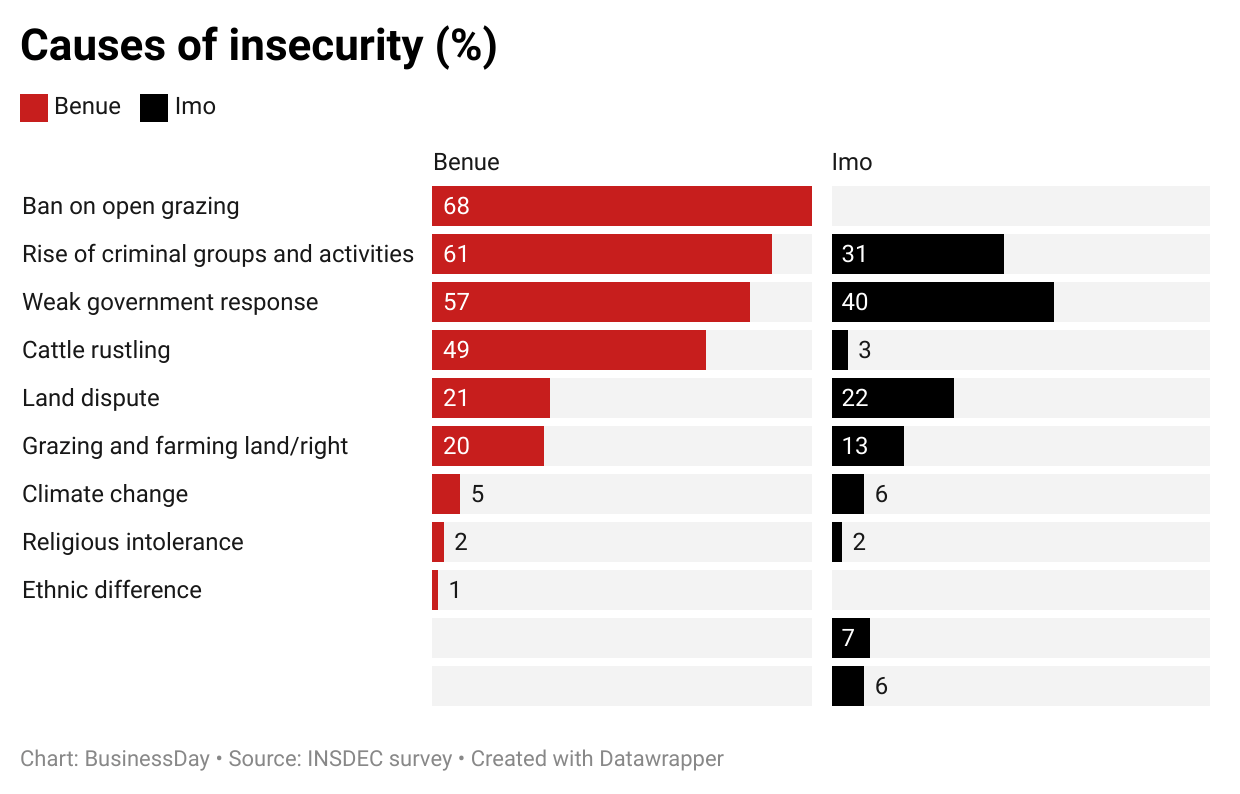
But the report goes even further by offering visual clarity on what the people themselves perceive as the root causes of insecurity. In Benue, 68 percent cited the ban on open grazing as the top trigger. This was followed by the rise in criminal groups, weak government response, cattle rustling, and land disputes. Meanwhile, in Imo, residents pointed to land disputes, partisan governance, and community leadership crises as the main drivers of insecurity. These are not just economic issues—they are structural and policy-induced.
Across both states, the drivers of insecurity were further disaggregated. In Benue, herders were blamed by 100 percent of respondents, followed by political thugs, bandits, and local militias. In Imo, 37 percent cited partisan government officials, 27 percent pointed to external stakeholders, and 25 percent to partisan security personnel. These are deeply institutional issues—not simply the fallout of poverty or unemployment.
It is time to stop lazily blaming insecurity on poverty. What we’re dealing with is a breakdown in governance, the erosion of public trust, and the unchecked influence of political and ethnic interests.
The report also highlighted vast ungoverned spaces—areas where the state has little or no control. These include parts of Borno, Niger (Shiroro, Rafi, Paikoro, Munya), and Zamfara, where forests such as Rugu and Kamara have become sanctuaries for bandits. In these regions, governance has all but collapsed.
Testimonies from the frontlines
The testimonies from affected communities are harrowing. One market leader in Benue said, “These Fulani attacks have become regular. They started in the interior villages. Now they’ve reached our towns. People are fleeing, and the pressure on safer areas is unbearable.”
A farmer in Imo added, “Lives were lost, people were injured, homes were destroyed. Even our health has been affected. People are terrified. By 6 or 7 p.m., everyone retreats indoors.”
Across both states, residents lamented that they could no longer farm, feed their families, or sleep peacefully. Starvation, displacement, and trauma have replaced stability.
Governance must evolve: The case for anticipatory action
Kale states that the government must shift toward anticipatory governance. “It is a situation where policies are not only designed to respond to crises but to foresee and mitigate them before they inflict widespread harm,” he explained.
Truly, governance in Nigeria has been far more reactive than proactive. Pam Dachungyang, Senator representing Plateau North, confirmed that security personnel were only deployed after dozens had been killed in the affected area in Plateau State. This backwards logic—waiting for disaster before acting—has become the defining feature of Nigeria’s security architecture.
Security through inclusion and opportunity
In an incisive column, Epa Ogie Eboigbe, Executive Vice President of INSDEC, makes a compelling case for a more strategic pathway out of Nigeria’s criminal quagmire. He argues that Nigeria’s security crisis requires a deeply strategic and long-term approach rooted in both institutional reform and societal renewal. He advocates for stronger intelligence capacity and better collaboration between security agencies and the communities they serve. Eboigbe highlights the importance of trust-building as a cornerstone of any successful security strategy—emphasising that without public confidence in the system, even the most advanced operations will falter. Furthermore, he underscores the need for judicial efficiency, calling for reforms that ensure swift, transparent justice to deter criminal behaviour.
Beyond enforcement, Eboigbe stresses that sustainable security is inseparable from economic inclusion, insisting that meaningful job creation and poverty alleviation must form part of the government’s arsenal in addressing criminality at its roots. His argument is clear: defeating insecurity is not just a battle of arms, but of ideas, trust, and systemic coherence.
Ultimately, all roads lead to the same conclusion: political reform is imperative. Our security institutions can only be as effective as the political environment that shapes them. The impunity that allows violence to thrive begins with the failure of leadership to prioritise lives over vested interests.
It is time to stop managing crises and start governing with vision. Because the real emergency is not in the oil fields—but in the villages, towns, and cities where ordinary Nigerians are dying needlessly every day.