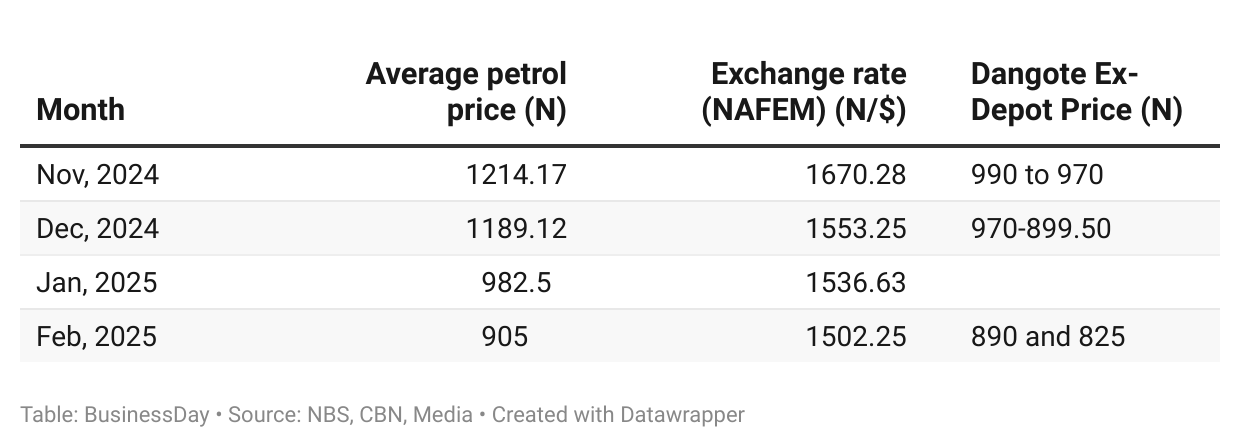
Data suggests that falling petrol prices, which started in November 2024, are a result of naira’s appreciation by 9.87 percent (December- February). Global crude oil price has been relatively stable. Again, it should also be noted that Dangote, which seems like a price setter right at the moment, has been enjoying economies of scale, which lower per-unit costs of refined fuel. Experts have suggested that as the refinery nears its full refining capacity, which is currently at 85 percent, the falling trend may continue.
The price of Premium Motor Spirit (PMS) has declined from an average of N982.5 in December 2024 to N905 in February 2025, following consecutive price reductions by the Dangote Refinery. This marks the lowest petrol price in six months, the last being N830.46 in August 2024.

Globally, petrol prices are largely determined by crude oil prices and exchange rates. However, Nigeria has long been an exception, as fuel prices were heavily subsidised for years. Despite the removal of subsidies, historical data shows unidirectional causation between the exchange rate and PMS prices. While the exchange rate directly influences petrol prices, the reverse is not necessarily true.

Furthermore, data from 2014 to 2024 suggests that PMS prices have consistently remained below the exchange rate, a trend that appears set to continue.

Between 2 December 2024 and 26 February 2025, the Naira appreciated by 9.87 percent, while PMS prices dropped by 23.89 percent. As Bismarck Rewane, CEO of Financial Derivatives Company Limited, succinctly put it, the reforms introduced by the Central Bank of Nigeria (CBN) are working.
There is little doubt that Dangote Refinery has been a major driver of the price reduction. In November 2024, the company cut its ex-depot price from N990 to N970, followed by three subsequent reductions, bringing it down to N825 by 26 February 2025.
However, a critical point that many overlook is that Dangote Refinery had not been operating at near-full capacity until recently. Reports surfaced in early February 2025 confirming that the refinery is now running at 85 percent capacity, with Devakumar Edwin, Vice President of Dangote Industries, stating that the facility is on course to hit full capacity within 30 days.

Economies of scale and the price decline
A concept in economics suggests that when a company operates at full or near-full capacity, it benefits from economies of scale—a scenario where increased production leads to lower per-unit costs. Initially, Dangote Refinery may have faced high production costs due to startup inefficiencies. However, as production expanded to 85 percent capacity, fixed costs such as machinery, labour, and logistics have been spread across more barrels, effectively lowering the cost per unit of refined fuel.
If the refinery reaches its full 650,000 barrels per day (bpd) capacity, these efficiencies will be further maximised, making petrol even cheaper compared to smaller refineries. If the FX market remains stable and full capacity is reached, Dangote may implement additional price reductions.
Who is determining PMS prices?
An important question arises: how much of the price drop is truly driven by market forces? Since November 2024, Dangote Refinery has effectively become Nigeria’s dominant price setter, while petrol importers have voiced concerns about the repeated price reductions.
This situation is not without historical precedent. In the 1870s, John D. Rockefeller’s Standard Oil monopolised the U.S. oil industry by employing predatory pricing—a strategy in which a firm lowers prices aggressively to eliminate competition before raising them again to maximise profits.
While Dangote’s case is not identical, the refinery is undoubtedly emerging as the most dominant player in Nigeria’s petroleum sector. The NNPC Limited (NNPCL), which should be a major competitor, does not yet operate its refineries efficiently and thus cannot enjoy the same economies of scale.
Logistics and the role of the Government
Kelvin Emmanuel, an economist, weighed in on the latest price cuts, highlighting how Dangote’s growing refining capacity is driving the reductions. He remarked that “the positive cracking margins are truly beginning to kick in,” making further price reductions possible.
Despite importing 12 million barrels in February and dealing with costs in USD, Dangote has continued to apply a bridging allowance for downstream offtakers—a mechanism that was previously “the exclusive preserve of PEF before it was subsumed after PIA”. This strategy, he noted, is helping to maintain price uniformity across the country.
Emmanuel also criticised the government’s lack of planning, particularly in logistics, which remains a major factor in petrol pricing. “When I said the government did not plan, this is one of the things I’m referring to,” he remarked. He advocated for a portion of the levy charged per litre by the Nigerian Midstream and Downstream Petroleum Regulatory Authority (NMDPRA) to be allocated to a privately managed fund. This, he argued, would help revive Nigeria’s 22 depots and improve pipeline distribution infrastructure, ensuring more efficient fuel evacuation.
While Nigeria’s fuel market is now deregulated, true competition has yet to emerge. Until other industry players enter the market and NNPCL operates its refineries efficiently, market forces alone will not dictate PMS prices. The government, therefore, must continue to support local refining while ensuring that logistics bottlenecks do not distort fuel pricing.