Ibom Air’s meteoric rise is putting paid to the popular assertion that the government has no business in business.
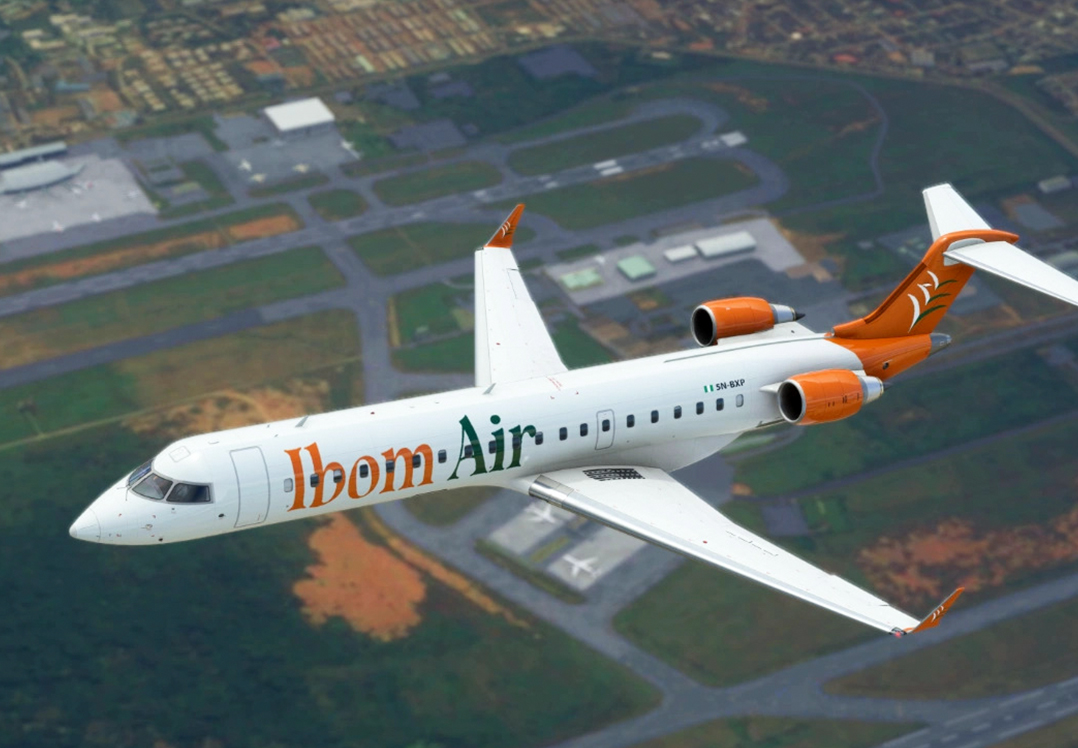
Launched on June 7, 2019, with a single Bombardier CRJ900 aircraft, Ibom Air, owned by the Akwa-Ibom state government, entered Nigeria’s challenging aviation landscape amid skepticism.
Many doubted whether the initiative—spearheaded by then-Governor Udom Emmanuel—could outlast his administration or avoid the fate of other state-run ventures mired in inefficiency. But six years later, Ibom Air has not only survived; it has soared.
The airline has now acquired nine aircraft- two Airbus A220-300 and seven Bombardier CRJ900 aircraft. It also anticipates orders of eight more aircraft in the near future.

Like every other airline operating in the sector, Ibom Air is not immune to challenges in the sector. The over 70 percent drop in the naira since foreign exchange reforms were implemented in 2023 squeezed airline operators who still have to grapple with poor infrastructure, spiralling inflation and high interest rates.
According to people familiar with the airline’s operations, Ibom Air flies high above several other airlines in Nigeria, thanks to intelligent minds that support the airline’s vision; its corporate governance structure and commitment in on-time departure and customer service.
On-time Departure
Flight delays and cancellations have become an all-too-familiar occurrence in Nigeria’s aviation sector, raising serious concerns about the reliability of airlines and the overall efficiency of the industry.
But for Ibom Air, it is a different experience, as the airline not only ensures on-time departure on all of its flights but is in the habit of publishing its departure performance monthly.

In terms of schedule reliability in the airline business in Nigeria, Ibom Air and ValueJet Airlines rank top with statistics from the Nigerian Civil Aviation Authority (NCAA) to back up this claim.
It was not surprising when last year, Ibom Air was announced the ‘Best Airline of the Year’ for the third consecutive year by the African Travel Quarterly Travellers.
“A close friend introduced me to Ibom Air and since then I have never flown any other airline except it is not flying to my destination. For me, what endeared me to the airline is its consistency in on-time departure, especially at a time when almost all airlines hide under operational reasons to delay flights,” Jude Nnaemeka told BusinessDay.
According to Nnaemeka, if Ibom Air can’t take on many passengers because of capacity, they will rather not put up the flights for booking so that people do not get disappointed over delays and cancellations.
“The airline’s online departure history has seen the airline operate full flights on all their operating destinations. This is because travellers trust that the airline will depart at the scheduled time of departure,” Festus Akande, another passenger, told BusinessDay.
Operational Model
George Uriesi, the airline’s chief operating officer, had disclosed that from inception it mapped out a strategy that it believes would work for it by not competing with big intercontinental airlines but will consolidate and compete healthily on local and regional routes.
The airline chief disclosed that Ibom Air has no ambition of operating outside Africa, saying, “We have no ambition to go outside Africa. We want to see Ibom Air be a world-class African regional airline.”
The airline may have learnt some lessons from Nigerian airlines that ventured into international routes and suspended operations as a result of aero politics which drained the airlines’ financial gains.
Ibom Air understands that fuel consumes a chunk of airline’s revenue, so the airline chose two aircraft fuel efficient types. It operates two Airbus A220-300 and seven Bombardier CRJ900 aircraft.
The Airbus A220 is considered one of the most fuel-efficient regional jets available today for shorter routes. Specifically designed to serve the 100-150 seat market, the A220 offers exceptional fuel economy for shorter, regional flights. According to Green Worldwide, this aircraft’s fuel efficiency stems mainly from its cutting-edge Pratt & Whitney PW1500G geared turbofan engines, which reduce fuel consumption by up to 20 percent compared to older-generation aircraft.
In March 2005, Bombardier announced that it upgraded the CRJ900 by redesigning the wing-tip and winglet and optimising the wing’s leading-edge devices to provide lower lift / drag ratio and reduced-approach speeds. This resulted in improved payload range, take-off and landing performance and lower fuel costs.
IATA IOSA certification
Few airlines in Nigeria have the International Air Transport Association (IATA) Operational Safety Audit (IOSA) certification. They include Air Peace, Ibom Air, Arik Air, Overland and United Nigeria Airlines.
In April 2023, the Ibom Air was awarded the International Air Transport Association’s (IATA) Operational Safety Audit (IOSA) Certificate, a globally recognised standard for airline safety. This achievement further solidified Ibom Air’s commitment to safe operations and paved the way for its official membership with IATA in August 2023.
Broader Impact
The Ibom Air’s Maintenance, Repair, and Overhaul (MRO) facility, another critical project, is expected to generate significant revenue for the state. Currently providing limited services to Ibom Air, the facility is nearing full completion and has already attracted interest from several African airlines.
When fully operational, it will be one of only four such facilities in Africa, alongside those in Ethiopia, Morocco, and South Africa. African airlines spend hundreds of millions of dollars annually on maintenance and repairs abroad, and Akwa Ibom hopes to capture a share of this market. For instance, Ethiopian Airlines disclosed in 2019 that its MRO facility generates $80 million annually.
The Akwa Ibom government is optimistic that the MRO will contribute significantly to its projected 28 percent IGR growth, reaching N80 billion by 2025.