The Nigerian economy witnessed a lot of ups and downs with the naira volatility, high inflation and rising interest rates taking the centre stage all through the year.
As the naira weakened against the U.S dollar and prices climbed even higher, the central bank raised borrowing costs, a move that many economists have argued may not be all that effective in controlling stubbornly high inflation.
Here are the 9 major highlights
Naira


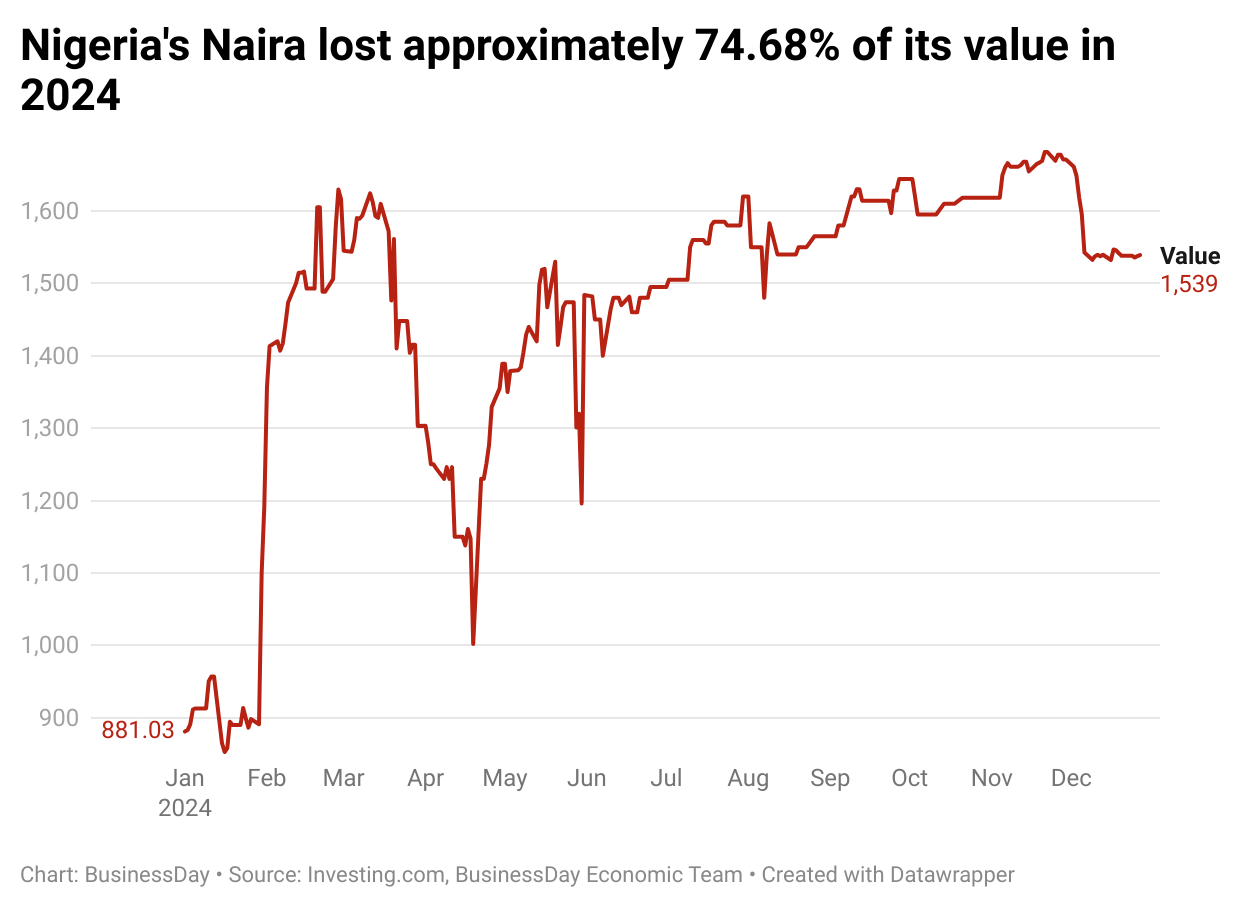
The Nigerian naira witnessed a twist and turn year – from almost reaching N2000/$1 in February to now N1,538 as at Thursday, 26th December 2024 – but is poised to stabilise in 2025 on higher FX inflows.
The naira at different times was accorded the worst performing currency this year but for once in April when it emerged as the best. The currency has shed some 70 percent of its value since the government loosened currency control last year.
But the recent BMatch system by the CBN together with more dollar supply expected from investments, especially in oil and gas next year, the naira is set to rebound to between N1000 to N1200/$1, according to Abdulrauf Bello, portfolio manager at investment firm Cowrywise.
Inflation

While the naira was gasping for air, inflationary pressures were eroding consumers’ spendings shrinking the value of their once big salary. All through the year, inflation only declined twice – July and August – but for most of the year, it continued to accelerate despite monetary instruments deployed by the CBN to curtail it.

In November, prices quickened to a 30-year high, rising to 34.6 percent with food inflation almost at 40 percent. But President Bola Tinubu expects it to fall to 15 percent next year.
Analysts see inflation rising all through the first quarter of 2025 before beginning to moderate on high base effect and expected incentivisation of farming to improve agricultural produce.
Interest rates

As inflation is accelerating, key interest rates are rising in response to prices. But this policy step has not been able to anchor inflation which has risen for most of the year.
In November, the CBN beat market forecasts by raising its key benchmark interest rate up 25 basis points, marking the sixth straight rise but the lowest it has been jacked up under CBN governor Olayemi Cardoso.
The quarter-point hike now puts the borrowing costs at 27.5 percent with a cumulative 875 basis points — the longest tightening cycle since the reenactment of the CBN Act in 2007 — highlighting the pressing need to stabilise prices and support the currency.
The token rate hike had analysts seeing an end to the long tightening cycle but with inflation quickening to 34.6 percent in November – the highest in three decades – monetary policy rate might not be slowing anytime soon.
GDP

Nigeria’s economy in real GDP saw a steady growth in 2024, rising from 2.98 percent in the first quarter of the year to 3.19 percent in Q2 and 3.46 percent in Q3 driven mainly by the services sector, which contributed more than 50 percent to aggregate output in the July-September period.
Despite the pickup in growth this year, it was still short of the 6 percent target set by President Bola Tinubu when he took office last year in Africa’s most populous nation and top oil producer.
But hitting the projected 4.6 percent in 2025 may be achievable should the government stay the course and improve key sectors like manufacturing and agriculture.
Unemployment

Again Nigeria’s unemployment unexpectedly fell in the second quarter of 2024, spawned by the steady rise in self-employment, as loss in paid employment puts citizens’ entrepreneurial skills to test.
The National Bureau of Statistics (NBS), which defined a rise in unemployment as generally meaning the number of people searching for jobs, said the unemployment rate dropped to 4.3 percent in the three months to June from 5.3 percent in the first quarter of the year.
The data further revealed that jobless growth has been waning for the past three straight quarters despite the tough business climate that’s resulted in exodus of multinationals and downsizing of workers in some companies to stay afloat.
Per capita income

The gross domestic product (GDP) per capita income earned by an average Nigerian plummeted to a staggering 72.8 percent, a 20-year low in 2024 reflecting policy missteps made in the last decade that have weakened the economy and worsened living conditions.
The per capita income stood at approximately $3,223 in 2014, but recent estimates by the International Monetary Fund indicates it has plunged to $877 this year.
But while Africa’s most populous nation saw its average income earned per person nosedived in the last 10 years, West African peers like Ghana, Cote d’Ivoire and even Benin Republic GDP per capita were modest.
Foreign reserves

On the bright side, Nigeria’s external reserves grew by almost $8 billion over the 11 months period to November 2024, swelling to $40.8 billion as portfolio investors take advantage of the elevated interest rate environment.
According to data from the Central Bank of Nigeria (CBN) as at Thursday, December 26, the foreign reserves has been on the rise since April this year where it hit $31 billion and increased by $ 1 billion between October and November.
The steady rise in net reserves can be attributed to the hawkish monetary policy stance of the CBN which has seen foreign portfolio inflows surging on account of the rate hikes.
Debt

Nigeria’s public debt stock rose by N12.6 trillion between March and June 2024 amid continued depreciation of the naira despite the Central Bank of Nigeria’s efforts to shore up the local unit.
This spike in the nation’s debt burden now puts the total debt at N134.3 trillion as at the second quarter of 2024, according to the most recent data published by the Debt Management Office (DMO).
While debts are piling, the cost of servicing these obligations are growing with the country’s debt-to-service-revenue ratio quickened to 162 percent in the first half (H1) of 2024, up from the 128 percent reported in the same period last year.
The government also plans to spend some N16 trillion on debt servicing next year, an amount higher than budgetary allocation for critical sectors like security, education, health and infrastructure.
Tax reforms

The Nigerian government, knowing that it has a shortage of revenue and ballooning debt profile, sees proposed changes in its tax laws helping to significantly boost revenues, as the West African nation seeks to control its widening deficit and borrowing costs.
President Bola Tinubu proposed four bills which are awaiting legislative action, including the Nigeria Tax Bill to streamline tax codes and generate more revenue for a country whose tax-to-GDP lags behind African peers.
But the said progressive VAT increase from 7.5 percent up to 15 percent by 2027 is feared to stoke prices and deepen poverty, especially in the northern region where the reforms have been most scrutinized.