Phillip Isakpa
An unexpected e-mail pings its way on to my monitor, and its headline catches my attention: “Arik Air sees significant rise in passenger figures in August. Airline reaches milestone carrying 5 millionth passenger during summer period.” This took me back to the only time I travelled Arik, just over a year ago, only six months after the establishment of their Lagos-London route. It was a pleasant return journey (helped undoubtedly by the comforts of Business Class), but they seem to have sunk below my radar, as my last two flights to Lagos have been on British Airways and Virgin Atlantic, both of which have dominated Nigeria-UK traffic for the best part of the last ten years. BA, of course goes back to the early 1990s when they swallowed up the often-lamented British Caledonian, while Virgin were brought in more recently, early in the Obasanjo period.
If BA appeals to the establishment-minded who like their air travel cool and formal, and Virgin’s international image is of more relaxed air travel verging on the casual, Arik air went into the market with a different philosophy pitching particularly at Nigerians, both in Nigeria and in the diaspora. Thus, after its founding in October 2006, the airline made a conscious effort to build up their domestic market first. The airline’s progenitor, Joseph Arumemi-Ikhide (whose names produced the acronym Arik), developed his vision in the early years of the last decade, when aviation in Nigeria was going through a period of turbulence. On the one hand there was the fading of the idea of state-owned national carrier, on the other, some serious problems of standards and operational efficiency, aggravated by a series of crashes and other security scares. It is said Joseph, an engineer by profession, was so frustrated by the condition of local aviation that he invested in his own Hawker jet, which he offered to contacts in the oil and gas industry to fly around Nigeria. On the basis of this corporate jet business, he felt it was time by the middle of the decade to raise his sights, and set up an airline that “Nigeria and the world would be proud to fly.” Lessons from other airlines, and serious moves for reform, seemed to provide a conducive environment.
The beginning was the acquisition of old Nigeria Airways facilities which were refurbished, followed by the setting up of a domestic network, beginning with Lagos and Abuja in October 2006, extending to Calabar, Benin, Enugu and Port Harcourt in the next six months, so that by the end of 2008 there were fifteen Nigerian destinations including six in the northern states. And from a fleet of five aircraft (three CRJ-900s and two Boeing 737s) there are now 26 aircraft for both long and short-haul. International flights are mostly managed by the Portuguese company Hi-Fly, and while Iberia manage the international fleet, Lufthansa is charged with the domestic fleet.

Read Also: Ex-Arik Air boss appointed Cleanserve Energy CEO
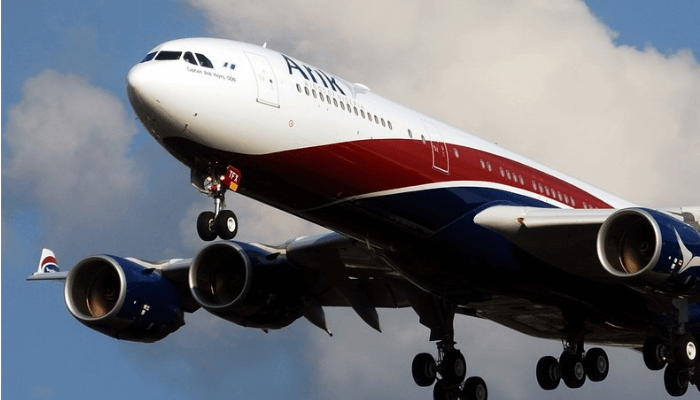
The international flights were begun in December 2008 with the daily Lagos-London flight, on a newly acquired Airbus A340-500. This was under the eye of the CEO of Arik Air International, Michael Arumemi-Ikhide, son of Joseph. Although the first flight out of Nigeria had been to Accra in January 2008, it was 2009 which saw expansion elsewhere in Africa, to Cotonou, Freetown, Banjul and Dakar, but notably in June that year, on the key route to Johannesburg, which has been one of Arik’s most successful ventures, that saw dividends this year at the time of the World Cup (which doubtless boosted their figures for the summer quarter). This year there has been an important breakthrough in starting to fly to New York
Talking to Keelan Morris, Corporate Communications Manager at Arik Air International, and Adrian Richards, Manager international Sales and Marketing, in their fifth floor office of a tower block in the city of London, I felt growing confidence that Arik is now attaining cruising speed, as it approaches its fourth anniversary. Although they are non-committal as to where the expansion might go next, there have a list of twenty possible destinations (such as Paris, Beijing and Dubai), indications of the airline’s ambitions.
The word Morris and Richards like to use is ‘credibility’, which is one reason there has been a slow and patient build-up and testing, without beating the drum internationally. The deliberate Nigerianised image, with Nigerian menus, and Nollywood films on the in-flight entertainment, was evident on the flight I took a year ago, with Economy full to bursting but some spaces in Business Class. This is, they say, much less evident on the South African route, where there is more of a two-way “corporate market”, bearing in mind that there are now over a hundred South African businesses that have begun operating in Nigeria in the last ten years. Arik now feel it is time to demonstrate to the international corporate market the advantages of what they have to offer, one of those ‘best-kept secrets’ that West Africa is so good at nurturing.