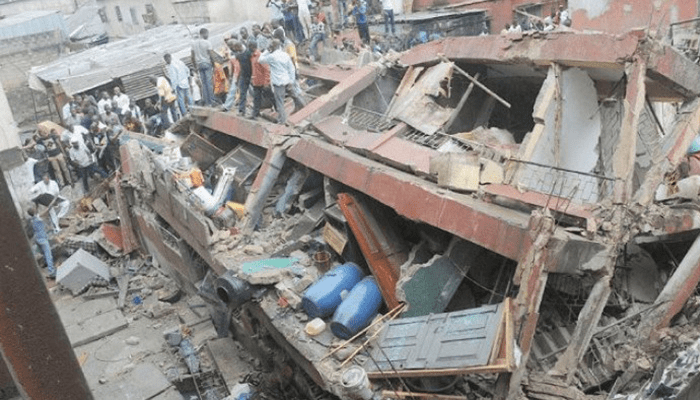
Gradually but steadily, building collapse is becoming a norm in Nigerian cities, especially Lagos, the country’s commercial capital. Even as this piece is being written there are reports of a collapsed building in another part of Lagos. It should be noted however that this latest occurrence differs from one that occurred recently in Ebute Metta, Lagos.
Meanwhile, we need to appreciate that building collapse is an old phenomenon that dates back to the early 70s. This means that, for so long, Nigeria has been losing lives and investments to this man-made problem.
Record shows that from 1974 to 2019, Nigeria recorded about 146 buildings collapses that killed over 1,000 persons with many others sustaining various degrees of injuries, just as unquantifiable amount of investment funds were lost.
Q: It tells the world that all that have been heard and said by both government and built environment professionals are no better than “the fury of an idiot signifying nothing”
Though building collapse is a national problem, it occurs mainly in the cities, with Lagos as its headquarters. It is unfortunate, and we share in the pain of its reality. Despite its claim to excellence, Lagos remains the epicentre of building collapse incidents with the latest incident occuring as recent as May 1, 2022.
Arguably, Lagos is unique in many respects and prides itself as the ‘Centre of Excellence’. Indeed, those who manage its affairs and resources also take pride in describing the city in superlative terms.
According to them, Lagos is a mega city in the league of New York, Tokyo, Singapore, etc. It is also one of the smart cities of the world; the most thriving economy in Nigeria and the largest economy in West Africa whose GDP is much more than those of four countries in the sub-region put together.
Much as we agree with some of these descriptions, it is worrying that Lagos has, on many occasions, failed excellence tests. For example, Lagos is the third worst city to live in the world, according to Global Liveability Index released by The Economist Intelligence Unit and the World Bank. Again, Lagos tops Nigerian cities where building collapse incidents occur most frequently.
A more recent record on building collapse incidents in Nigeria shows that between 2011 and 2019, about 84 collapse incidents were recorded and only 21 happened outside Lagos. The report adds that 59 percent of these incidents involved buildings still under construction while 41 percent were existing structures.
Before the November 1, 2021, collapse of a 21-storey building still under construction at 44, Gerrard Road, Ikoyi, known as ‘360 Degrees’, Nigeria had had three major incidents involving Reigners Bible Church building in Uyo, Akwa Ibom State, in which 50 lives were lost.
The other two happened in Lagos and these were Lekki Gardens a 5-storey building which collapsed and killed 34 people; and then the Synagogue Church of All Nations Guest House, which collapsed and killed about 116 people, including 84 foreign nationals.
After the collapse of the 21-storey building in Ikoyi, leaving about 45 people dead, including the developer, Femi Osibona, Nigerians thought Lagos had seen the last of building collapses because that was one incident that shook Nigeria and its building industry to the foundations given its location and the magnitude of the structure involved.
But they were mistaken. The collapse of the 3-storey building in Ebute Metta that killed 10 persons and left several others with injuries means no lessons have been learnt. It tells the world that all that have been heard and said by both government and built environment professionals are no better than “the fury of an idiot signifying nothing.”
It behoves on us to stress that these are unfortunate and avoidable incidents. Though we agree with those who blame the incidents on Lagos large population, which buoys high demand for housing, leading to estate developers cutting corners in their bid to match supply with demand; we agree more with the argument that government’s regulatory laxity fuels these dismal incidents.
Read also: Building collapse: We must implement national building code- Ooni
Building experts contend that buildings fail when there is weakness in the materials used or when the building is not stable. But there are also cases of using substandard materials; lack or poor soil tests, poor supervision and corruption by government agencies; lack of building professionals on site, etc.
All these are within government control. In Lagos, there have been serious cases of negligence which is made worse by lack of political will or strength of character to deal with erring builders or developers.
On two occasions, Lagos has admitted negligence in its regulatory functions. In 2016, following the collapse of the Lekki Gardens building, Governor Akinwunmi Ambode sacked the then general manager of the Lagos State Building Control Agency (LASBCA), Adeigbe Olushola. In 2021, when the 21-storey Ikoyi building collapsed, Governor Babajide Sanwo-Olu suspended Gbolahan Oki, the LASBCA general manager at the time.
Allied to this is government’s failure to prosecute offenders. By September this year, it will be eight years of the Synagogue building collapse incident. Lagos initiated a court case against the church, which is yet to be concluded to date. Again, the panel it set up to investigate the Ikoyi building collapse has already done its work and made recommendations to government. Nothing is being heard on that now.
It is, therefore, clear to us that lack of political will, ineffective monitoring of building development, lack of manpower and corruption among officials in charge of building approval in relevant government agencies contribute significantly to building failures in Nigeria, Lagos especially.
It is our well considered view, therefore, that time is now for government to get serious with its regulatory and supervisory functions. It is time too for the state to up its game by enforcing compliance with building approvals and related activities. Indeed, the time to save lives and people’s investment is a compelling one. And one way of ensuring this is to ensure that the phenomenon of Building Collapse is consigned to the realm of perpetual antiquity.