In its Mobility Report for 2014, Ericsson, a telecoms service provider, contends that a combination of cheap phones and content is driving data traffic in sub-Saharan Africa. The breakdown for mobile data traffic on social media shows that 74 percent send messages; 62 percent check friends’ updates; 46 percent upload videos/photos and 15 percent stream content. But that’s not all.
Years after the first of seven series on Harry Potter was published and long after the last instalment of the movie series was viewed in cinemas readers in developed countries who can’t afford a pricey hard copy are keen on reading it on their low-end mobile phones. The British boy wizard’s story was among the top 20 search terms on Worldreader Mobile, an app for reading books on mobile phones.
Twilight, another serial novel about romance and vampires, was the 20th-most searched term, according to a report: Reading in a Mobile Era, published by Unesco in partnership with Worldreader and Nokia.
In Nigeria men and women enjoy reading on their mobile phones. The ubiquity of mobile phones and mobile broadband connectivity has sparked a reading revolution. The most used and viewed medium in Nigeria are the TV, laptop, smartphone and tablet. Nigerians spend 193 minutes on their smarphones – 66 and 19 minutes more than their counterparts in South Africa and Kenya respectively (see infographic).

Romantic novels and religious books are the top books read on Worldreader – though three times more men read on mobile devices, women read six times more per month than men; hence romantic fiction is popular.
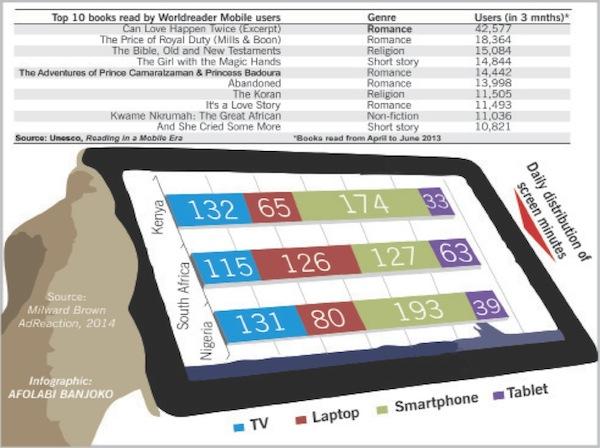
But readers are hungry for relevant local content. They want books written by local authors either in English or local languages and that can be read to children. Things Fall Apart and two short stories: And She Cried Some More and The Girl with the Magic Hands are by Nigerians.
As technology improves and more people get online on their mobile phones, filling the gap is left to local writers and publishers. By 2019, Ericsson reckons 600m mobile subscribers in Africa will be surfing the web with 3G/4G technology, up from 500m that used GSM/EDGE in 2013.
Kachifo, a Nigerian publisher, has partnered with Worldreader to make its books digital. Can publishers and writers profitably slake readers’ thirst for local content? Reading 1000 pages on a mobile device costs 2 cents compared to $15 to $30 dollars for a hard copy. A revenue sharing formula between telecoms providers and publishers could be worked out: 99 percent of Nigerian mobile subscribers pay as they go on their phones.

Tayo Fagbule