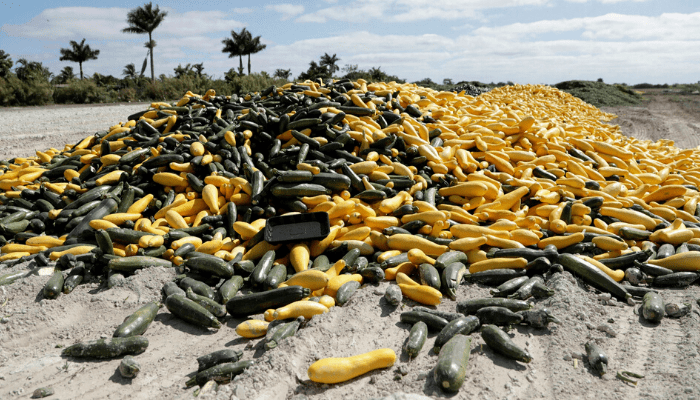
Katie and Jim DiGangi, who run a dairy farm in Wisconsin, have spent the last several weeks dumping as much as 20,000 gallons of milk a day. In California, Jack Vessey, a lettuce and leafy green farmer, has destroyed 350 acres of his crop by ploughing his tractor through unharvested fields.
The two farms are almost 2,000 miles apart but both have become examples of the damage done by the coronavirus outbreak to the complex supply chains that bring food from farms to tables in the US.
As restaurants, hotels and schools have closed, farmers and ranchers who supplied them have lost customers. But redirecting their production to grocery stores has proved difficult because of the differing demands of commercial food operations and people cooking in their kitchens.
The result has been scenes out of the Great Depression: farmers destroying their products as Americans line up by the thousands outside food banks. While officials maintain there is no immediate threat of food shortages, no one is sure how long it will take to re-engineer supply chains so more food can reach stores and farmers can earn their keep.

“We haven’t seen anything like this in our lifetime,” said Mr DiGangi, a seventh-generation dairy farmer. “It’s obviously uncharted territory for everyone.”
Shifting to sell to retail in grocery stores is really complicated. It’s not about just flipping a switch and making it happen
Michael Nepveux, American Farm Bureau Federation
The US food bottlenecks have been exacerbated by the closing of several meat processing plants after workers were infected with coronavirus.
Smithfield, a leading US pork processor, has temporarily shut three plants, including one in Sioux Falls, South Dakota, where hundreds of employees tested positive. Tyson Foods, the largest US meat packer, reopened its pork plant in Columbus Junction, Iowa at a curtailed pace this week closing it because almost 200 employees tested positive.
Then on Wednesday, Tyson halted production at its largest pork plant in Waterloo, Iowa, citing worker absences, Covid-19 cases and community concerns.

The Tyson plant can slaughter 19,500 head of hogs per day. Combined with closures at other pork plants, a quarter of the nation’s pork production capacity of more than 500,000 hogs a day stands idle, said Steve Meyer, an economist with Kerns and Associates.
We’re definitely taking on water really fast right now,” said Jen Sorenson, incoming president of the National Pork Producers Council and a pork producer in Iowa. “The loss of packing capacity is terrifying to producers because there is no place to take market animals.”
Cattle have been less immediately affected by plant closures because they can be put out to pasture, said Colin Woodall, chief executive of the National Cattleman’s Beef Association. But he added: “If those plants don’t reopen, that’s a different story. We can manage about two weeks, but a month or more? That’s a different subject.”
Christine McCracken, a protein analyst at Rabobank, said that a build-up of livestock combined with the difficulty of shifting supply chains would cause financial problems. “That will eventually lead to bankruptcy in the industry and a correction in herd numbers,” Ms McCracken said.
Farmers are suffering even as supermarket demand for their products remains robust. But industry analysts say shifting production away from restaurants has been tricky because commercial and consumer products are prepared and packaged so differently.
In the case of eggs, for example, commercial kitchens take delivery of huge pallets of eggs, often pre-shelled, whereas supermarkets prefer smaller cartons. Restaurants will also often take delivery of uncut sides of bacon, rather than the thinly sliced, smaller portions sold in supermarkets.
“Shifting to sell to retail in grocery stores is really complicated,” said Michael Nepveux, an economist with the American Farm Bureau Federation. “It’s not about just flipping a switch and making it happen.”
The shift in demand from restaurants to supermarkets has also caused pricing dislocations. Ground beef, which is bought more frequently in supermarkets, has become more expensive, while high-end steaks sold in restaurants have been falling in price.
“The tenderloin, the most expensive cut, is heavily exposed to restaurants,” Mr Nepveux said. “Not many consumers are buying a fillet mignon to put on the grill at home.”
Mr Woodall of the National Cattleman’s Beef Association estimated that “about half of our production goes to hotels and restaurants. It’s been a huge hit for the beef industry”.
A wholesale pork price index has surged by a third to 70 cents a pound in the past week as slaughterhouses are shut down by the coronavirus, according to the US Department of Agriculture.
The US government has set aside $16bn to farmers as direct payments as part of its stimulus package and has committed to purchasing $3bn in fresh produce for food banks.
Tom Wolf, Democratic governor of Pennsylvania, said food banks were also having difficulty securing supplies because “some of their sources are drying up”. In his state, he noted that a Cargill distribution centre was shut down for two weeks “because employees were concerned about the virus”.
The looming issue for crop growers such as Mr Vessey is that they do not have much time to waste. Decisions will soon need to be made about how much money to invest in planting new crops for harvest.
“I’ve been through tough times and got through them,” Mr Vessey said. “This is going to be difficult — and it’s not knowing, what is my business going to look like in the fall?”