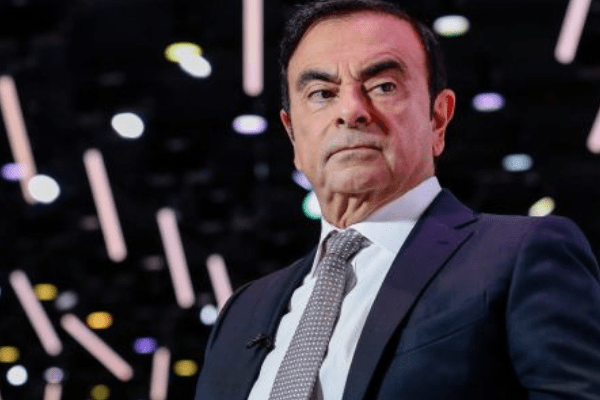
Japanese prosecutors have arrested the ousted Nissan chairman Carlos Ghosn on new allegations that he reassigned personal investment losses to the carmaker, shattering his family’s hopes that he might be released from detention before Christmas.
The move, which could potentially add a more serious charge of embezzlement to Mr Ghosn’s existing indictment for falsifying his pay, marks a significant escalation in the high-profile case.
Mr Ghosn’s arrest for the third time, which people close to his family described as “devastating”, came less than an hour before the former Nissan head was due to have his first bail hearing following more than a month in detention.
Legal experts and diplomats had expected that bail would be granted after the court rejected a request by prosecutors to extend his detention on Thursday.

In a statement on Friday, the Tokyo District Public Prosecutors Office alleged that Mr Ghosn had avoided losses from a derivatives transaction totalling ¥1.85bn ($16.6m) by transferring them to Nissan from his personal asset management company at the height of the financial crisis in 2008.
Mr Ghosn is also alleged to have transferred, via a series of payments across four different years, $14.7m from a Nissan subsidiary account to one held by an unidentified person who helped the former Nissan boss make the derivative transfers.
Prosecutors said that the transfers represented an aggravated breach of trust in violation of companies law but did not explain the link between the two actions.
Under Japanese rules, the re-arrest on Friday means Mr Ghosn could be held for up to 20 more days beyond the initial 48-hour period.
If found guilty of violating the companies law, Mr Ghosn could face a penalty of up to 10 years in prison, a fine of up to ¥10m ($89,000), or both — the same penalty as for falsifying financial statements.

Mr Ghosn and Greg Kelly, another Nissan board member and a close aide to the former chairman, have been held at a detention centre in Tokyo since November 19 after they were arrested and charged with understating Mr Ghosn’s pay by $44m over a five-year period.
The arrest on Friday involved only Mr Ghosn, and the Tokyo District Court said it had received a request for bail for Mr Kelly, who is suffering from a spinal ailment.
A separate investigation by Nissan has alleged that its former boss used company funds for personal expenses. Both Mr Ghosn and Mr Kelly remain directors at Nissan.
The Japanese lawyers for Mr Ghosn and Mr Kelly were not immediately available for comment on Friday.
In a statement, the carmaker, which continues to co-operate with the prosecutors, said it was not in a position to comment on the re-arrest. “Nissan’s own investigation is ongoing, and its scope continues to broaden,” it said.
But the company has not included the most recent allegations as a major part of its internal investigation, according to a person familiar with the matter.
Earlier this month, Mr Ghosn and Mr Kelly were re-arrested on new charges over falsified financial statements covering the past three years.
Mr Ghosn, who remains chairman and chief executive of French carmaker Renault, maintains his innocence, according to a person familiar with his legal defence. Mr Ghosn’s lawyer in Tokyo, Motonari Otsuru, told broadcaster NHK that Mr Ghosn found the current situation “unacceptable” and he would seek to recover his reputation in court.
Mr Kelly’s lawyer, Yoichi Kitamura, has said he believes his client will be found innocent at trial.
Prosecutors suffered a rare rebuke from the Tokyo court when it rebuffed its request on Thursday to extend Mr Ghosn’s detention by another 10 days over the fresh allegations.
Yoji Ochiai, a lawyer and former prosecutor, said the court rejection had been unexpected, prompting Tokyo prosecutors to bring forward its investigation on the more serious charge related to Mr Ghosn’s personal investment losses.
For Mr Ghosn, who may have to go through intensive interrogations lasting up to eight hours a day in the new year, Friday’s move could pose a tough blow. “A re-arrest after having hopes raised for bail is very tough,” said Mr Ochiai.
Many legal experts had expected prosecutors to buy time to collect evidence by starting the investigation on financial statements before advancing towards more difficult allegations.
“This was really what they were after from the beginning,” said Tatsuo Uemura, professor in securities regulation and corporation law at Waseda University. “Prosecutors will do everything they can to win a case.”