Mobile operators in Nigeria; MTN, Airtel, Globacom and 9mobile recently announced their commitment towards deepening financial inclusion to at least 90 million customers in the next 30 months on the condition that they are given a level playing ground to perform mobile money functions.
When BusinessDay reached out to the telecommunication companies, inquiring how they plan to achieve the set target, leverage on already existing customer base, recognised brands and distribution network were the measures cited.
“With a combined customer base of over 160 million and our trusted and recognizable brands, Telcos can easily upsell financial services to this existing base of customers, with a good percentage of them currently classified as un-banked,” Usoro Usoro, the GM of Mobile Financial Services at MTN Nigeria told BusinessDay by mail.
Although, at the time of this report, the three other mobile operators were yet to respond on the measures they want to use in achieving the set target.

In Nigeria, Telcos are excluded from accessing mobile money licences directly under current guidelines, while in most sub-Saharan African markets where mobile money is successful, Telcos are given a level playing field.
A survey by BusinessDay showed that the Telco led model in African countries reported tremendous progress owing to the already existing large customer base of the Telco’s.
Kenya has about 60 percent mobile money service penetration, while Ghana has about 40 percent service penetration, and Nigeria with a lot more population numbers, remains at 1 percent, largely due to its bank-led model.
Ghana’s decision to have a Telco led model resulted in a 73 percent increase in registered mobile money customers in just one year, according to World bank data, and has helped lift financial inclusion rates in Ghana to 58 percent in 2017 from 41 percent in 2014.
This was not different for Ivory Coast which has experienced a mobile money revolution. As a result, there are now more adults with mobile money accounts of 24.3 percent than with bank accounts of 15 percent.
In fact, Ivory Coast has the fifth highest rate of mobile money accounts in the world behind Kenya (58 percent), Somalia (37 percent), Uganda (35 percent), and Tanzania (32 percent), according to Brookings Institute, a highly regarded, non-profit public policy organization based in Washington, DC.

Kenya also improved to 81.6 percent financial inclusion rate in 2017 from 74.7 percent in 2014, Ivory Coast improved to 41.3 percent from 34.3 percent and South Africa increased marginally to 69.2 percent from 70.3 percent.
Nigeria mobile operators therefore concluded that it is overly possible to significantly reduce the country’s financial exclusion rates of about 41.6 percent to 20 percent if the telecommunications operators with a wider subscriber base than the total banked population are allowed to drive mobile money penetration. This was disclosed at the meeting held on Tuesday September 4, 2018, where the major Telcos were in attendance.
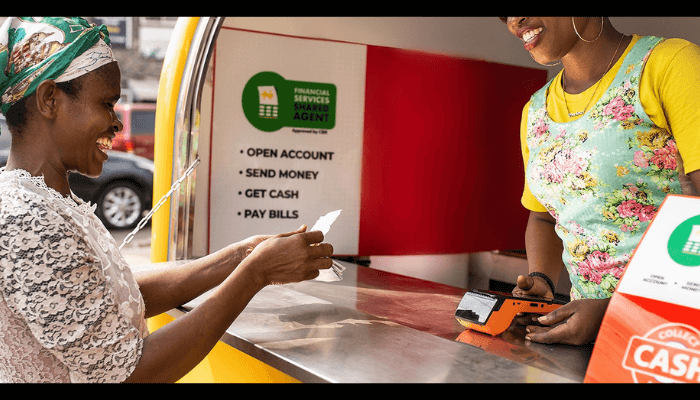
“We also intend to leverage our combined distribution network of over 1 million agents, present in all 774 local government areas in the country, to provide financial services to the last mile, supported with massive educational campaigns required to appropriately educate and promote the basic services required to drive adoption, such local and international transfer services, micro-loans and bill payments,” Usoro concluded in a mail response to BusinessDay.
Meanwhile, figures released by the National Bureau of Statistics (NBS) revealed that MTN Nigeria as at the end of second quarter 2018 has active voice subscribers of 66.4 million, followed by Glo with 39.8 million while Airtel and 9mobile reported 39.7 million and 16 million respectively.
Sources also told BusinessDay that the country’s financial institutions, telecommunication companies, Central Bank of Nigeria (CBN), Nigerian Communications Commission (NCC) and the Vice President, Yemi Osinbajo, held a meeting recently which was aimed at finding common ground in bridging the nation’s financial exclusion gap.
The sources however disclosed that the Vice President promised that efforts will continue at ensuring Telcos have opportunity to drive financial inclusion in a country that has huge exclusion rate. Although financial inclusion experts have also disclosed that stakeholders fear Telcos to lead the way in driving financial inclusion in the country.
Responding to stakeholder’s fear of Telcos dominating the Fintech space through mobile money, Dolapo Ashiru, Lagos-based analyst said “a communication company like MTN Nigeria is already bigger than most banks in terms of turnover and profitability.”
“Stakeholders may be afraid that the Telco’s who are dominating the market share in their telecommunications industry will also begin to make more profit and generate more revenue in mobile money functions,” a financial inclusion analyst who pleaded anonymity said.
“There is also an argument for rural telephoning but a combination of MTN, Airtel,9mobile and GLO already rakes up about 140 million subscribers and they have the capacity to do more, so there is reason for concern,” Ashiru said by Phone.