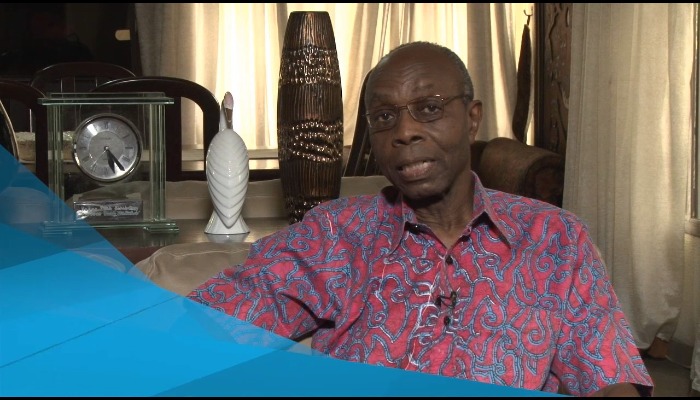
Vincent Maduka, veteran engineer and broadcaster, was the first director-general of the Nigerian Television Authority (NTA). Appointed to the position in 1977 by the Olusegun Obasanjo military administration, he was summarily removed by the Shehu Shagari civilian administration which was uncomfortable with the non-partisan posture NTA was adopting under his watch. He was, however, reinstated by the Muhammadu Buhari-led military government which overthrew Shagari’s government. Maduka retired voluntarily from NTA at the age of 50 to set up and run a management and engineering consultancy firm. Between 2008 and 2016, he served on the faculty of the Pan-Atlantic University, Lagos, as a Senior Fellow.
ZEBULON AGOMUO, editor, and CHUKS OLUIGBO, assistant editor, recently visited Maduka at his residence in Lagos for an interview. The Leeds University-trained engineer and one-time chief executive officer, WNTV-WNBS Ibadan, who says he was privileged to have had the opportunity to accelerate the drive of the station to a show-piece position in programming and commercial viability, spoke on wide-ranging issues around Nigeria’s quest for development.
The Nigerian Bureau of Statistics (NBS) not too long ago released data showing Nigeria is out of recession. From what you see, would you say we are really out of recession?
Well, I am not an economist and economic theories are beyond me. But what I understand about going into a recession is that your GDP growth rate has gone negative continuously. It can waver, it can go up and go down, but if it has gone down consistently for a given length of time, I think they say if it happens like that for two or so consecutive quarters, then it is defined as a recession. So, the word recession is a technical word with a definition. Even the GDP term, itself, is basically what I understand to be macroeconomic, not what directly affects the micro economy, the individual; it is a sort of average over a mass of group and sub-group figures. So you can have a very high GDP but maybe the top 1,000 people in the country contribute practically the total GDP figure, while the bottom is really starving; and the national GDP sounds very impressive.

READ ALSO:54gene secures $15m Series A round to scale human genetics research
Growth is a rate of change, it is not absolute. If you went from 1 unit to 2, you have grown 100 per cent and you should be shouting and singing. Now, 1 may be cheap poverty, 2 is less cheap poverty. So if you have grown from 1 unit to 2 in one year, you have gone from 1, which is very, very poor, to 2, which is very poor. People say that GDP is not a measure of the wellbeing of the people, and I can agree. We have gone into recession means we have bottomed in the decline. Now when our GDP was high, how did the poor man feel? When we bottomed, how did the poor man feel? Probably little, or no change. We talk about the poor man only, though the poor man is not the only person in society. Take the very rich, whether recession or not, they are comfortable; it may be the rate at which they are amassing wealth that is changing. The middle class is what everybody is trying now to promote. The middle class is defined by certain professional characteristics, but, for a layman, I see the middle class as those people who can afford to pay their bill basically without much stress; maybe I should even qualify the bill to be a normal bill. If you sport certain high tastes, you may have difficulty paying your bill, but you are not poor; if you pay your normal bill – your rent, your transport, your food, your children’s school fees, and so on – I will call that middle class. That’s my own definition, but for the marketer the criteria may be different. For me basically, the aspiration of anybody in society should be a class where you pay your bill, including health, food, shelter, etc. There are some societies where the nation picks up the bill for school, there are societies in which the nation picks up the bill for health, and there are nations which are committed to housing everybody. That is a socialist setting where the nation is catering for people rather than the fittest surviving and prospering in the society, which is essentially capitalist in orientation. But for me, whether you are capitalist or socialist, a man should be able to pay his bills without undue strain. To that extent, whether you are in a recession or not, that is a measure of your well-being. Even if you are still at the top, there can even be anxiety because if you are working in a place and can pay all your bills and that organisation has sacked so many people but hasn’t sacked you yet, and you don’t know when it will be your turn, there will be anxiety. That, I think, is what even people who have not lost their job must feel in a state of recession. And when the economy begins to rise again, if your organisation has been sacking people, they don’t start employing immediately. So while the figures may say that things are changing for the better, you may not see it yet.
So, we are getting out of recession, that’s statistics. What is the quality of life of the Nigerian, whether it is in a growth pattern or in recession pattern? For a government, statistics indicate to them whether they are doing fairly well or not. The government needs the statistics and when they use it properly, it won’t be fair to say they are just fooling us or they are bamboozling us. They can’t go by just looking through the window to see where the sun is. They need to look at figures, like the rest of the world; the extent to which those figures are reliable may be another question.
READ ALSO: Nigeria’s genomic capacity for drug production grows on major investments
President Muhammadu Buhari recently presented the 2018 Budget proposal to the National Assembly. Before the presentation, some members of the National Assembly had said they would not attend the session because the 2017 Budget had not been implemented up to 50 per cent and they did not see the reason for the presentation of a new budget. The budget size has also been growing in the past few years, yet the ordinary person on the street does not seem to feel the impact. Where are we getting it wrong?

I really can’t be certain. Clearly, if you have not performed a budget to a certain extent, it doesn’t mean you shouldn’t bring a new budget. Are they saying because we haven’t performed adequately on the 2017 Budget we should then do nothing in 2018? I don’t agree with that. On the other hand, you have to do some arm-twisting. If the law says you should tell us how well you have done this year, you have to do that, otherwise the whole thing becomes a joke. You give a set of figures, whether you perform or you don’t perform, next year you bring another set. I think the National Assembly has a right to say, ‘Wait now, how well have you done this year?’ If nobody is checking anybody, then the whole thing is a racket. So they should make some noise, by all means, they should ask the executive to give an account of their stewardship. How can they enforce that? There is really no way except to say, ‘Alright, we will not pass your budget.’ I think it is a threat, and I think it is not an unreasonable thing to do, but I hope that having said so, the executive itself should react properly, explain. Look, impunity comes in all forms of ways and the biggest problem with this country is impunity, the lack of discipline, acknowledging what is right and what is wrong. Do you see what is right and not do it, or you don’t know what is right to do? It’s an important element of our development as a human society.
So, a new budget is fair to bring forward, but if they say they don’t know how you performed last year, go and give them an account and explain where you had problems. I have seen some figures in the tax collections and they have not met their target. The other one is an oil sale. I thought they were ambitious with the production projection, having just come out of the crisis with the Niger Delta Avengers, but then they were conservative about the price which they pegged below $30. It is a forecast. The best you can do is to rely on experience, short of going to the native doctor to divine for you, and I am not sure those divinations have helped this country or individuals over the years. I have to give the government kudos on the use of statistics. This government is taking statistics seriously now. If there are errors, first let’s know that those who prosper in this world use figures and so let’s start using figures, too. We may not be perfect now, we can improve on them, but we have recognized that figures are so vital for a modern economy.
Do you see any merit in the suggestion in some quarters that if a government knows it may not perform up to 50 per cent of a budget, it makes no sense to hike the budget figures up to over N8 trillion?
Yes, I agree. It is pointless. But if you consider the needs of this country, what is N8 trillion, really? Divide it by 200 million people, it is easy arithmetic. If you spread it across everybody, it is not a lot of money; it’s still a terrible poverty-level budget. Now, to want an increasingly higher budget could mean you would like to be there, like others, but if you are just bandying figures which you cannot support, then you are just taking us and yourself for a ride. But remember that some of these figures are for debt servicing. Let’s remove all that and see what actually is available for spending. And you then go and borrow to service debt? Borrowing, like every financial exercise, is valid as long as it is properly executed. Borrowing is a valid way to do business, but you must use the money for something that enables you to pay back. If you use it to build roads, those roads, whether tolled or not, will lead to better economic activity, it will lead to growth, which will lead to more tax collectable and more money accruing to government to defray the debt. But if you borrow money to play some rascality, like an election campaign, then I think that’s incompetence. Look at the kind of money we are borrowing now, some for funding education abroad, or health abroad, the amount of dollars they [the Central Bank] are releasing every week to satisfy those needs; now, they are valid to the extent that those needs are important today, so, don’t get me wrong, but are we making provisions to limit those needs in the future? Why is it that Nigerians have to go to Ghana for medical treatment, for instance? I know some patients require some cancer treatment and they go to Ghana next door. I am not under-rating Ghana as a nation, but let’s face it, it is Ghana that should be coming here for treatment; the economy of scale is such that it is Nigeria that should have the capacity to absorb their needs, not the other way around. Maybe they (the government) are thinking about it, but they must tell us what they are thinking so that we are sympathetic to their cause. What is the government’s plan for reversing the medical tourism out of Nigeria? Ok, don’t even bring the tourism yet into Nigeria, just abate the outgoing, for now. These are what we call low-hanging fruits. Recently I was reading how the medical profession in Nigeria may soon collapse entirely: Some 900 or so graduating and graduated doctors from two or so hospitals are all planning to go abroad. I don’t know any medical graduate below the age of 30 who has any plans to stay in this country; they are heading straight out.
READ ALSO: Biotechnology needs proactive reporting, scientists tell science journalists
A lot of our leaders travel abroad and return to talk about international best practices but we don’t see them put these things into practice to make Nigeria a better place. Why do you think this is so?
I want to be generous to them and say maybe because they don’t know better. Somehow, it seems so easy that as soon as we get to the Lagos airport we shut our minds from whatever we have seen elsewhere. The only person who can say why he/she is doing or not doing something is that person. I think our journalists should, also, be up and doing. Instead of speculating about what is on these gentlemen’s minds, I think we should demand an opportunity to question them. Every day somebody in the White House (US) addresses the White House correspondents in the US and they question her; a woman is now in charge. I know she is very evasive, from my point of view, but that’s her job and American journalists take what they want from her and go and do further searches. So, it is a vicious circle, but who is going to break it? I have headed a journalism organisation before and we wanted to follow international best practices. Don’t expect a government to tell you where they are going wrong, you go and find out and ask questions. In the process of trying to find out, they cudgel you. It was even a government institution that I ran, and they threatened me openly: ‘Who the hell do you think you are? Where do you think you are? You are playing with your job.’ Now, you don’t have another job, but would you just run away with your tail between your legs? So there is a clash and then they probably sack you. They have done it once before. In fact, in my case one head of state was about to sack me, then we met coincidentally, he asked me one or two questions, I answered and he gave me an appointment to come see him during the week. When I went there and we talked, he said this was not what they told him about me.
We have to do our job properly. The British journalist belongs to the same club as the ministers; they went to the same schools, so the minister doesn’t look down on the journalist. In NTA, I had a reporter get a court case in which the Federal Government lost; she reported it fluently, but the minister in charge said it was an insult for an ‘ordinary’ NTA staff to be talking like that about the Federal Government. Now he himself, who the hell was he? That’s how they see you because we have that power difference. A road sweeper, or whoever, becomes a member of the House tomorrow and you are dirt as far as he is concerned; a never-do-well man follows a politician and becomes his special assistant or whatever and he thinks you are dirt; somebody who couldn’t touch you at school, on the sports field, becomes minister of sports or anything else and then he says to you, ‘You are only a journalist, you don’t talk to me like that.’ So, how do we do the work by international best practices? A top American journalist earns millions of dollars. If you, his employer, talk rudely he will leave you and go elsewhere because someone will snap him up immediately. That is because journalism makes money there. Here you work for so many years and you can’t even own a second-hand car: not that car is such a big deal. I studied in the UK as an undergraduate. My professor and head of department cycled to the school every day and I saw him park his bicycle, but the day we went to his house, I saw a car parked in his garage. When we got inside, I asked him why he came to school every day on a bicycle even though he had a car. He said one reason was the traffic in the city; two, where to park because you had to pay to park; and three, good exercise. The car was for weekend fun with his family. Now, he had basic comfort – health, education, even public transportation, well taken care of.
Here too, we have a right to aspire to the good life because there are also people in our country who are already enjoying those things. What more right do they have to have them than the rest of us? What have they done that we have not done? We have a right to aspire to what I call the middle-class standard of living, but we all have to work for it, all of us, and we are not working for it yet, partly out of meanness and abuse, and partly out of the low application of intellect. Not only knowledge but also application. You cannot have a country of 180 million people anywhere in the world and 100 million are and remain in poverty. The closest to us is India with a population of 1.1 billion but 90 per cent of them are now out of poverty, with only 10 per cent in squalor and poverty. (I’m aware India has taken considerable, but measured, time to get there.) Our own case, 90 per cent are in squalor; and this is obtainable in no other country in the world as big as us today. Some northern European countries have less than 10 million people, and they have the highest standards of living in the world. Do you, therefore, need a small population to be prosperous? Fragment Nigeria? Observation shows us the opposite.
Wherever you see two or three Nigerians gathered, some of these issues you mentioned keep cropping up. Are we ever going to get out of this vicious circle?
Let me take two things. One, if genetically we were sub-human, the white man would be telling us; they would even say it’s a scientific thing, they would be nice about it and they would be sorry for us. They would be nice to us, but they would tell us that genetically we are inferior. But they are not saying so; even the rudest of them is not saying so. So, genetically nothing is wrong with us; it’s a question of organization, management. The organisation is also scientific. If it was not scientific, then go back to your native doctor and do a divination about what you are going to do tomorrow. I take it that genetically we can make it, but we have problems which are historical, what you probably extol as your “culture” as if no other people have a culture. The most important value for many Nigerians today is chieftaincy title or personal recognition within society. Where else is it done? Ok, the British grade athletes. You win Olympic gold or whatever a specified number of times and they make you MBE [Member of the British Empire], but it is for that excellence you performed. Here, corruption is endemic in our so-called culture and your value system which you are holding on to; it is abuse. If you are a big man, it is your right automatically to annex someone else’s property and tell him to go to hell. The Yoruba Oba says he has put his leg on a woman, your wife, and that’s it, he takes your wife and you can’t ask him a question. He is not doing that exactly today but the entire structure, mentality and value system, is still like that; we don’t question the king. And how many crowned kings do we have? You have a king in your locality, the kabiyesi; you have a king in the market; you have a king at the bus-stop; you get to a university, there is a king, the vice-chancellor, who can do as he likes; you are driving and there is a traffic light and someone says, ‘Who the hell are you to stop me?’ That mentality doesn’t make you look at issues objectively but rather subjectively: what is in it for me? We have a sense of personal injury when you demand the discipline of the Nigerian, and that is not helping. It is the commonest thing you see everywhere, on the road.
You talk about leaders, what we have are not leaders. A leader is someone who can get you from Point A to Point B, Point B being a place you wouldn’t have got to but for the leader, and it is where you, and he, want to go, not like an armed robber telling you to take him to your bedroom. A leader is a service deliverer; leadership is about doing work. That’s not what we have!
How does a journalist in a society like ours strike a balance between being a watchdog and ‘protecting’ the government of the day as well as his business?
Journalism is a business. If you don’t make money and you can’t pay salaries at the end of the month, you are out. Journalism thrives on the number of adherents, customers. One, you may just be popular as a village dancer. Two, that popularity can bring money, and in the Nigerian media space today, two basic ways: one is an advertisement. If you are popular, a lot of people gather around you and that’s the marketplace where you can sell. That is the conventional western commercial concept of journalism as a business. If you are making good money, paying good wages, hiring top, competent journalists, and those journalists are confident, then you could do good journalism that asks questions and influences society positively. I have given you the American example, but there is no serious money to be made in journalism in Nigeria. Maybe one or two media houses are making money and their bosses are singing and celebrating, but the journalists are not. Maybe one company pays more than another, but we are not where I am talking about yet. Look at what happens here, taking the worst case. You criticise government and someone in government telephones your boss and gently reminds him of a skeleton “in your cupboard”. When you come to work the following day your boss warns you and says, ‘Please don’t put me in trouble, stick to the straight and narrow.’ He may have a skeleton in the cupboard; he may not have but he may simply be intimidated by whatever. It also has to do with our morality of power. There is what is called the power distance between those who have it and those who don’t. In modern nations, the difference is small. In medieval society, power goes with impunity.
So, our problems here are many. Are we solving them? Do we analyse them, find out what they are and try to solve them? No. Under Chairman Mao, the Chinese scrubbed the faces of their people in the dust. Nigerians can’t take the sufferings that the Chinese went through under Chairman Mao. I was alive and an adult. There was no civil right that Mao respected, there was no decency in the way he treated his people. He wanted one thing out of them: work, work, work. I am not saying that is the way to go, but if you wake up one day and the rest of the world has left you behind, what do you do? The Chinese sacrificed their ordinary people; they died but they couldn’t be bothered, at least, that is what we thought. They were either trying to raise the standard of living of their people or trying to catch up with the West, but Mao sacrificed so many people’s lives. Today, the Chinese are shining and everybody wants to go to China, including America. They had the numbers and in modern economics, numbers are the biggest assets. If you want to change a society, you have to analyse that society. What are its strengths? What are the things it can do better than others?
We hear a lot of older Nigerians often talk about the good old days. Is there really anything like the good old days in Nigeria?
Yes, but we have not been able to sustain the good old days. It is not entirely our fault, part of it is historical. I went to Kings’ College, Lagos. The entire student population at peak in the school was 120. We had nearly 20 teachers, practically, all graduates; half of them were Europeans. We had chicken and jollof rice on Sundays – did I ever eat chicken and jollof rice in my own house before I went there? But it was not sustainable, not that number. I graduated from university in 1959, did an internship for two years and came back to Nigeria to start work. I joined WNTV Ibadan on the day I returned home. Almost every day, car dealers were coming with catalogues of brand new cars for me to choose from. I bought a brand new car two years after taking a degree. If I had come straight home after graduation I would have bought a brand new car less than three months after university. I had a three-bedroom flat from the government, a steward, and a driver, all on my salary and I was paying back on the car. The total monthly money you paid back from borrowed money must not exceed one-third of your salary. All the Nigerians who graduated that year, whether in Nigeria or overseas, could not have been up to 300, so they could pick and choose jobs, especially as the white man was also leaving and creating vacancies. How did I choose a career while in secondary school? One of the ways was to look at the government gazettes to see where there were vacancies (for the foreseeable future). We looked at the posts occupied by expatriates and projected that they would soon leave and so we chose a course of study along that line because a job was surely waiting for us. By the time you spent 10 years in the public service, you were chief executive. That was the first phase (of the good old days). What followed was not planned. Nothing has been worked out scientifically. It’s just been haphazard. God is in charge, that’s what we always say.
Population explosion may have played a big role in what followed. What do you think?
Right, but let me tell you a (hackneyed) marketing joke. Two people were sent to what they call Black Africa to go and sell the people their shoes. When one got to the airport, he observed that no one was wearing shoes, so he concluded there was no market for shoes there, and took the same plane back to his country. The second one saw that no one was wearing shoes, so he sent a telegram home asking them to send as many shoes as they could because so many people didn’t have shoes. The same picture, two messages: one said it was hopeless, the other saw an opportunity. Why is it that all the countries with a large population in the world are leading countries? So, there is something in numbers, but your growth rate in numbers should not exceed your economic capability to grow. It is an unhappy thing for scientifically-minded people that we have not taken advantage of anything – our numbers, our crops, even, our oil. People seem to be getting interested now because we have come to a point where there are no jobs for you to take up so easily, so people are beginning, hopefully, to use their heads.
In recent years we have heard governments talk about the potential in agriculture. Do you think the government is actually doing the right things to see that we move from potential to really harness the benefits in that sector?
If I say yes, it is because they are pointing out the road, which is partly what a leader does. But I can say no also because you can’t speak English to sheep simply because you are their shepherd; you have to talk to them in their language so that they deliver what you want. These are people who are not economists, they are not business-minded, many of them are not even proper farmers, what they are doing is subsistence farming. So, you have to organise the entire value chain. Even in my time when we were talking about perhaps the unsustainable easier life, we had what we called agric extension service people who were like technicians in agric; they visited local farms and showed farmers what to do and how to do it better. That was what they were paid for. We even had sanitary inspectors. That was the colonial times: these people say there are a problem and the try to solve it; we say there is a problem, you and I moan, then we open the book of prayers and start from chapter one asking God to come and solve our problems. God has given the whole world brains, including us, but we are still waiting for him. Now, I believe in prayer too.
Could it be that it has something to do with our system of government?
Maybe the system of government we are practising is not the best because I don’t know any backward country that can take themselves up by the bootstraps through democracy. Democracy is about you being popular. The most popular man among rogues is a rogue. The most popular among priests is a priest. So you are voting for somebody that is generally like you in outlook. If he is too high, you say you don’t like him; he has to be generally average or slightly above average, that’s the man you’ll vote for because you can understand him. You won’t vote for the teacher with the biggest cane in school, for popularity, but maybe he is the one that delivers the most academic performance. But we really need a man who says this is the way we are going, it is good for all of us, and some people out of ignorance say no, we’ll go the other way, and he holds them by the scruff and puts them back on line. However, if you are going to vote for him in another four years, he would likely soften, there are probably more dissenters, and settle: If they don’t want progress, he would not force them to make progress, as, otherwise they won’t vote for him next time. That’s the worst case scenario I am painting, but basically, that’s what democracy is about. And you are not going to make progress like that, I am sorry to say.
We made a lot of progress under Olusegun Obasanjo, even though people don’t recognise the progress we made. Obasanjo changed the face of Nigerian banking totally, he put in place a modern pension scheme, introduced health insurance scheme, etc – things that modern societies are doing. And people were screaming and cursing. He delivered telephony to the private sector, after what Babangida had instituted; he started the process of handing over the power sector to private operators. He privatised the refineries and somebody reversed them. Obasanjo wasn’t a saint. Chairman Mao of China wasn’t remotely a saint. Stalin of Russia was nowhere near a saint. I don’t necessarily admire them. But if you have a juvenile family, you don’t vote on going to school or going to the park. We have a short time to catch up with the world (if possible), you don’t have the luxury. America has been going 300 years or more, they can afford democracy. Britain? It’s now part of their blood, their DNA. Our culture is anti-democracy; it’s winner-take-all and that’s why corruption is so rife, whether elected or appointed corruption. But how do you have or find the good leader who is not a democrat, who runs the government of the people for the people, but by the leader? How can a Nigerian leader emerge who is not a democrat and yet will really do things for our own public good and not his own benefit? And when he becomes tired or is beginning to drift, how do we change him? Not for him to hand out small change to poor uneducated voters to put his name on the ballot. For me, that’s the major, if not, the only advantage that any democracy has over a benevolent dictatorship, where the leader says, ‘My people, enough is enough, this is the way we are going and you must come with me, and if you don’t come with me, well, we’ll see.’ But he is doing it, not out of meanness or personal, or parochial gain, but for everyone’s good.