Abimbola Agboluaje
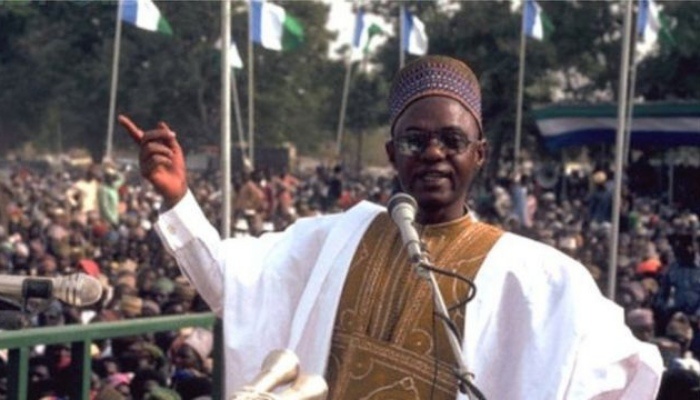
What is it about the current administration that inevitably draws comparison with the Shehu Shagari (1979-83) regime? Its definitely not the cap. Whereas Shagaris redefined the idea of verticality, embracing the sky even as his flowing robes vacuumed the floor behind him, Yar Aduas has no astronautic pretensions. Yet, amid mounting evidence, one increasingly finds it difficult to dismiss the conclusion that, at least in terms of their basic understanding of governance, which means no understanding at all, the current regime is a tragic throwback to the Shagari era.
There are just too many sad reminders. For instance, just like Shagari, Yar’ Adua took office on a dubious platter, and, in one of those grim ironies that have become symptomatic of postcolonial Nigerian history, from the same person, Olusegun Obasanjo, a man whose perverse generosity clearly knows no limits. Just like Shagari, Yar’ Adua has shown the same cack-handed approach to governance. Shagari was clearly not prepared to assume the reins of power (Beckoned to Serve’ is the fitting title of his official memoirs) when the General from Ota forced it upon him in 1979. In a similar vein, Shehu Musa Yar’ Adua was anything but ready for the arduous task of governing a country of Nigeria’s famed complexity when Obasanjo handpicked him, admittedly from a clearly limited field of aspirants. But OBJ, nothing if not morally pretentious, had obviously decided that protecting his own back (and he had every cause to, given what has since emerged) was of greater moment than the fate of an entire nation.
Read Also: At 59, ‘Up NEPA!’ still a Nigerian reality
However, as American politicians are fond of saying, elections have consequences, and what we are currently seeing unfold in Nigeria are the utterly tragic consequences of Obasanjo’s 2007 imposition. After two years in the saddle, the current administration (sic) cannot persuade even the most generous observer that it came into office with any ideas whatsoever as to how to supervise a modern economy. Just like Shagari, there is absolutely no sense that someone is in control, or that whoever that is, that that person realizes the sheer enormity of the challenges facing us as a nation. All we get is the same fatuous reassurance that something is being done- NEPA will be sorted out soon, we are told; same thing for the country’s worsening road network- all will be taken care of. All this from a regime that took eight months (you heard me right) to reshuffle a cabinet.
Which is why the comparison with Shagari is so fitting- a reluctant (though captive) president; a ruling party with hegemonic aspirations, yet little administrative nous; a thieving legislature; a compliant police force; and an overall climate of official lethargy and moral debility. Surely, you couldn’t make it up, but that is the tragic pass that Nigeria has now come to, and in many ways, what has happened in Ekiti state over the last few weeks has merely served to drive home the point that both the current regime and the Shagari government indeed share the same moral structure.
But Ekiti provides a teachable moment for several other reasons. For one, it sharply undercuts the Yar’ Adua government’s grating rhetoric about the rule of law. To the extent that no serious watcher of developments in Nigeria ever took seriously Yar’ Adua’s celebration of the rule of law (pray, isn’t it a bit rich for a government whose inception was an affront to justice to declare fidelity to the law as its moral basis?) as its axial principle, Ekiti was a fantastic opportunity for it to underscore its dedication. But what did the Yar’ Adua government do? It re-wrote the script on political partisanship, doing everything within its power to give the PDP’s Segun Oni crucial advantage over the clearly more popular Action Congress’s Kayode Fayemi. Yar’ Adua sanctioned the use of the police (think of Shagari and Sunday Adewusi) and soldiers to intimidate the PDP’s opponents, whether real or imagined, brutalize authentic representatives of civil society groups, and create a state of terror under which the poor people of the state are still reeling. Presented with an historic opportunity to stand above the fray, Yar’ Adua spurned it, choosing instead the same path of moral abjection that has been the undoing of every administration in Nigeria’s political history. The ethical vacuum in our leadership was there for all to see as the president, the police, the misnamed Independent National Electoral Commission, and sections of the media unashamedly connived in a blatant display of impunity. On the back of this blatant obliteration of the right of Nigerians to elect a leader of their choice, the elections scheduled for 2011 have assumed a new significance. At the very least, it has confirmed what many of us have long feared: that though he may have no conception of governance, Yar’ Adua is nonetheless a diligent student of power, and that when push comes to shove (as we just saw in the case of Ekiti), he will exercise no scruples in using the leash on the opposition. That is the only sensible explanation for his decision to keep Dr Maurice Iwu, the disreputable chairman of INEC, in office. The sad truth is that Yar’ Adua needs Maurice Iwu the same way Shehu Shagari needed Justice Ovie-Whiskey- as insurance that power will remain in the hands of the PDP, no matter what the generality of the people want.
So what can the opposition do? An unusual historical situation requires an uncommon response. The PDP has sent out a clear message; that if there is a way to power for other political tendencies, it is no longer through the ballot box. The onus is now on all well-meaning Nigerians within and outside the country to start pooling ideas on how to oust what has effectively become an army of occupation. The PDP has murdered sleep. It must not be allowed a minute’s nap.