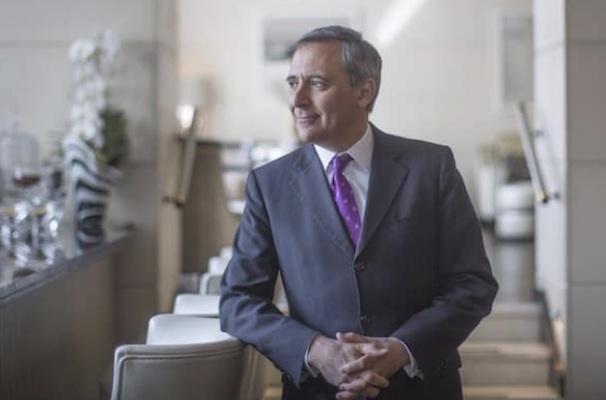
Richard Solomons has chosen a table at the furthest corner of the club lounge on the top floor of the InterContinental London Park Lane hotel. The vantage point provides great views of the city.
“Don’t be flattered,” he jokes. “This is my normal seat.”
Perhaps that is because the spot also allows him to see all who approach. Yet some accuse the chief executive of InterContinental Hotel Group (IHG), operator of brands such as Holiday Inn and Crowne Plaza, of failing to spot the disruption coming up from behind in the hotel industry.

Mr Solomons, 54, a former investment banker, spent nearly two decades at IHG before taking the helm in 2011. Under his stewardship, the FTSE 100 company has seen consistent growth, its share price rising about 50 per cent.
But a downturn could be on its way. Analysts say the hotel industry’s upward cycle has peaked. The large hotel groups survived the financial crisis by selling off property and becoming primarily hotel managers rather than owners — a strategy pioneered by IHG.
Since then, occupancy and room rates, particularly in the US, have reached record highs. Across the sector, revenue per available room, the industry’s preferred metric, is 13 per cent higher in the US than it was in 2007, the last peak in the cycle.
In response, hotel groups are racing to add scale by consolidating. IHG is the world’s largest hotels group by room numbers. But it will soon be overtaken by Marriott, which has agreed a $13.3bn deal to acquire US rival Starwood, following a bidding war with China’s Anbang Insurance. (Mr Solomons notes how industry insiders call the combination “Marwood”, but suggests “Starbang” would have “sounded a little better from a marketing perspective”.)
French hotelier Accor bought the owner of the Fairmont, Raffles and Swissôtel chains for $2.9bn at the end of last year. According to Dealogic, hotel deals totalled $35.5bn globally in 2015.

Mr Solomons is unruffled by the action in rival boardrooms. “Why am I under pressure to do a deal?”, he says, noting that IHG did acquire the boutique hotels operator Kimpton for $430m in cash in December 2014.
He touts the company’s organic growth, such as plans to sign up a further 1,300 hotels under IHG’s umbrella. He has launched a luxury brand, Hualuxe, in China. The company is working on digital initiatives designed to persuade travellers to book directly through IHG’s sites rather than online travel agents.
The bullishness belies the fact Mr Solomons considered launching a bid for Starwood. Despite denials at the time, regulatory filings and people familiar with the matter have revealed that Mr Solomons and IHG senior staff met several times with Starwood representatives last year.
When asked about this, he starts by saying “we never confirmed whether we were involved or not involved” in a potential deal for Starwood, before I point out that the filings and our reporting proved that IHG’s interest was serious.
He changes tack. “I think you’d be surprised if we hadn’t looked, given that we’re one of the top four players in the world.” So was the deal too expensive? “You can always buy growth. Is that better for your customers? Is that better for your shareholders? If it’s not, it’s not.”
Hotel groups such as IHG increasingly have to deal with the effect of internet challengers. One of them, Airbnb, is turning homeowners into hoteliers, matching travellers with people with second homes and spare rooms to rent out.
As muzak tinkles above Mr Solomons’ table, just like it does in hundreds of similar executive lounges around the world, he talks about Airbnb’s marketing pitch. The company helps travellers avoid the identikit tourist experience by staying with locals instead. Is the San Francisco-based start-up changing how people travel?
Audacious bid for Starwood Hotels shows China’s global ambition
“They have a nice website,” he says. “They have made it easy to book [short-term home rentals] and easy to use. But over the last 10 years — and the numbers have probably changed now — branded hotels have grown faster than the short-term home rental market.”
Still, Mr Solomons suggests regulators — from consumer rights watchdogs to city housing authorities — need to do a better job of scrutinising Airbnb’s model. He believes the site is increasingly used by professional landlords to skirt round rules in many cities and countries about where rooms can be offered for short stays.
“You live in one apartment, there are five others on your floor, and they’re all owned by a professional Airbnb landlord, you’ve basically got a hotel in your apartment block,” he says. “That’s pretty disruptive and we couldn’t do that.”
Airbnb tells its landlords to abide by local property laws on short-term stays.
Online travel agents such as Priceline and Expedia have also made it easier for travellers to book over the web, at the same time eating into hotel companies’ margins by charging steep commission. Greater scale could help IHG’s battles with online travel agents, because more hotel rooms could allow it to negotiate smaller commission fees with these internet groups.
Mr Solomons insists this theory is a red herring, saying customers using these sites are more likely to be price sensitive than “brand loyal”.
Unable to offer cheaper rates than online travel agents, hotel groups offer perks such as digital check-in and free meals if they book directly through their websites. In this way, hoteliers hope to create repeat customers, who are more valuable to the company.
“There’s a very large group of people who want to have an interest in being loyal to a brand,” he says. “We see it in every walk of life … They have got confidence in the brands. You build that confidence. You build trust.”
A leader’s character has a big effect on a company’s culture, but Mr Solomons is reluctant at first to discuss his personality. “I like to talk about my business, not me.”
But his favourite pursuit suggests a competitive streak. Mr Solomons drives a 1965 BMW 1800 TiSA, and has raced at tracks such as Silverstone and Goodwood in the past couple of years.
“We talk a lot about winning,” he admits, adding that an organisation of IHG’s size cannot be run by dispensing orders from the top.
Which corporate leaders does he admire? He suggests Steve Jobs, the late founder of Apple, but adds, “Do I admire some of [Jobs’s] business approach, his style? Not really.
“[Sir] Martin Sorrell [the high-profile founder of WPP, the advertising group] was incredibly helpful when I took over … I admire an awful lot of what he’s done. But I don’t think that I want to be like them.”
Sir Martin is a leader who relishes dealmaking, helping him to build the world’s largest advertising company.
Mr Solomons says he will hold to a different path.
“We have about 5 per cent of the world’s hotel rooms, and about 13 per cent of the future pipeline,” he says. “That’s a pretty big business. We just don’t need to do defensive deals to get bigger for the sake of being bigger.”
WPP’s chief, who advised IHG on advertising, describes Mr Solomons as a strategic leader. “Right from the very beginning, he understood the need to focus on the consumer, build the brands, segment the markets and differentiate.”
He defends Mr Solomons against analysts who argue IHG must join the dealmaking boom to avoid being left behind. “It’s easy for analysts to make judgments from the sidelines,” he says. “If he had taken a leap, there would be people saying he took too big a risk.”
FT