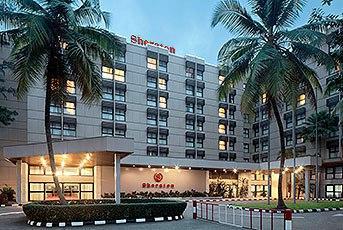
The boom in the Nigerian hotel market is slowing, as investors now find it difficult sourcing funds to complete ongoing projects across the country.
Expanding hotel businesses became more difficult due to widening margins in Nigeria’s forex market, evidenced in the parallel segment where one dollar exchanges for well above N300.
Investors are also confronted with the unfavourable bank interest rate at 11 percent, high above the single digit obtainable in other markets .
As a result, over 15 hotel projects across the country, earmarked for Three, Four and Five-Star offerings are abandoned, with additional 2,000 to 3,000 rooms, which were on course to enter into the hotel market to engender competitive pricing, now stalled.

BusinessDay findings are that work has long stopped at Starwood’s Luxury Collection Brand under construction in Ikoyi, Lagos, on which about $US350 million has already been spent.
Despite the assurances of Robert Dyson & Diket Ltd, the promoter of the project, and Starwood Group, the managers of the hotel, that the twin tower-hotel offering 15 storey buildings each with about 340 rooms beside 125 choice apartments, was nearing completion in 2012, guests are still awaiting its opening.
After the groundbreaking ceremonies for Hilton Hotel Airport; a 250-room outlet located on Murtala Muhammed Airport Road, not much progress has been recorded on the project.
It would be recalled that at the groundbreaking ceremony, the manager, Aero Marine (West Africa) Limited, the promoter of the hotel and Hilton Hotels and Resorts, noted that the facility was expected to open in the first quarter of 2013 and would become the second offering operated by Hilton Hotels and Resorts in Nigeria, yet there seems to be no movement around the site, save for the many aircraft taking off and flaying across it.
From Ikoyi, Victoria Island, Lekki, Ikeja and within the premises of Murtala Mohammed International Airport, there are over seven of such abandoned hotel projects. Nothing is being said of the 105-room Golden Tulip Apapa, while Abuja has over four hotels in the pipeline, whose completion dates have elapsed.

Even with the hype over the coming of the prestigeous Marriot Hotels to beef up the market, guests are seeing less in terms of action.
Besides Ikot Ekpene in Akwa Ibom state, where Starwood is sure of opening the 146-room Four Points by Sheraton on schedule, (before the end of 2016), every other of its projects across the country is ongoing and may not open on schedule due to lack of funding on the part of its partners and promoters.
Decrying the situation, Mark Aliche, a hotelier, observed that with an 11 percent interest rate, hoteliers were no longer gullible to loans from banks, and the so called cheap funding from Foreign Direct Investments (FDI) are no longer cheap with the crash of the dollar. “Imagine a foreign partner who committed $5 million dollars as his equity share in 2010 asking for his money in dollars now. Where do I get such money from? So, until the business rebounds, I am not investing further”, Aliche lamented.
Just like Aliche, Daramola Ogunwusi, another hotelier, said the rising dollar is adding to the many challenges of the hotel business. “You are expected to pay tax to the State and Federal Government as well as other agencies. You must renew your franchise fees, management agreements. “You must furethermore, import most of the things you need, according to the specification of the brand managing your hotel. And in all, guests are shouting that Nigerian hotels are overpriced. So, how do you survive?, he asks.
“The only way is to halt whatever project now, sell or convert to residential buildings to pay off your loans”, Ogunwusi said.
Ogunwusi said that most hotels scheduled to open opening now, are indigenous and unbranded ones, whose owners are either politicians or promoters who invested on behalf of the politicians because they are the ones that have free and investible money now.
Going by the development, the hotel industry may not achieve its growth forecast. Already, no hotel has met its revenue target in January and February.
While the rooms available grew from 7, 229 in 2010 to 11,335 in 2013, according to W Hospitality, the current economic reality will slow down investment in the hotel industry and hamper room supply as well as jobs, and impact of the sector’s contribution to Nigeria’s Gross Domestic Product, except the naira begins the gain value and the country truly takes its economic diversification seriously, Ikechi Uko, a travel and hospitality experts warned.
OBINNA EMELIKE