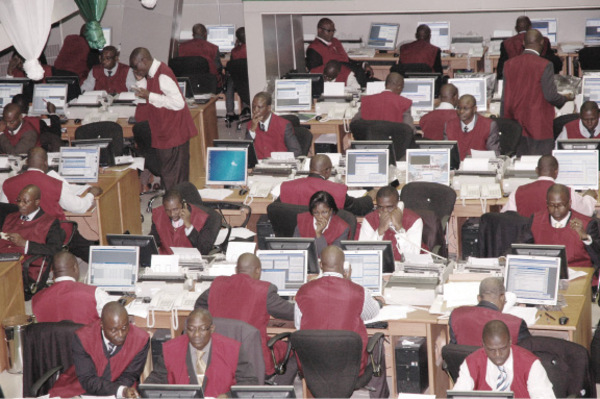
 The Nigerian Stock Exchange (NSE) is seen following the Cairo Exchange in Egypt as the worse performer in Africa, analysts data seen by BusinessDay show.
While the benchmark indicator that tracks Egypt’s stock market (EGX 30) lags in excess of minus 23 percent in returns to stockholders, that of the Nigerian stock market (All Share Index) heads to close the year 2015 in excess of minus 22 percent.
Interestingly, the Bourse Régionale des Valeurs Mobilières (BRVM), a regional stock exchange serving countries like Benin, Burkina Faso, Guinea Bissau, Côte d’Ivoire, Mali, Niger, Senegal, and Togo impressed investors with a positive return of about 13.9percent.
Other bourses that impressed stock buyers are the Uganda Securities Exchange which recorded a positive return of circa 11.73percent; and Botswana Stock Exchange which its domestic companies index (DCI) recorded positive return in excess of 11.61 percent.

The Gregory Kronsten led team of research analysts at FBNQuest said, “Lagos has been very volatile this year. It shed -8.4% in the first quarter, then increased by 5.4% in Q2 but declined again to 8.6% in Q3. Foreign investor appetite for Nigeria remains low mainly due to fx challenges stemming from subdued global oil prices.
Rate cuts (both MPR and CRR) by the MPC at its last meeting were expected to boost liquidity, at least in the near term. However, there has been little or no positive reaction by the market.
“New listings on the exchange would be welcomed by investors as these would improve its appeal, as well as give a better representation of the economy. Whether listings will feature in 2016 is difficult to say. However, clarity on the government’s fiscal position could prove to be a positive catalyst”, FBNQuest analysts added, saying that the decline in oil prices broadly mirrors the decline in the Lagos bourse.
At the Nigerian Stock Exchange, despite attractive rock-bottom prices, with technical justification for position-taking for long-term value investors, equities continued to hemorrhage, as sentiments remained weak across the board.
“The performance of African Stock markets in 2015 has not been quite different from the European, Asia and American markets in terms of mixed returns, as more exchanges recorded more sell-offs than rally”, said analysts at Proshare.

Returns from the Johannesburg Stock Exchange which is the largest stock exchange in Africa, was at paltry 2.92 percent as at last week; while that of Kenya and Ghana are competed in the negative territory of 12.3percent and 12.5percent respectively.
“We advise investors to key into the market with a long-term horizon, focusing on value stocks, dividend paying stocks, as well as defensive companies. We believe hazy outlook for the economy as well as limited foreign portfolio investors (FPI) participation will continue to weigh on sentiment in the near-term”, research analysts at Lagos-based United Capital plc said in their recent equity note.
Development in the international oil market and its spillover on the foreign reserve and FX market of Africa’s biggest economy is a major source of concern to foreign investors who hitherto were major buyers of Nigeria’s equities, but has recently continue to tread cautiously at Custom Street.