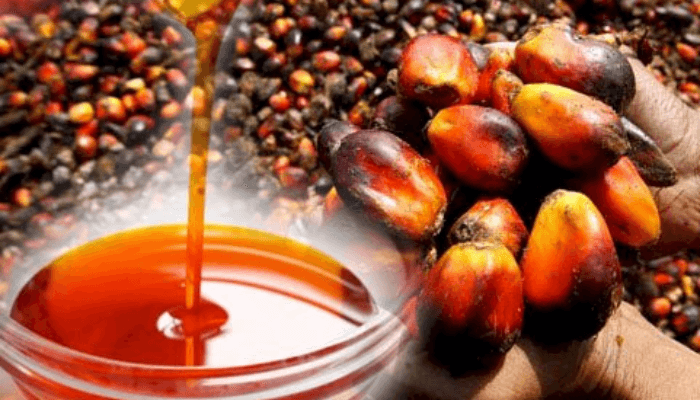
Every morning, palm oil goes into the pot before anything else.
Before the onions. Before the pepper. Before the day properly begins.
In kitchens across Nigeria, palm oil is not a choice; it is a constant. It colours the stew, thickens the soup, carries flavour from one generation to the next. It is measured by eye, not by scale. Trusted by habit, not by label.
And that is precisely the problem.

Increasingly, what looks like palm oil is no longer just palm oil. It pours the same, smells almost right, stains the pot in familiar ways. But it has been stretched, thinned with water, darkened with dye, reheated and recombined somewhere between the mill and the market. Not because the cook was careless. But because the system was.
The woman stirring the pot does not know this. She cannot know this. There is no label to read, no seal to break, no standard to rely on. The oil was bought the way it has always been bought, from a trusted seller, in an open container, passed down the chain by word and reputation.
What has changed is not the ritual, but the market beneath it.
Palm oil has become scarce, expensive, and profitable to fake. Demand has outpaced structure. And into that gap has crept a quiet adulteration, one that touches almost every household, precisely because it is so ordinary.

This is not a story about bad actors alone. It is a story about what happens when an essential good is left to circulate without guardrails.
When a daily staple is treated as an informal trade.
When a market grows, but is never built.
And when trust, once assumed, is no longer enough.
The other side of the story?
John Dale did not set out to become a whistleblower.
He was doing what he had done for years, supplying pure palm oil into the domestic value chain when something began to feel off. A delivery left his control clean and uncontaminated.
Somewhere along the chain, it returned as something else. Water had been added. Dye introduced. The oil reheated and stretched for volume. Margins were fattened. Consumers were none the wiser.
When he confronted the buyer, he was not thanked. He was blacklisted.
“That was when I knew this was no longer isolated,” Dale later wrote on LinkedIn. “It is spreading.”
His account, now circulating quietly among producers and traders, captures something more unsettling than adulteration. It exposes a systemic market failure in one of Nigeria’s most essential food commodities.
Palm oil is not a luxury. It is a staple. Almost every Nigerian household uses it daily. Yet the retail end of the palm oil market – where purity matters most – is almost entirely informal. No dominant packaged brands. No enforceable retail standards. No traceability consumers can trust.
Where there are no guardrails, opportunists thrive.
When Demand Outruns Structure
Nigeria produces roughly 1.4 million metric tonnes of palm oil annually, according to industry and government estimates. Domestic consumption exceeds 2 million metric tonnes. The shortfall – more than half a million tonnes – is bridged by imports costing the country about $600 million a year.
This gap matters. Not because imports are inherently bad, but because scarcity changes incentives.
When pure palm oil becomes expensive and supply-constrained, adulteration becomes profitable. Mixing water, colouring agents, or unsafe additives stretches volume and lowers unit cost. In a market without testing, packaging, or brand accountability, the risk of being caught is low. The upside is immediate.
Economists recognise this pattern. It is not unique to palm oil, nor to Nigeria. Whenever a staple commodity combines inelastic demand, supply gaps, and weak retail institutions, quality collapses.
This is not greed in the moral sense. It is arbitrage in a broken system.
A Familiar Nigerian Story
Nigeria has seen this movie before.
In the 1990s, groundnut oil and other vegetable oils were routinely diluted. Unsafe additives entered circulation. Consumer trust evaporated. The market shrank, even as population grew.
What fixed it was not outrage. It was structure.
Industrial processors entered. Packaging became standard. Brands invested in quality assurance. Consumers shifted from open containers to sealed bottles. Informality receded, not completely, but decisively.
Palm oil has simply failed to make that transition.
The Illusion of a “Traditional” Market
Palm oil is often treated as a traditional product, best left to smallholders and open markets. This framing is sentimental, and dangerous.
Palm oil today is a mass consumer good in an urbanising, health-conscious society. Treating it as an informal commodity while expecting industrial-grade safety is a contradiction.
The retail segment is where the value – and the risk – now lies. Yet Nigeria has:
- No dominant retail-focused palm oil processors
- Minimal branded, packaged palm oil at scale
- Weak enforcement of food safety standards
- No consumer-visible quality signals
As Dale notes, “We consume this oil every day. Leaving something this critical entirely informal is not just bad economics – it’s dangerous for our health.”
Read also: Nigeria’s palm oil revival: Quiet success, deeper reform needed
What Structured Palm Oil Markets Look Like
To see what is missing, one does not need to look far.
In Nigeria itself, Okomu Oil Palm Company and Presco Plc operate industrial plantations and processing facilities that meet international standards. Their crude palm oil feeds structured downstream users – food manufacturers, fast moving consumer goods (FMCG) firms, export markets – where traceability and quality control are non-negotiable.
Globally, Wilmar International transformed palm oil markets across Southeast Asia not by moralising, but by integrating processing, refining, packaging, and branding. Consumers do not buy palm oil in buckets; The lesson is consistent: where processing and packaging dominate, adulteration collapses.
Not because people become virtuous, but because systems change incentives.
Not because people become virtuous, but because systems change incentives.
The Missing Middle in Nigeria
At one end are smallholders and processors producing legitimate crude palm oil.
At the other are millions of consumers. In between lies a vast informal trading layer with little oversight and no brand accountability. This is where adulteration happens.
The opportunity – and the solution – lies in building retail-focused processing and packaging capacity:
The opportunity – and the solution – lies in building retail-focused processing and packaging capacity:
- Food-grade refining for domestic consumption
- Small-unit packaging for mass markets
- Simple but enforceable quality standards
- Brand differentiation based on purity
This is not capital-intensive by global standards. It is simply institutionally neglected.
Why This Is a Market Opportunity, Not Just a Crisis
Consider the fundamentals:
- Daily, habitual consumption
- Large and growing population
- Rising health awareness
- Proven historical precedent in vegetable oils
- Billions of dollars in annual market value
Few sectors offer such inelastic demand with so little formal competition.
The first serious players to establish trusted, packaged palm oil brands, priced accessibly, distributed widely, will not need to fight consumers. They will be welcomed.
Trust, once earned, compounds.
What Must Change
Three interventions matter most.
First: Processing and Packaging as Infrastructure
Palm oil retail must be treated as food infrastructure, not informal trade. Incentives – tax, credit, policy – should favour processors who package for domestic consumption.
Second: Enforceable, Visible Standards
Standards that exist only on paper are useless. What works are consumer-visible signals – labels, seals, batch numbers – that make adulteration costly.
Third: Institutional Pressure, Not Noise
Markets reform when credible institutions – processors, financiers, media, regulators – align around structure. Not outrage. Not hashtags.
Why John Dale’s Voice Matters
What gives Dale’s account weight is not outrage, but proximity. He is not speculating. He has confronted adulteration inside the system – and paid the social price for doing so.
His experience is a warning. But it is also a signal.
Where insiders begin to speak, markets are close to change.
Nigeria’s palm oil problem is solvable. The country has the land, the demand, the history, and the precedent. What it lacks is retail market architecture.
Until that architecture exists, adulteration will persist – not because Nigerians are dishonest, but because the system rewards dishonesty.
And systems, not sentiments, are what economies ultimately obey.
With acknowledgment to John Dale, whose firsthand account helped surface this market failure and sharpen the urgency of reform.