South Sudan, Africa’s poorest country and one of the world’s least developed economies, is projected to record the highest growth on the continent in 2026 as oil exports resume, according to the World Bank.
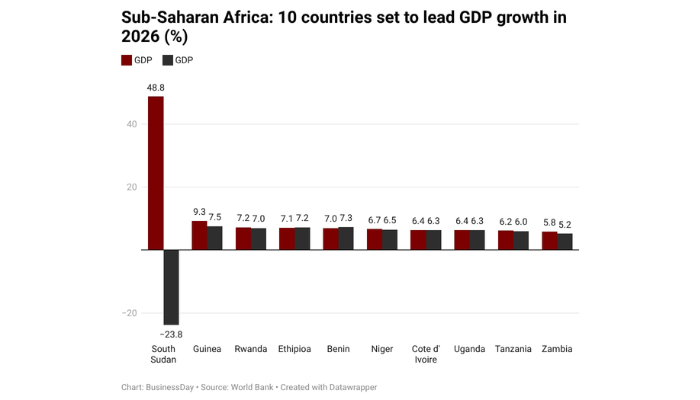
BusinessDay analysis of the multilateral lender’s latest Global Economic Prospects report shows that the conflict-stricken nation is expected to rebound sharply after years of economic distress, with Gross Domestic Product (GDP) growth estimated at 48.8 percent, following a deep contraction of 23.8 percent last year.
“In South Sudan, a substantial recovery in 2026 following five years of contraction is expected to be supported by a normalisation of activity and the resumption of oil exports,” the report said.
The upbeat outlook is echoed by the International Monetary Fund (IMF), which has recently ranked South Sudan among the world’s fastest-growing economies. The Fund forecasts GDP growth of 27.2 percent in 2025, largely driven by the restoration of oil exports.
The east African economy is heavily dependent on crude oil, which typically accounts for more than 90 percent of government revenue and a significant share of GDP.
But oil output was severely disrupted in early 2024 after damage to the export pipeline running through Sudan, compounded by escalating regional conflict, triggering a sharp economic contraction that year. Repairs to the pipeline and renewed efforts to ramp up production are now underpinning expectations of a rebound.
Read also: Carney’s wake up call to Africa at Davos
According to IMF estimates for 2025, South Sudan ranks as the poorest country in the world, with GDP per capita of $251, placing it among the lowest globally.
The country is also the world’s youngest nation, with a population of nearly 14 million, having gained independence in July 2011. In its early years, South Sudan showed promise, recording GDP growth of 29.8 percent in 2013 as investors arrived and optimism spread among citizens.
That momentum was short-lived. In December 2013, a prolonged inter-ethnic conflict erupted, lasting seven years and deepening the economic crisis. The worst year was 2016, when inflation soared to 549 percent, according to Trading Economics.
Although a fragile peace emerged in 2020, renewed conflict by 2023 again derailed the economy. GDP contracted by 27.6 percent, while inflation spiked to 112 percent.
Beyond South Sudan, the World Bank’s report shows that Guinea is forecast to grow by 9.3 percent in 2026, up from 7.5 percent, while Rwanda’s expansion is expected to strengthen to 7.2 percent from 7.0 percent.
At the other end of the spectrum, some economies are projected to see only marginal improvements. Equatorial Guinea is expected to grow by 0.4 percent after contracting by 1.6 percent, while Lesotho’s growth is forecast to slow to 0.7 percent from 1.3 percent. South Africa, the continent’s biggest economy, is projected to record a modest uptick to 1.4 percent, from 1.3 percent.
In Guinea, growth is being lifted by the anticipated start of exports from a new large-scale iron ore project, which the Bank said would significantly boost output. Rwanda, meanwhile, continues to benefit from strong investment and a broad-based expansion in services, although growth has been partly tempered by slower agricultural output linked to climate effects.
Beyond the smaller economies, Africa’s most populous country, Nigeria, is also expected to post its strongest growth in more than a decade through 2027.
The World Bank projects that Nigeria’s expansion will be supported by sustained momentum in services and a rebound in agriculture after productivity fell to a 40-year low.