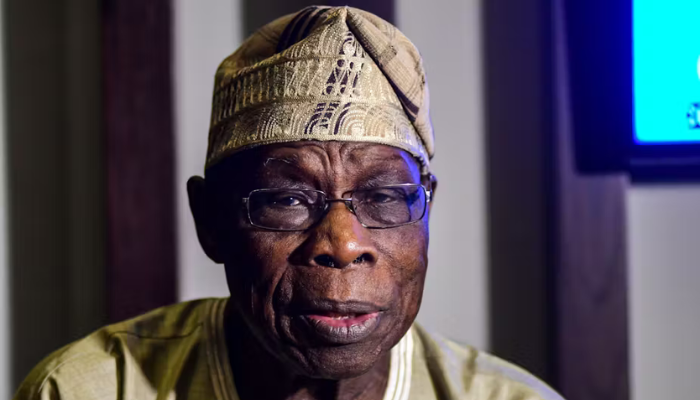
Today, Olusegun Obasanjo, soldier, statesman, and farmer, turns 89.
For decades, he has occupied a rare place in Nigeria’s political and social landscape: a former military ruler who voluntarily handed power to civilians, a two-term democratically elected president, and a pan-African voice who helped shape continental institutions. Yet beyond politics and diplomacy lies another identity Obasanjo has long insisted defines him best.
“I am a farmer,” he once said bluntly, rejecting suggestions that his interest in agriculture was a “romance”.
It is this quieter but deeply personal story, of a boy raised in a farming settlement who built one of Nigeria’s most recognisable agricultural enterprises, that offers perhaps the most revealing portrait of the man many Nigerians call “OBJ”.
Read also: Obasanjo stirs age mystery again as surviving classmates all cross 90

Roots in the soil
Olusegun Matthew Okikiola Aremu Obasanjo was born around March 5, 1937, in Ibogun-Olaogun in present-day Ogun State, into a modest farming family of the Owu branch of the Yoruba people.
His earliest memories were shaped by rural life. By the age of five, he accompanied his father to the fields where cassava, maize, plantain, and oil palm were cultivated. Those childhood experiences would remain deeply ingrained.
Years later, he would recall that farming was the only profession in his life that was not accidental.
“I was born and bred in a village,” he said. “Everything I have done in my life is by accident. The only thing that is not accidental is farming.”
Education took him away from the village and eventually into the Nigerian Army, where he trained as an engineer and rose steadily through the ranks. He served in the Congo, Britain, and India, and played a major role in the Nigerian Civil War between 1967 and 1970, eventually accepting the surrender of Biafran forces.

Soldier turned head of state
History thrust Obasanjo into national leadership in February 1976 after the assassination of military ruler Murtala Muhammad during a failed coup.
As military head of state, he continued Muhammad’s reform agenda and embarked on an ambitious transition programme that culminated in the 1979 general election — Nigeria’s first successful handover from military to civilian rule.
Read also: Adoke claims Obasanjo revoked OPL 245 over dispute on 60% stake
On October 1, 1979, he transferred power to Shehu Shagari, an act that remains one of the defining moments in Nigeria’s democratic evolution.
But Obasanjo was only 42 when he left office. Rather than retreat quietly into retirement, he turned to a lifelong ambition.
A return to the land
Just a week after leaving office, Obasanjo travelled to Ota in Ogun State to inspect farmland he intended to cultivate.
For Obasanjo, farming was not merely a business. It was identity.
To prepare himself, he enrolled as an apprentice at the Institute of Agricultural Research and Training in Ibadan. The former head of state insisted on being treated like any other trainee.
“I cleaned chicken houses. I fed chickens,” he once recalled. “That is how to be a farmer.”
His determination was tested early. After securing a loan from United Bank for Africa to establish the farm, financial difficulties followed. By 1982, less than three years after leaving power, he was reportedly struggling and had to seek financial assistance from an old friend, Samuel Ogbemudia, to keep the business afloat. The setback did not deter him.
Read also: Obasanjo: I rejected El-Rufai as successor in 2007, said he needed time to mature
Building an agricultural empire
Over time, Obasanjo Farms Ota grew into one of Nigeria’s most recognised agricultural enterprises. Spread across vast hectares of land behind the General Hospital in Ota, the farm evolved into a large integrated agribusiness operation, with poultry, livestock, crop cultivation, and modern farming infrastructure.
For more than four decades, the farm has employed workers, trained agricultural practitioners, and attracted investors interested in Nigeria’s growing non-oil economy.
Today, it is widely regarded as one of the largest poultry operations in the country.
The enterprise reflects Obasanjo’s long-held belief that agriculture must form the foundation of economic development.
“When you look at countries that have made it,” he once said, “they developed agriculture first for food security, second for processing, third for export, and fourth for employment.”
The second presidency
Two decades after he first left power, Obasanjo returned to national leadership.
In 1999, following years of military rule and political instability, he was elected president at the start of Nigeria’s Fourth Republic. He served two terms until 2007.
During that period, he pursued economic reforms, established anti-corruption institutions such as the Economic and Financial Crimes Commission and the Independent Corrupt Practices Commission, and secured roughly $20bn in debt relief for Nigeria.
Internationally, he remained an outspoken advocate for African cooperation, playing a role in transforming the Organisation of African Unity into the African Union in 2002 and later serving as the continental body’s chair.
Read also: Obasanjo urges global intervention as killings persist, calls situation ‘national shame’
A restless elder statesman
Even after leaving office in 2007, Obasanjo has remained an influential voice in African affairs.
He founded the African Leadership Forum, participated in peace initiatives across the continent, and authored numerous books on leadership, conflict, and governance. His writing and public interventions have often stirred debate but also ensured he remains central to national conversations.
Yet away from political commentary, his farm continues to symbolise another side of his life, discipline, labour and persistence. Obasanjo has often repeated that leadership must be grounded in productivity.
The farmer general at 89
At 89, Obasanjo’s Journey from village farm boy to soldier, from military ruler to democratically elected president, and from political leader back to agriculture remains one of the most remarkable personal arcs in modern Nigerian history.
In a country still searching for economic diversification beyond oil, the symbolism of that journey may be as significant as any of his political achievements.