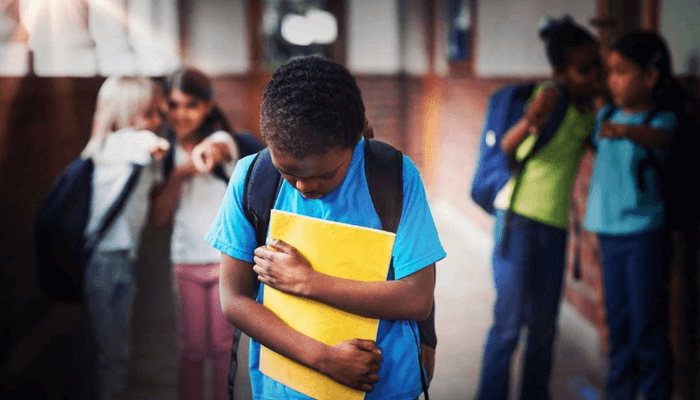
Across primary and secondary schools in Nigeria, incidents of bullying continue to raise concerns among parents, educators, and policymakers.
Studies have shown that unchecked bullying contributes to anxiety, absenteeism, poor academic outcomes, and, in extreme cases, self-harm. Addressing this challenge requires coordinated policies, stronger enforcement mechanisms, and a culture shift within school communities.
The instances of bullying in Nigerian schools is surging almost every year, with studies estimating it affects up to 85 percent of adolescents, particularly in secondary schools.
Bullying is a type of aggressive conduct that involves using force or compulsion to harm another person, especially when the action is repeated and involves a power disparity.

It can also mean a purposeful, recurrent act, word, or other behaviour that one or more children perform against another.
Common forms include physical violence, verbal abuse, and bullying by peers, often resulting in severe mental health issues and reduced academic performance.
Instances of school bullying in Nigeria, and its implications abound. In 2021, Nigerians woke up to the sad news of Sylvester Oromoni, a student of DOWEN College, who was reported to have died after nursing multiple internal injuries he reportedly sustained after been beaten by fellow students who were bullying him at his boarding school. The young boy is said to have refused to succumb to pressures from some fellow students to join a cult group.
Similarly, many Nigerians were left heartbroken at the death of Karen-Happuch Akpagher, a 14-year-old, a boarding student of Premiere Academy, Lugbe, Abuja, who was sexually assaulted and later died of complications.
Nigerians have not forgotten how in a special school for the deaf in Kuje, Abuja, an 11-year-old boy was being sodomised and forced to perform oral sex on older schoolmates, some years ago.

Read also: Budget controversies: Government versus citizens, who’s to blame?
The boy, using sign language spoke about being driven out of school in the night to a gathering where men conducted rituals, drew children’s blood, forced them to perform erotic acts and also killed. The boy also said he was brutalised whenever he refused to do as instructed.
According to Olaoye Abiodun and Osundina Olasunkanmi, “Bullying among secondary school students have been seen as a common anti-social behaviour in our contemporary society.
“This pattern of behaviour has negatively affected learning environment and the psychological nature of many students.”
Consequently, if such a pattern of behaviour is not checkmated, it would be counterproductive to the education system where character, moral and knowledge are to be focal points moderating the drive of such environment.
Education stakeholders argue that the problem of bullying in schools has pervasive and a going concern for all education stakeholders who desire to make school climate a safe haven
Isaiah Ogundele, an education administrator, noted that the case of bullying is as old as the school system all over the world.
However, he said in the past, the students were easier to manage or control because there was a cooperation between the school and the homes.
“Most schools then were mission schools where they held discipline with high esteem. The surge is as a result of private schools springing up in every corner of the country with little control from the government who supposed to regulate all school activities.
“The surge of bullying is as a result of the eye brow schools where some parents are not ready to yield to the tone of disciples in the school of their children,” he noted.
Ogundele reiterated that these attitude of no respect for teachers contributed to the unruly behaviours of some students who are always fond of flaunting their parents wealth to bully and oppress others.
“The background of most of the bullies are from a home where custom, tradition and culture has been eroded.
“The more excesses of some parents in the private schools. The more problem of bullying will continue in our schools because parents have pay their bill and whatever they do cannot be condemned; they are all above the law,” he said.
Way forward.
Ogundele advocates for anti-bullying exercise to be included in the curriculum. This, he said will create awareness when the students are been taught in the classrooms.
Besides, he emphasised the ministry of education must support the school by ensuring that there are consequences for the culprits.
“There must be a policy in place to promote anti-bullying in schools, such as declaring a week activities tagged as anti bullying or zero tolerance for bullying.
“School managers need to inculcate the idea of speaking out in the victims, whenever they experience bully from their senior or mates,” he said.
Besides, he said there must be stringent measures such as signing an undertaken by both the student and the parents indicating the penalty for bullying before admission.