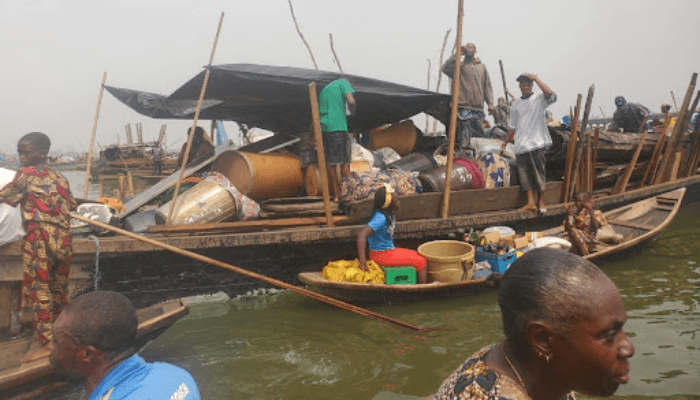
Relative calm has returned to Makoko’s waterfront after weeks of tension, protests and uncertainty triggered by the Lagos State Government’s demolition of parts of the stilt settlement.
But beneath the fragile peace lies a deeper question: does the newly signed five-point agreement mark the beginning of genuine regeneration, or merely a pause in a long-running contest between urban planning and urban survival?
The truce emerged after the Lagos State House of Assembly intervened, dispatching an ad-hoc committee led by Hon. Noheem Adams for an on-the-spot assessment of the cleared areas. A subsequent stakeholders’ meeting involving community leaders, youth representatives, and Babatunde Olajide, the special adviser to Governor Babajide Sanwo-Olu on E-GIS and urban renewal, produced a framework now seen as a political cooling-off mechanism.
At its core, the agreement outlines five commitments: residents will halt further construction on demolished sites; the community will establish a 10-man committee to deliberate on compensation for displaced persons; the state will define the boundary of the regeneration plan; the proposed Water City project will be designed for Makoko residents; and, crucially, government affirmed there is no plan to eliminate the community.

For many residents, that final assurance was the most significant line in the pact.
Between survival and safety
Makoko has long occupied an uneasy space in Lagos’ urban imagination. To critics, it is a symbol of neglect and environmental vulnerability; to its residents, it is a living, breathing economy built on fishing, informal trade and intergenerational resilience.
The state’s justification for the demolition rests squarely on safety. Officials argue that sections cleared fell within statutory high-tension power-line setback corridors, buffer zones where habitation is prohibited due to the risk of electrocution or catastrophic fire outbreaks. In a wooden, water-based settlement, they contend, a fallen cable could result in mass casualties within minutes.
From a governance standpoint, the state frames the intervention as preventive rather than punitive. Allowing people to remain under high-voltage infrastructure, officials insist, would amount to tolerating foreseeable disaster. They argue that similar enforcement actions have been undertaken elsewhere in Lagos and that applying softer standards in Makoko would institutionalise inequality in safety enforcement.
Yet this logic, however technically sound, collided with lived reality. For displaced families, the demolitions were not an abstract exercise in risk management but an immediate loss of shelter and livelihood. Images of floating debris, dismantled wooden homes and disrupted fishing activity fueled public outrage and reignited long-standing suspicions about waterfront land values.

The trust deficit
Even as the government insists that the Water City regeneration model is not a prelude to luxury redevelopment, skepticism persists.
Makoko sits along increasingly valuable waterfront real estate, near the Third Mainland Bridge and vital transport and utility corridors. Residents and civil society actors fear that “regeneration” in Lagos has, in past cases, translated into displacement, often with compensation frameworks that communities perceive as inadequate or opaque.
This is where the new agreement will be tested.
The commitment to establish a 10-man community committee to deliberate on compensation introduces a participatory mechanism that was previously absent. Equally significant is the state’s promise to define clear regeneration boundaries, a move that could reduce ambiguity over what areas fall within safety corridors and what zones are earmarked for in-situ upgrading.
But implementation will determine credibility. If compensation negotiations stall or boundary demarcations lack transparency, the fragile truce could unravel.
The $10m vision and funding realities
Lagos state’s broader defence of its actions rests on a stated $10 million regeneration vision. Officials say $2 million has already been earmarked since 2021, with expectations of an additional $8 million in counterpart funding from the United Nations. Global funding constraints have slowed progress, but the state insists the Water City concept remains intact.
The regeneration model, as described by government, prioritises sanitation upgrades, structured housing layouts, improved drainage and regulated waterways, while preserving Makoko’s fishing economy. Environmental assessments reportedly ruled out earlier shoreline extension plans due to ecological risks, reinforcing the decision to pursue in-situ upgrading instead.
The policy logic aligns with global urban planning trends that favour incremental slum upgrading over wholesale eviction. But Lagos faces a structural dilemma: the city is expanding rapidly, formal housing supply lags demand, and informal settlements continue to extend into wetlands and infrastructure corridors.
Makoko thus becomes both a test case and a symbol. Can Lagos reconcile safety enforcement with inclusive urbanism?
Politics of intervention
The House of Assembly’s intervention adds a political dimension. By stepping in to mediate and produce a written agreement, lawmakers effectively recalibrated the narrative from confrontation to negotiation. For Sanwo-Olu’s administration, this offers breathing space and reframes the issue as structured regeneration rather than forced eviction.
Yet political management cannot substitute for social trust.
Residents are demanding visible, immediate measures: compensation clarity, accommodation plans for those displaced, especially families living on boats and a transparent presentation of regeneration boundaries. Their position suggests cautious engagement rather than full confidence.
A defining moment for urban governance
Makoko’s truce represents more than a localised agreement; it reflects a broader urban governance dilemma facing megacities across the Global South. How do authorities enforce safety codes in high-risk informal settlements without triggering social upheaval? And how do they upgrade vulnerable communities without turning regeneration into gentrification?
For now, hostility has given way to dialogue. Boats move again through calmer waters. Meetings replace street protests. But the five-point pact is not an endpoint; it is a framework whose legitimacy will depend on what happens next.
Peace has returned to Makoko — temporarily.
Whether planning follows through with protection, participation and tangible improvements will determine if this truce becomes a turning point in Lagos’ approach to informal settlements or just another chapter in a cycle of demolition and dissent.