Is it fair to write a song to a woman? – Daniel Beddingfield, Wrap My Words Around You
In ‘I Had a Dream’, the poet persona wakes up “in a field of green” where lovers are “half-moons” in a vibrant sky. This opening is cinematic and surreal, setting the book’s thematic tone. It establishes a cosmic love motif which recurs throughout this collection of poems. Lanre Sonde is a poet obsessed with dreams, enthralled by nature. This is showcased across the trilogy, of which this is the final instalment, in visual images.
From the first poems of this book, it’s clear this would be the final chapter. Lanre is bringing the dreams to a wrap, doing a recap and ushering in an Amen. ‘Meet me in my Dreams’ is a plea to the love subject to steady the restless time, make a move, and take her place next to him, so his dream can bloom into reality.
I am standing on my words

I am still waiting in the hallway
holding your flowers
This poem provides emotional contrasts, blending longing and apprehension. The image of a silent, dark hallway, with a ticking clock in the background, creates tension. The lines are hauntingly vulnerable.
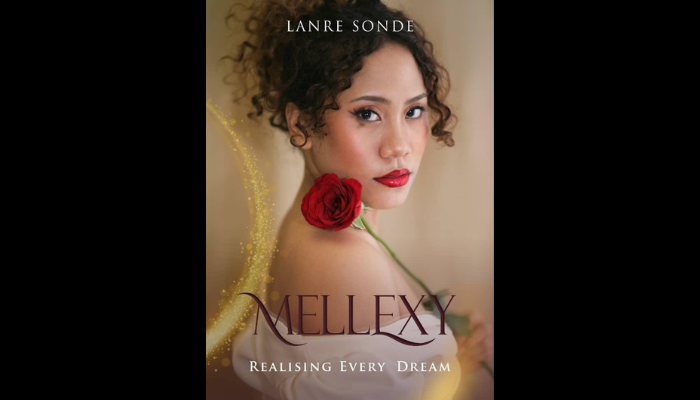
Some of the details which stayed hidden in the first two Mellexy books are finally unveiled in “Realising Every Dream”. We’re finally introduced to the project’s cover model, a painter and friend of the author. We also meet the poet’s muse and lover, Boluwaji. It’s venturesome to write a poem for a woman—how special can someone be to be written into three poetry collections! I mean, it’s almost impossible to fit love in a poem.
It takes a keen mind to see poetry in the mundane. Love thrives with iteration—simple pleasures and gestures. This is why ‘To All the Cliches’ is relatable and has a universal appeal. It echoes age-old romantic tropes, leaning fully into the seemingly ordinary. Love is a dedication to the banal, a servitude to the carnal—breakfast in bed, forehead kisses—and shared fantasies.

I want to share a kiss with you on a rooftop
with an orange moon as the backdrop
I want to dance with you by the beach
As the waves (a)wash our feet
by the setting sun
This poem, unlike most in the Mellexy books, is unfettered by metaphors—it draws strength from honest emotions and authentic aesthetics, as if to underscore that love isn’t a performance. It doesn’t seek to reinvent romantic cliches, but to show the magic of a refrain, the beauty of knowing and being able to sing along.
‘Mellexy: Realising Every Dream’ is a love story written in metaphors, set in a universe where the lover is both a muse and a miracle. Each poem is an unfolding of chapters in the journey of intimacy—from the vulnerability of yearning, to the expression of desire, the mythic visions of a shared future, and finally, condensing in gratitude and fulfilment. It’s a lyrical exploration of destiny and devotion.
The author maintains a tender, hopeful, and idyllic tone and mood, creating a coherent narrative with little or no variation in voice or intensity. He uses poems as moments or portraits rather than as part of a narrative progression, favouring repetition as a device. Lanre Sonde’s choice of metaphors depicts love as sacred, often employing celestial and spiritual imagery. This consistency risks monotony, with the frequent reuse of nature and astral symbols, where urban and memory-based imagery could keep the images fresh and exciting.
The poet tends to overload his verses with metaphors, often failing to establish clear connections between the images. The poems are more powerful when he employs a single dominant metaphor and anchors the abstract in experiential narrative. This is evident in poems like ‘Butterfly’ and ‘Footprint’. Overall, the imagery in this collection of 51 poems is rich and sensuously captivating.
Perch here
on my delicate petal (Butterfly, page 33)
The Mellexy series is consistent in structure—short lines, imagery, and bursts of lyrical vulnerability. There are also a few creative titles, such as ‘You Took My Heart to High School’ and ‘Lovember’. Ultimately, the poet plays it safe, leaving no room for surprises.
The greatest strength of this collection of poems is the impact it has when read aloud. An advantage of the acoustic is that it’s forgiving—less likely to face critical scrutiny on stage than on the page—and it appeals to emotions. The dreamy imagery would transport a listener into the realms of reverence.
In ‘This Is’, the poet persona confesses, I have dreamed of this moment / This is eventually…/ this is real, in a moment of recognition and fulfilment. His search is complete. This is underscored, albeit several poems later, in ‘Realising Every Dream’. The title poem doesn’t imagine, demand or promise anything—it simply rests the poet’s quest for love. It’s an end to dreams, unlocking a new chapter of happiness.
Jide Badmus is a poet, editor, and book reviewer; author of four poetry books (and seven chapbooks). He is the poetry editor for Con-scio Magazine, a mentor in the SprinNG Writers fellowship, and a member of the Board of Advisors for Libretto Magazine.. He writes from Nottingham, United Kingdom