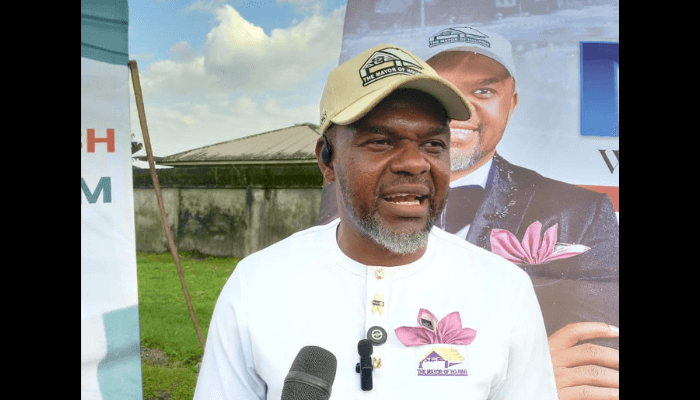
The Mayor of Housing, My-ACE China, took advantage of the just-concluded Port Harcourt International Trade Fair 2025 to unveil what he called the ‘Alesa Model’ on Corporate Social Responsibility (CSR). He said the model seeks to create an engagement and penetration model to help companies survive in the volatile oil region from where many companies fled long ago.
China, a real estate success strategist, who is the managing director of the Housing and Construction Mayor Limited, the company behind the upcoming Alesa Highland Sustainable Green Smart City in Port Harcourt’s emerging oil and gas city and port city, told newsmen at the Trade Fair that companies should learn to get the buy-in of host communities from the onset before starting construction.
He said this would be done through what he called an equity-inclusive system where the host communities would be sure what is in it for them, and be sure of specific equity in a new company coming their way.
He said Indorama had created 7.5% equity to Eleme and Elelenwo people to secure their buy-in but said the Alesa Model seeks to deliver value to the land owners even before project commencement.

Talking to newsmen at the Obi Wali International Cultural Centre, venue of the trade fair, China said: “I know that Corporate Social Responsibility, as the name suggests, is the most responsible response any company can give to any society. As a matter of fact, Corporate Social Responsibility is more important than philanthropy because philanthropy might be a whim and caprice, and responsibility is a duty. So, CSR is the duty of every company to positively and responsibly affect the society where they are doing business.”
He said there are several models. “But the model that I believe is most sustainable, most inclusive, and most, committing, is the Equity Inclusion Model (EIM).
“The Equity Inclusion Model is where you include CSR into your company equity. And it’s more powerful when it is at the founding stage of the company, so that when you are founding your company, you already have an equity that goes to CSR. So when you are budgeting for marketing, you are budgeting for sales, you are budgeting for staff salary, CSR becomes an intrinsic part of your budget.
“And that is what we are doing in the Housing and Construction Mayor Limited, through one of our subsidiaries, the Alesa Highlands Estate Limited, that is the corporate entity managing the Alesa Highlands Sustainable Green Smart City.”
In Alesa, he stated, “We not only included the community and the aboriginal land owners in a 10% equity structure in all our expenses, all our budgeting, and all our profit allocation and resource allocation; but we did that at inception. And that is why we named the project after the community—Alesa. But we had to find a meaning for Alesa in our corporate identity.

“Alesa for us means: Advanced Living Environment for Sustainable Advantage, which is what the Green Smart City stands for. So for us to go as far as even looking for a meaning for the aboriginal name that has existed for centuries, it shows our commitment to CSR.”
On why the company chose 10% equity inclusion, the CEO said it is a concept from Confucius, one of the greatest sages that ever lived, who said: “Tell me and I will forget. Show me and I might remember. But involve me and I will be committed.”
So, he went on, involvement of the aboriginal owners seems the key to penetration in the Niger Delta. He said: “They might not be involved in the running of our company, they might not be involved in the board of decision, but they are involved in resource allocation to the tune of 10% for everything. And we have already started disbursing that 10% equity from the early days when that 10% was as small as possible.
“And we are the first company in Nigeria to scale CSR. To us, CSR is not something you do in a company when you have made it and you are established. CSR is something you do in a company from day one. When you are a baby company, you do baby CSR. When you grow to a toddler company, you do toddler CSR. When you become a crawling company, you do crawling CSR. When you become a running company, you do running CSR. When you become an international company, you do international CSR.”
He admitted that the Alesa community initially was a little bit shocked and apprehensive to the model as a promise, because they were afraid it would not be sustained. “But seeing that the CSR was growing directly proportional as we grow, they have now not only embraced us, but they are now committed to this project as if it is their own. And they are ensuring that not only that the project succeeds, but that every enabling environment we need in the community for this project is made available. Before we say the word, they provide it. This is because they now know this is for their own good.”
China admitted that there is a trust deficit between operational companies and host communities in the oil region due to decades of crisis and failed hopes, when the operational companies do not make the host communities see that this company operating in your community is for your own good. “Most times, they allow the host community to get the pollution and the negative effluence of their presence in the community, but don’t get the positive response in the Corporate Social Responsibility resources to the community. So that mutual suspicion, which we too felt palpably when we started, but right now, it has not only dissolved, but I can say unequivocally that Alesa community, the King, the aboriginal land owners, are equal stakeholders in the Alesa Highlands Development Green Smart City as we are.”
He talked about things to happen in Alesa beyond the housing project, the biggest shopping mall in Nigeria, integrated areas for community women to trade, greenery, solar power, etc, but mentioned plans in future to float a low-cost housing initiative which he said is going to be the first indigenous low-cost housing initiative.
“Beyond that, we intend to also do a Real Estate/Agric collaboration that would create the greatest Green Economy. Just like we have the Blue Economy in Rivers State, we also want to unearth the Green Economy of Agric. So within the next one or two years, you’ll be hearing about initiatives that are masses-based and social-based, that will involve every cadre of the society.
“Unfortunately, Alesa Highlands Sustainable Green Smart City is a top-level luxury elite development for the top of the top of the society. We will now do a downward integration that will now begin to trickle down till we can do the basic housing solutions and Agric solutions that can make an average and even below-average worker in Rivers State not only have access to luxury, healthy, sustainable living, but also luxury, healthy, sustainable food. This is because shelter and food must go hand in hand even before clothing.”
Read also: Excitement sweeps through Alesa Eleme as land papers arrive to begin world smart city
Advice to business owners: CSR is a social rent:
He advised other businesses not to exhibit selfishness. He said: “Do not be like the community you are complaining about. When the community thinks only about itself, they are selfish. When a business thinks also only of itself, it is selfish. So as you are complaining that communities don’t want to encourage your business, you too should not also do business without encouraging the community.
“You should budget for CSR before you start business. You should make CSR not as a luxury you can afford after you succeed; you should budget CSR as part of the cost of doing business. When you are doing business cost analysis, you budget for rent. There is no business that doesn’t budget for rent because there is a location your business will be located. Just as important as rent, there is also the ‘people-rent or the social rent of the location where you are. CSR is a social rent.”
He said when you don’t do CSR, it’s like you are staying in a place for free. “You’ve not paid your rental penetration to that social space. So when you pay physical rent, you should also pay social rent by CSR. And when you do it willingly, the community will embrace you. But when you wait for the community to come and carry green leaves and do protest in front of your business premises before you pay, it shows that you are not an effective and a goodwill business person.
“So, don’t be like the community you are complaining does not support you. Show them how it should be done and they will follow suit.”
On what the community too should do to reciprocate, China said CSR thrives in a structured society or community structure. “Why many companies stop involving in CSR is whereby the community is so disorganized that a few individuals hijack the goodwill of companies and dilute it, and the community feels no effect of that CSR.
“That is why in Alesa community, in my own niche which is housing, they have created the Alesa Land Development Committee to not only interface between all land transactions between investors and the community, but they regulate the activity of land transactions to stop fraud and miscreants from diluting the CSR effect. They have closed the door to any non-qualified individual to collect and disburse CSR on their behalf. They have created an official channel for companies to send the CSR to the community in housing.
“So, anything that has to do with land and development, we already know the agency in the community to channel our CSR through. Once every community does that, not only in housing and land, but in markets, in all aspects of the economic life of the society or the community, then people coming in will know those to even negotiate with. That is what Indorama did with the Aleto Eleme community and it has been yielding positive accolades.”
He said when the community is not structured, they dilute and allow the diversion of CSR. “When they are officially structured and government registered and recognized them, when somebody knows that the community knows him, the government knows him, company knows him, any disbursement of CSR will at least go for the reason it was disbursed and the effect will be felt.”
He said Alessa has started the new system and he expects the model to be replicated across all of Niger Delta. “As a matter of fact, the community should not wait for development or companies to come before they create those structures. Those structures should be in place and start advertising themselves to the world, that ‘this community has this structure and we are waiting for you to come, you are in safe hands.’ That is better.”