“Gbese Is Gbese” – This is what we refer to as debt in Yoruba language, “Ugwo” in Ibo language and “Bashi” in Hausa language.
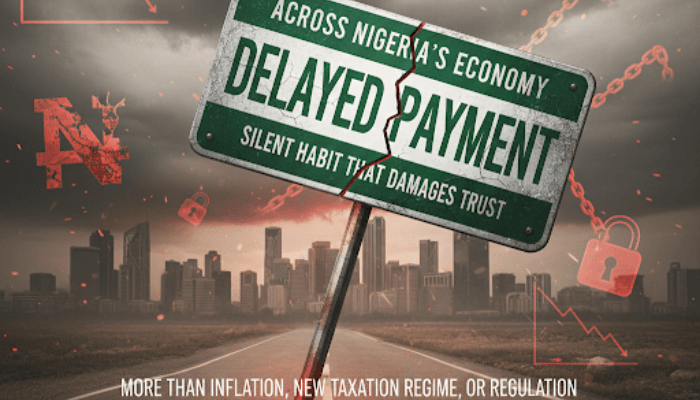
Across Nigeria’s economy, one silent habit damages trust more than inflation, new taxation regime, or regulation. Delayed payment. Unpaid invoices. Endless excuses after contracts reach the execution stage or completion stage. This habit cuts across governments at all levels, ministries, agencies, large corporates, dominant buyers, and borrowers of loans. The result hurts small and growing enterprises, weakens supply chains, kills emerging businesses, and erodes confidence in Nigerian business culture.
Payment of debts represents more than an accounting duty. Payment reflects character, whilst delayed payments or non-payment reflect a lack of integrity in business on the part of customers delaying payment, no matter the excuse. Payment reflects respect for business contracts. Payment reflects moral and spiritual responsibility to other people’s livelihoods. When payment fails, trust collapses. When trust collapses, markets weaken, and livelihoods are affected adversely.
Timely payment stands as both a spiritual and civic obligation. A buyer receives goods or services. Value exchanges hands. Financial obligation arises. Obligations are met. This cycle is broken when obligations are either not met in a timely manner or are not met at all. Delay beyond agreed terms breaks trust. No society builds sustainable enterprise on broken trust, and the supporters of those delaying payments are as wicked as the debtors they support.

Many Nigerian businesses sign contracts in good faith, hoping to pay when the obligations become due. On that basis, suppliers mobilize staff, capital, equipment, and credit to ensure that they keep their own part of the contract. Work completes. Invoices submitted. Silence follows. Payment stretches from weeks to months. Months slide into many years. Small firms struggle to pay salaries and meet up with obligations. Owners fund operations from personal savings. Banks tighten credit. Some enterprises close without noise or protest. Whilst those who want justice call on debt recovery firms like Kreeno Debt Recovery And Private Investigation Agency – KREENO CONSORTIUM, to leverage their professional, ethical recovery technical expertise in criminal prosecution, to ensure victims of delayed payments and fraud get their well-deserved justice.
“Such conduct goes beyond inefficiency. Such conduct qualifies as economic abuse. Funds belonging to one party remain trapped by another party with greater power. Survival pressure shifts downward. Risk transfers unfairly. The weaker party absorbs pain, whilst the stronger party enjoys free credit. Any party holding on to another’s capital is a business rapist,” so says Dr. Ohio O. Ojeagbase of KREENO CONSORTIUM. It is as bad a crime as its synonym referred to above. You rape the business of the funds it needs to grow.
Public institutions play a central role in this pattern. Federal, State, and Local Governments, Ministries, Departments, and Agencies owe contractors across various sectors, including infrastructure, healthcare, security, technology, services, consulting, and many more. Budget cycles end. Files move slowly. Approvals stall. Each delay starves businesses of working capital or cash flow, which is the lifeblood of thriving businesses. Public trust suffers alongside the business collapse.
Private sector giants also contribute to these failures. Large buyers dominate supply chains. Payment terms stretch unilaterally. Thirty days turn into ninety days. Ninety days turn into negotiations. Smaller vendors accept silence to avoid being blacklisted. Fear replaces fairness.
This culture damages local supply chains. One unpaid invoice triggers a chain reaction. A manufacturer delays raw material purchases. A transporter delays vehicle maintenance. A supplier delays wages. Economic activity slows. Productivity drops. Retrenchment occurs or employment of new personnel ceases. Unemployment rises quietly. Entrepreneurship suffers. Young founders enter markets with ideas and energy. Delayed payment drains momentum. Innovation stalls. Risk appetite shrinks. Many talented Nigerians exit productive sectors or migrate in search of stable systems, “JAPA” syndrome rises. JAPA is the local slogan for exodus from the country, in search of greener pastures. Investor confidence also declines. Who wants to invest in a country where everyone is exiting?

Ethical payment culture signals seriousness. Investors watch contract enforcement, and this is where Legislatures need to enact enforceable laws against such loan defaulters or institutions delaying in payment of invoices. Sanctions must be meted against them, especially government institutions who delay payments to contractors in perpetuity, causing the businesses to become moribund. Investors track cash flow reliability. When payment discipline fails, capital seeks safer environments. Nigeria loses growth opportunity quietly, without dramatic headlines.
A sharp ethical gap exists between contract signing and payment execution. Many organizations display professionalism during bidding and negotiation. Documentation appears solid. Commitments sound firm. Values disappear after delivery. Silence replaces dialogue. Excuses replace honor. Civil courts are approached by these defaulters, in an attempt to delay repayment of debts owed lenders and banks, capitalizing on the inefficiencies in the Nigerian judicial system, where cases take decades to be resolved.
Boards and executives bear the fiduciary responsibility of accountability and supervision. Leadership sets the tone. Payment discipline reflects governance quality. An organization committed to integrity pays debts on schedule. An organization tolerant of payment delays normalizes this abuse. Culture flows from leadership behavior. Reform requires action as we commence year 2026. Values must shift from convenience to conscience. Payment must regain status as a priority, not an afterthought. Public and private sectors share joint responsibility to making this a reality.
Policy reform starts with enforcement. Contract terms require legal weight. Penalties for delayed payment, needs clarity and application. Compounded Interest on overdue invoices should apply automatically. Transparency in public payment schedules must improve. Digital tracking of financial obligations across Government ministries and agencies would reduce excuses and payment defaults.
Governance reform matters. Boards should receive regular reports on outstanding payables. Audit committees should flag chronic delays. Executives should face consequences for repeated contract breaches. Performance evaluation should include payment discipline metrics and this is where KREENO CONSORTIUM could be engaged to handle these performance evaluation using Machine Learning.
Leadership example remains decisive. Senior officials and chief executives shape norms. When leaders insist on timely settlement, systems adjust. When leaders tolerate delay, abuse spreads. Ethical leadership restores confidence faster than speeches.
Business and religious organizations also hold influence. Trade groups should publish payment codes. Peer pressure changes behavior. Recognition for ethical payers encourages compliance. Silence protects bad actors. Open standards protect markets. KREENO Consortium is calling on the National Assembly and Judiciary to step up with legislations that would protect Nigeria’s business climate if The Executive Arm is falling short of its duties, in taking the bull by the horn.
Citizens play a vital role. Demand accountability from public officers. Hold your elected officers accountable. Question delayed projects. Support businesses and lenders facing unjust withholding of their payments. Ethical markets grow through collective insistence on fairness, by stopping impunity amongst citizens that are also involved in holding on to people’s funds and killing businesses.
“Nigeria stands at a crossroads in these early days of 2026. Economic growth targets face pressure. Youth unemployment remains high. Purchasing Power remains low. Trust deficits widen. Payment culture reform offers a practical starting point. No new infrastructure is required to achieve this discipline. No complex technology needed. Only discipline and character is required.” Says Dr. KREENO. This does not in any way take away the need for robust infrastructure or new and advanced technology to be sourced in the near future. The objective here is to emphasise that with what is currently available today, these goals can be achieved through improved transparency, character, and discipline.
A fair economy respects value exchange. A fair economy honors agreements (whether verbal or written). A fair economy protects the vulnerable from silent exploitation. Owed remains owed. Payment delayed remains injustice prolonged, and this is where both the Judiciary and Legislature come handy.
Restoring trust demands courage. Courage to pay promptly. Courage to enforce contracts. Courage to reject free credit built on another person’s pain. Such courage rebuilds markets. Business success in Nigeria will depend less on size and influence and more on integrity and reliability. Nations grow when promises mean something. Enterprises endure when trust flows freely.
The future belongs to systems rooted in fairness, good corporate governance, and integrity-in-business culture. Payment discipline represents a test of national character. Nigeria must pass this test so that the year 2026 will see Nigeria rise out of the ashes of our collapsing trust system and resulting in improved economic growth
For more information, clarifications, and support, Contact Prof. Prisca Ndu on +234 902 148 8737 or priscan@kreenoholdings.com
.