The World Health Organisation says the global response to Human Immunodeficiency Virus (HIV) stands at a crossroads despite decades of progress, due to disruptions in service delivery, funding cuts, and regional conflicts.
Each year on December 1, WHO and its partners commemorate World AIDS Day. This year’s theme, “Overcoming disruption, transforming the AIDS response,” calls for sustained political leadership, stronger international cooperation, and human-rights-centred approaches to end AIDS by 2030.
“After decades of progress, the HIV response stands at a crossroads. Life-saving services are being disrupted, and many communities face heightened risks and vulnerabilities. Yet amid these challenges, hope endures in the determination, resilience, and innovation of communities who strive to end AIDS,” WHO stated.
In Nigeria, health experts are marking the day in solidarity with those lost to HIV while acknowledging national progress. “Every World AIDS Day reminds us that progress is possible but not automatic,” the LabCoat Agency (an organization of young health experts) noted. “The theme for this year speaks to the harsh realities communities face, from conflicts to economic hardships and misinformation. Let’s walk together to strengthen the AIDS response, support those affected, and ensure that no one is left behind,” the agency encouraged.

The Nigeria Centre for Disease Control and Prevention (NCDC) also joined the global commemoration, stressing the need for stronger systems. “The need to build resilient, innovative and people-centered health systems is important in building a future where disruptions do not slow progress,” NCDC stated.
Read also: Africa’s HIV response shifts as donor funding tightens, Roche executive says
What the numbers show
WHO reports that more than 40 million people are currently living with HIV worldwide. In 2024 alone, the virus caused an estimated 630,000 deaths and 1.3 million new infections. The agency warns that while progress has been made, ongoing disruptions continue to slow global response efforts.
The 2024 global quality report by the AIDS Healthcare Foundation (AHF) shows that tuberculosis remained the leading cause of HIV-related deaths accounting for about 12.3 percent globally. In Nigeria, 99 percent of newly enrolled HIV clients were screened for syphilis, and 93 percent of those who tested positive completed treatment.

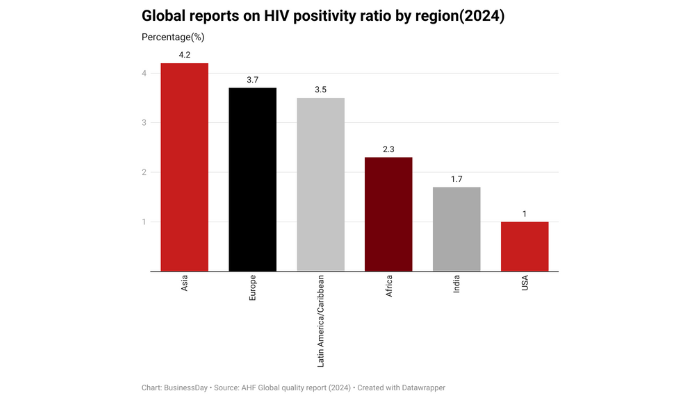
Across regions, the Africa bureau tested the largest number of people,over 3 million in 2024, and recorded a positivity ratio of 2.3 percent. The Asia bureau posted the highest positivity ratio at 4.2 percent, followed by Europe at 3.7 percent.
The World Health Organization defines HIV positivity ratio as the percentage of positive test results within a tested population. Globally, this ratio fell from 3.4 percent in 2020 to 2.6 percent by the end of 2024, according to AHF. Men recorded higher positivity ratios than women across all regions.
Among all key populations, people who inject drugs showed the highest positivity ratio at 8.3 percent, raising alarm over the rise of “bluetoothing”, a practice in which users share blood containing injected drugs, and potentially the virus itself. ABC News describes bluetoothing as a growing trend among young drug users and a major driver of new infections.