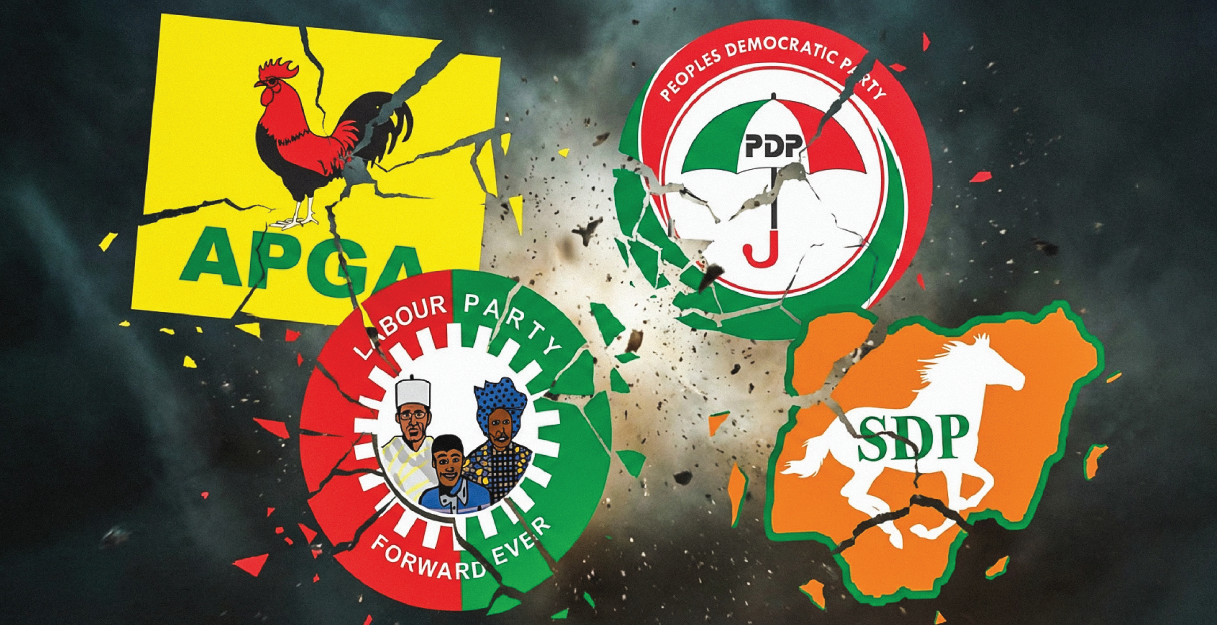
Democracy is not only tested at the ballot box; it is tested in what happens to those who lose. When opposition parties sink into court battles, walkouts, and even fistfights, they do not merely embarrass themselves – they strip citizens of the very instruments that make elections meaningful.
The recent Peoples Democratic Party (PDP) convention in Ibadan was meant to be a moment of renewal for Nigeria’s oldest and main opposition party. Instead, it became a theatre of implosion, the clearest symbol of how fragile and incoherent the opposition has become. Court injunctions, factional boycotts, and leadership tussles turned what should have been a unifying congress into a purge, ending with the expulsion of 11 top figures, including FCT Minister Nyesom Wike and former Ekiti State Governor Ayo Fayose. The fallout has deepened PDP’s crisis and triggered fresh defections to the ruling All Progressives Congress (APC), further undermining its claim to be a national counterweight to power.
Nor is the PDP alone. The Labour Party, which briefly carried the hopes of a younger generation and urban middle class, has squandered much of that momentum through internal wrangling and leadership disputes. What once looked like the early stages of a plural, competitive party system is hardening into a familiar pattern: one dominant ruling party and a cluster of quarrelling, unstable rivals. For many Nigerians, the fear is no longer theoretical. The country risks sliding into a de facto one party order – not by constitutional design, but by the collapse and discrediting of those meant to offer alternatives.
Real democracies depend on competition, accountability, and choice. When opposition parties implode or become indistinguishable from the ruling party, citizens lose the means to check power between elections and to punish bad governance at the polls. Today, the APC is too dominant at both federal and state levels, often facing only token resistance. Such concentration of power invites complacency, breeds corruption, and encourages authoritarian reflexes – the temptation to treat dissent as a nuisance rather than a legitimate part of the democratic bargain.

Nigeria’s democratic experiment has always been fragile, but the disarray of the opposition now threatens its core. Without credible challengers, elections risk becoming rituals rather than real contests. Policies go largely unchallenged; budgets are passed with minimal scrutiny; and the legislature loses its edge as a forum of robust debate. An opposition torn apart by litigation, boycotts, and even physical brawls cannot play its cardinal roles of offering policy alternatives, providing oversight, and giving citizens a peaceful path to change course.
Defection is a long standing cancer in Nigeria’s party system. Since 1999, party loyalty has been mostly transactional. Politicians cross carpets not because ideology has shifted but because access to patronage, protection, or personal ambition demands it. Between 2013 and 2014, five PDP governors and allied legislators defected to the newly formed APC and helped it win the presidency in 2015. In 2018, ahead of the 2019 elections, some actors returned to the PDP, citing crises in the APC. From 2021 to 2025, the cycle has continued, with renewed waves of defections from PDP to APC, often after leadership tussles and disputed conventions, and amid allegations that corruption cases quietly vanish once decampees join the ruling side.
Such fluidity undermines party development. Parties without stable platforms or clear boundaries become temporary vehicles for ambition rather than institutions that aggregate interests, train leaders, and discipline power. Where internal democracy is weak and godfathers dictate outcomes, factional conflict and litigation replace rules based competition. Because parties are weak, politicians defect; because politicians defect, parties never become strong.
Other democracies have confronted similar problems, with mixed results. In India, rampant defections in the 1960s and 1970s led to the 1985 Anti Defection Law, which disqualifies elected officials who switch parties outside narrowly defined processes. The law is imperfect but has imposed some cost on opportunistic “decamping” and helped stabilise party politics.
Where there is no effective opposition, governments lose touch with reality. Policies are not interrogated, abuses go unchecked, and citizens either disengage or turn to extra institutional forms of protest. Nigeria must not follow that script. If parties cannot or will not play their democratic roles, citizens and civic organisations must step into the breach.

In a system drifting toward one party dominance, citizen activism becomes the last line of defence. Beyond party labels, Nigerians need to deepen civic engagement: using petitions, peaceful protests, strategic litigation, and social media campaigns to demand transparency. Nigerians must insist on accountability even when opposition parties disappoint or self destruct.
Democracy is not just about periodic elections; it is about sustained participation. Elder statesmen, former presidents, retired generals, respected traditional and religious leaders, along with civil society groups and the media, have a moral duty to speak up. Their silence in the face of creeping backsliding is deafening. Civil society has already shown what is possible.
Organisations such as SERAP, Enough is Enough Nigeria, and BudgIT have used data driven advocacy, public campaigning, and legal action to challenge impunity and force disclosure. Their work needs scaling and replication across the federation. Opposition parties, for their part, must rediscover internal democracy, empower grassroots members, forge strategic alliances, and move beyond slogans to present clear, costed policy alternatives.
The implosion of opposition parties is not a side drama; it goes to the heart of whether elections will remain meaningful or become mere coronations. The search for credible opposition is therefore more than a partisan project. It is a struggle over the soul of the republic – over whether power in Nigeria will remain contestable, accountable, and ultimately answerable to the people.