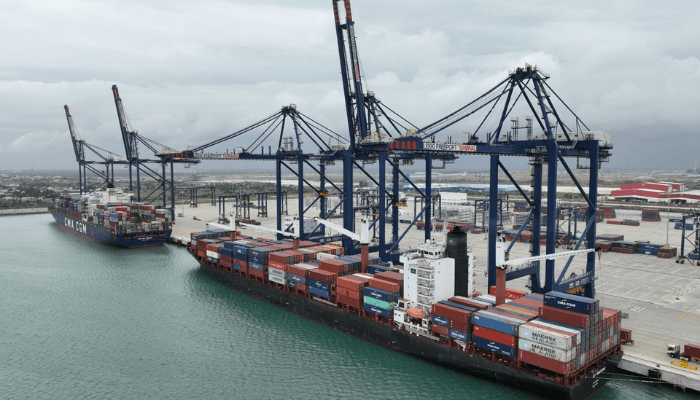
Nigeria loses billions yearly to foreign control of its shipping industry. With the new Blue Economy framework, the nation has a once-in-a-generation chance to reclaim its maritime sovereignty, create jobs, and unlock $20 billion in annual value by 2035.
For 15 years, Nigeria has quietly haemorrhaged an estimated $120 billion in potential earnings—not through corruption alone, but through the invisible hand of foreign vessels hauling our crude, containers, and cargo while our own fleet languishes. Every shipment of fertiliser or barrel of crude exported carries with it jobs, expertise, and national sovereignty that should belong to Nigerians. This is not just an economic imbalance; it is a question of sovereignty at sea.
The recently launched Nigeria Maritime Sovereignty & Blue Economy Acceleration Plan (NMS-BEAP 2035) offers the most coherent pathway yet to reverse this drain. It aims to reclaim $5–6 billion in annual freight earnings, raise maritime GDP from 2 to 5 percent, and generate over 250,000 jobs through indigenous fleet participation and shipbuilding. By 2035, the plan envisions that at least 80 percent of Nigeria’s shipping tonnage will be carried by Nigerian-owned vessels, anchoring prosperity within our shores.
The urgency is clear from the data. In 2024, Nigeria’s ports handled 103 million tonnes of cargo and recorded 4,005 vessel calls, yet less than 20 percent of this trade was moved by local operators. The country currently has only 7,000 certified Nigerian seafarers, far short of the 25,000 required by 2035 to sustain the sector. The result is a $7–9 billion annual forex leak, an economic wound that deepens Nigeria’s balance-of-payment pressures and weakens the naira.

But this narrative is reversible. Other nations have shown what political will and structured investment can achieve. In the 1970s, South Korea built a $40 billion shipbuilding industry almost from scratch, anchored on state-backed finance and technology transfer. The Philippines, now one of the world’s largest suppliers of seafarers, trains nearly 375,000 maritime professionals whose remittances generate over $6 billion annually. Nigeria, strategically located on the Atlantic corridor and already commanding West Africa’s largest cargo throughput, can replicate such success: if it aligns policy, finance, and enforcement.
Three pillars are essential for this transformation: finance, enforcement, and human capital.
First, activate and disburse the long-dormant Cabotage Vessel Financing Fund (CVFF). Nigerian shipowners currently borrow at interest rates of 25 percent for three years, while foreign competitors enjoy 4.5 percent loans over 25 years. Unlocking the CVFF with single-digit interest rates and 15–20-year tenors would be catalytic. Paired with a National Shipbuilding Fund and duty-free vessel imports, it could reduce capital costs by as much as 70 percent and stimulate shipyard investment in Lagos, Onne, and Calabar. The NMS-BEAP projects $12–16 billion in CAPEX by 2035, with a healthy 16–19 percent ROI, strong fundamentals for both investors and the Treasury.
Second, enforce cabotage with integrity. Nigeria’s Coastal and Inland Shipping Act (Cabotage Act) was meant to protect indigenous operators, yet it has been gutted by indiscriminate waivers that favour foreign fleets. The proposed Cabotage Joint Taskforce (CJT), uniting NIMASA, the Navy, Customs, and indigenous operators, must operate with transparency and authority. Real-time vessel tracking, publicly accessible waiver logs, and whistleblower incentives can deter sabotage. Without credible enforcement, policy remains paper.
Third, invest strategically in people. Nigeria’s maritime academies are underfunded and outdated. Establishing a National Seafarer and Technical Certification Centre aligned with IMO and STCW standards would close the skills gap and future-proof the workforce for digital, green, and LNG-based shipping. This is not an aspirational goal but an economic imperative. A skilled maritime workforce not only earns forex but also enhances safety, efficiency, and Nigeria’s reputation as a maritime nation.

Reform must also tackle the currency dimension. Freight billing in dollars has created a hidden inflationary pressure, shipping costs alone add an estimated 35 percent to domestic prices. Transitioning to naira-denominated freight settlements, backed by the Central Bank and key exporters, will localise value and stabilise the naira. Such a move is neither isolationist nor illegal: under the WTO’s GATS Article XIV bis, countries may adopt maritime sovereignty measures for national security. The U.S. Jones Act, India’s tonnage tax, and the UK’s post-Brexit cabotage reforms all affirm this principle.
Critics may argue that indigenous control risks inefficiency or rent-seeking. But the alternative, continued dependency, is far costlier. Maritime sovereignty does not mean shutting out competition; it means ensuring Nigerians benefit first from the resources of their own waters. When South Korea protected and nurtured its shipyards, it didn’t stifle trade, it built global champions.
The stakes are not abstract. If Nigeria executes the NMS-BEAP roadmap with discipline, activating CVFF by 2025, enforcing waiver sunsets by 2027, scaling shipyards by 2031, and achieving full sovereignty by 2035, the payoff will be historic. The blue economy could contribute ₦30 trillion annually, reduce unemployment, and reposition Nigeria as a maritime hub between the Gulf of Guinea and the global Atlantic trade system.
As the late Capt. Bashir, a pioneer Nigerian mariner, once demonstrated, rising from the defunct National Shipping Line to command a 350,000 MT Saudi Aramco tanker, our talent has never been the issue. What Nigeria lacked was a system. With political resolve and public pressure, symbolised by the ongoing 111,111-signature e-petition, the nation can finally build that system.
Our maritime story need not remain one of loss and dependency. If we act decisively, Nigeria’s blue waters can become a reservoir of prosperity, pride, and sovereignty, anchoring not only ships but also the nation’s economic future.