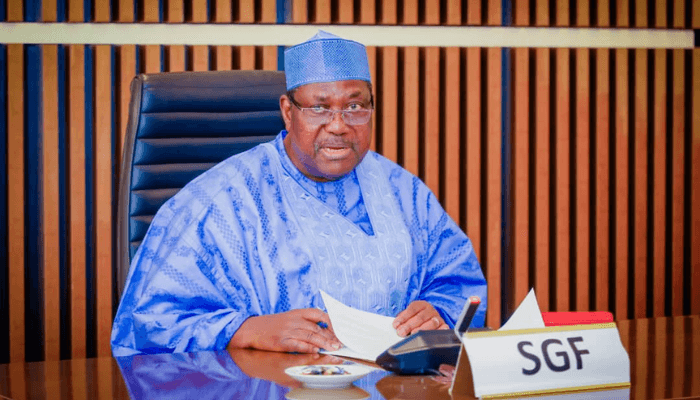
George Akume, Secretary to the Government of Federation (SGF), on Tuesday, said the North must wait until 2031 to have a shot at the Presidency.
Akume stated this while speaking at a two-day interactive session on Government – Citizens Engagement, organised by the Sir Ahmadu Bello Memorial Foundation in Kaduna.
This is coming on the heels of the current agitation by a section of the North to wrestle power back to the region in 2027.
Akume dismissed the agitations, noting that the current arrangement had ensured fairness, equity and stability in the polity.

“Before I take my seat, let me share with you what our leaders did in 1999 Pre-Jos Convention of the People’s Democratic Party (PDP).
Read also: Buhari’s legacy: A presidency of unkept promises
“They recognised and, rightly too, that the only way to ensure our unity and territorial integrity of our dear country was to entrench in our minds and practice rotational presidency between the south and North.”
Akume, who listed names of the PDP leaders such as Solomon Lar, Adamu Ciroma, Shehu Musa , Abubakar Rimi, Suleman Kumo, Issac Shaahu and Jerry Gana, saluted their courage, sincerity and patriotism of the leaders.
He noted that “their wisdom has paid off. This arrangement guaranteed stability of the polity.

“By this conception, the North, the region that is so dear to me, will be eligible for the presidency in 2031, not 2027.”
According to him “Nigeria will not seize to exist. But we need patience to arrive at our turn ”
Akume appealed to the stakeholders to “continue to walk this path together, with faith in our country and renewed hope in our shared future. So, we are all resolved in deepening our Democracy. ”
Vice President Kashim Shettima, in his remarks, stated that ” instead of governing Nigeria from a distance, the Administration of President Bola Tinubu is walking hand in hand with the people through critical national reforms.”
He reaffirmed the commitment of the administration to inclusive governance and responsive policymaking rooted in wide-ranging public engagement and empathy.
Shettima, represented by Ibrahim Hadejia, Deputy Chief of Staff to the President (Office of the Vice President), said that the Bola Tinubu’s Administration is convening conversations and institutionalising listening.
“It is always a privilege to gather under the luminous legacy of Sir Ahmadu Bello, his memory reminds us that leadership is not simply about occupying office, but about shouldering the burden of service.
“What we nurture today is not just a government of the people but a government with the people,” he said.
He highlighted several reforms of the Administration where public input significantly shaped final outcomes, including tax policy, education access, and economic relief measures following the removal of fuel subsidies.
On the student loan law which was initially passed as the Access to Higher Education Act, the VP said in response, the Administration repealed and reenacted the law, “removing income ceilings and guarantor barriers that had become symbolic walls between ambition and opportunity.”
He also reiterated government’s belief that “no student should be disqualified for being born on the wrong side of poverty.”
On tax reforms, Shettima said the Administration established the Presidential Tax and Fiscal Reform Committee, which engaged stakeholders from across the country to address grey areas in the reforms.
“When objections arose from governors and citizens alike, the President did not dismiss them. He welcomed their candour and ensured tax bills passed through public hearings.
“Even unpopular taxes inherited from past regimes, like the 10% single-use plastic levy and telecom tax, were suspended after critical review,” he stated.
Speaking on the contentious issue of fuel subsidy removal, Shettima stated that “the Tinubu-led Federal Government acknowledged the hardship faced by ordinary Nigerians and accompanied the policy with strategic responses.
Read also: Obi, Amaechi: Beware the desperation of single-term-presidency pledges
“We met with labour unions not with threats, but with empathy. We offered palliative packages, increased wages, waived diesel taxes, and introduced alternatives like CNG buses to cushion transport costs. We were not merely reacting. We were responding.”
He noted that reforms in other sectors of the economy followed the same pattern of engaging with the people and making necessary adjustments to the original propositions where necessary.
According to him, ” President Tinubu showed concern for the people and emphasised that “governance is not a theatre of perfection but a process of correction and a Government that listens is a government that learns. And a government that learns is a government that leads.”
He also applauded the Sir Ahmadu Bello Memorial Foundation for sustaining the legacy of the late Premier of Northern Nigeria, describing it as “a torch of civic dialogue that must never be extinguished.”