|
Getting your Trinity Audio player ready...
|
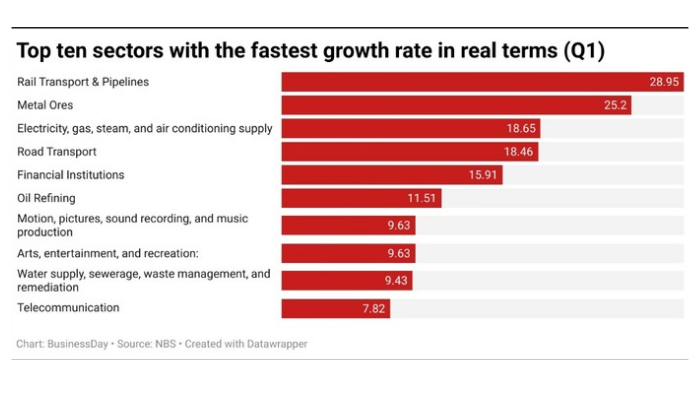
Rail transport & pipelines, metal ores, electricity, gas, steam, and air conditioning supply, along with seven other sectors, are the fastest-growing sectors in the first quarter of 2025, according to the latest Gross Domestic Product report.
The report, published by the National Bureau of Statistics, shows that rail transport grew fastest, by 28.95 percent, followed by metal ores by 25.2 percent and electricity, gas, steam, and air conditioning supply by 18.65 percent.
Others include road transport by 18.46 percent, financial institutions by 15.91 percent, oil refining by 11.51 percent, motion pictures, sound recording, and music production by 9.63 percent, arts, entertainment, and recreation by 9.63 percent, water supply, sewerage, waste management, and remediation by 9.43 percent, and telecommunication by 7.82 percent.
In the first quarter, Nigeria’s Gross Domestic Product (GDP) grew by 3.13 percent (year-on-year) in real terms.

The country retained its status as the fourth largest economy in Africa despite a rebasing exercise that expanded the country’s gross domestic product (GDP).
The NBS announced that the economy expanded to N372.8 trillion ($243 billion) in 2024, down from N314.02 trillion in the prior year as more sectors in the informal economy were considered in its calculations.
The statistics bureau adopted 2019 as its base year, moving away from 2010, as previously reported.
The rebasing exercise covers the period from 2019 to 2023 and reflects changes in the economy’s structure, sectoral contributions, and data sources.
According to analysts at CardinalStone Research, the report indicates a rise in the size of the services sector, profiting from better capturing in the real estate and trade sectors.

“Similarly, despite the growing insecurity concerns in the country, the NBS revealed that the agricultural sector became bigger, enhanced by the National Agricultural Sample Census (NASC) and National Agricultural Sample Survey (NASS), conducted by the Bureau. Conversely, the industrial sector declined as the size of the manufacturing and oil sectors reduced,” it said.
According to the GDP report by NBS, here are the fastest-growing sectors in Q1.
Rail Transport & Pipelines
The real transport sector grew fastest in the first quarter by 28.9 percent, from 42.58 percent in the fourth quarter of 2024. This implies that rail transport is more sought of and activities around the sector boost the economy.
Metal Ores
The metal ores sector followed with a strong 25.2 percent growth rate, although it marks a slowdown from the 36.59 percent recorded in Q4 2024.
The expansion of this mining sub-sector highlights rising global demand for raw materials like tin, iron ore, and lead, many of which Nigeria possesses in commercial quantities. Renewed activity in mining operations and government-backed initiatives to diversify exports have likely supported this momentum.
Electricity, Gas, Steam and Air Conditioning Supply
A key highlight of the quarter was the electricity, gas, steam, and air conditioning supply sector, which recorded a sharp turnaround from negative growth of -7.97 percent in Q4 2024 to a positive 18.65 percent in Q1 2025.
The sector’s contribution to real GDP also improved to 0.35 percent, up from 0.30 percent in the same period last year, suggesting improvements in grid reliability and gas supply to power plants.
Road Transport
Road transport grew by 18.46 percent, rising from 16.84 percent in the previous quarter. The growth reflects increased activity in passenger and freight movement, likely due to reduced fuel costs, improved road infrastructure, or higher mobility demand in urban centers.
Finance institutions
The financial institutions sector expanded by 15.91 percent, a substantial rise from the 5.93 percent posted in Q4 2024.
The increase is attributed to digital banking expansion, strong credit growth, and fintech innovation that continues to widen access to financial services, particularly among previously underserved populations.
Oil Refining
Growth in oil refining hit 11.51 percent in Q1 2025, up from 9.36 percent in the previous quarter. With private sector-led refineries, including modular refineries, beginning operations and refining capacities gradually ramping up, the sector’s performance is beginning to reflect structural reforms in the downstream oil industry.
Motion, pictures, sound recording and music production
The motion pictures, sound recording, and music production sector surged by 9.63 percent, up from just 0.95 percent in Q4. This marks a significant rebound and points to Nigeria’s vibrant Nollywood and music industry gaining more global traction and local investments.
Similarly, the arts, entertainment, and recreation sector also grew by 9.63 percent, though this was marginally lower than the same quarter last year. Its contribution to real GDP stood at 0.47 percent, showing the steady value the creative sector brings to the economy.
Arts, Entertainment, and Recreation
In real terms, the activity grew by 9.63% year-on-year, which was lower than the rate recorded in Q1 2024 by 1.12 percent, and higher by 2.46 percent when compared with that of the preceding quarter.
The activity of art, entertainment, and recreation contributed 0.47 percent to real GDP in Q1 2025.
Water Supply, Sewerage, Waste Management, and Remediation
The real growth rate of the Water Supply, Sewerage, Waste Management, and Remediation sector in the first quarter of 2025 was recorded at 9.43 percent (year-on-year), higher by 3.01 percent from the rate recorded in the previous year.
Its contribution to total real GDP was 0.25 percent in the first quarter of 2025, higher than its contribution of 0.24 percent in the same quarter of the previous year.”
Telecommunication
Lastly, the telecommunication sector—one of the consistent growth drivers in the Nigerian economy grew by 7.82 percent, a slight drop from 8.11 percent recorded in Q4 2024. Despite the slowdown, the sector remains pivotal, driven by increasing data consumption, mobile subscriptions, and expanding broadband penetration.