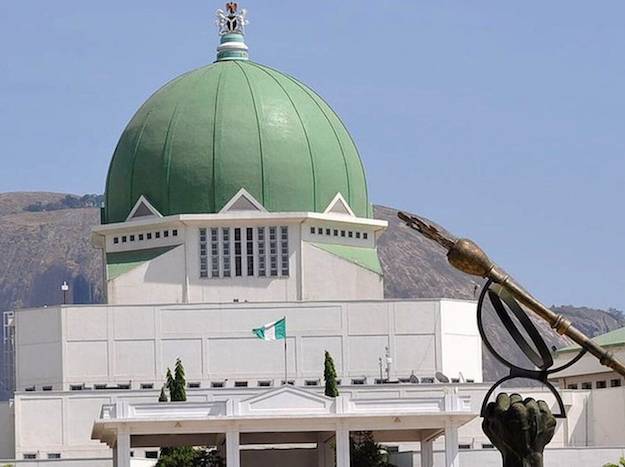
There are heightening concerns that the current constitution which allows 469 National Assembly NASS membership is no longer sustainable considering the economic and dwindling incomes of government, and huge threats to the economy.
There are 109 Senators and 360 members of the House of Representatives in the National Assembly, and unless the country is able to take the bold step to significantly cut this number and their jumbo pay, the already high cost of governance will continue to surge.
The concerns come amid the country’s over-dependence on oil, which has seen low prices, as well as supply output concerns.
Apart from the jumbo pay lawmakers receive, execution of developmental projects to benefit the generality of people is not commensurate.

This is seen as detrimental to the economy, hence the call to diversify it and employ new measures towards achieving a sustainable economic structure.
It is established that salary of Senators is N750,000 per month plus allowances of N13.5 million per month, totalling N14.25 million per month.
Also, it is publicly known that allowances of the lower legislative lawmakers (House of Representatives) surpass their basic salary, hence making the public request for such enormous allowances be removed.
The basic salary of a House of Representatives member in Nigeria is put at N1, 985,212 and the yearly allowance is N23, 822,000 respectively.
Experts say that with the current black market rate of 360 naira to the U.S. dollar, estimates are that majority of Nigeria’s population lives on less than $2.00 per day.

A former Senator in the 8th Nigerian Senate, Shehu Sani, who represented Kaduna Central senatorial district, had exposed how much senators earn. He said the secrecy was hurting his conscience because it was affecting economy.
Sani said he burst the bubble on how much lawmakers earn because it was hurting the country’s economy and that parliament was becoming attractive to only people who cannot contribute ideas for nation’s growth.
“Nigeria’s parliament is peopled by former governors and geriatric politicians. I decided to bust it open. It was a moral issue.
“The national assembly is one of the most non-transparent organs of government. It pricked my conscience and I decided to burst the bubble and open the national assembly to public scrutiny.If the expenses payment system was ended, then parliament would only be attractive to people who contribute ideas”, Sani had said.
Also, a former Governor of the Central Bank of Nigeria (CBN) and Emir of Kano, Sanusi Lamido Sanusi recently wrote to President Muhammadu Buhari and canvassed that pay of federal lawmakers, ministers and political appointees be slashed by half.
Sanusi, a renowned economist, opined that the review in remuneration would create jobs and boost economy.
In his letter, he wrote, “Where is the change? Change should start with NASS members. A senator receives N36 million monthly and if divided by half, N18 million can be used to create jobs for 200 Nigerians, each earning N90,000 monthly. When you multiply this by 109 Senators, it will give 21,800 Nigerians gainful employment.”
Sharing same opinion, the Senator representing Imo North and former governor of Imo State, Owelle Rochas Okorocha, has advocated a slash in the number of lawmakers in the national Assembly.
Okorocha specifically proposed a reduction for each state per Senator, and instead of electing more than 10 lawmakers in the Lower Chamber per state, there should be only three members of the House of Representatives per each state.
Giving cogent reasons, Okorocha said apart from cutting down costs of governance, if a change is made, it will grow the economy. He said the elected lawmakers are many and there are no dividends of democracy to the citizenry.
Okorocha, in an interview, insisted that the country is underdeveloped because the cost of governance is progressing far above the existing enterprises.
The ugly situation, he said, has put the country in a fix of degrading level that even the nation’s budget is run on deficit and government has resort to external borrowing.
“I was of the opinion that we should cut down cost of governance . I feel that the National Assembly is too enlarged and costing the country huge amount of money to run.
” There should be just one Senator per state while membership of the House of Representatives should be on senatorial basis by having just three Representatives from each state.
“By doing this, we can drastically reduce cost of governance and put food on the table of the common man. We need to sacrifice to provide for the needy who are numerous and wallop in abject poverty,” Okorocha said.
Almost 50 percent of Nigerians are extremely poor, making the country world’s poverty capital. Unemployment rate is 23 percent, according to the National Bureau of Statistics.
The majority of states owe workers’ salaries for months, as many still pay N18,000 minimum wage.
Cash-strapped Nigeria is struggling to maintain its broken infrastructure and has mooted aggressive revenue hunting through increment in value added tax, online transaction charges and re-erection of toll gates.
But politicians still earn unreasonably high salaries which cannot be sustainable in the 21st century economy.
SOLOMON AYADO, Abuja