|
Getting your Trinity Audio player ready...
|
The Nigerian manufacturing sector is struggling at the moment—as it has over three decades.
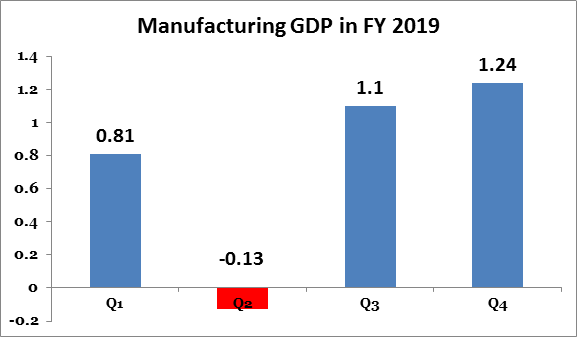
The sector grew by just 0.77 percent in full-year 2019, from 2.09 percent reported in 2018, according to a recent GDP report released by the National Bureau of Statistics (NBS). It contributed 8.74 percent to overall real GDP in the fourth quarter (Q4) of 2019, lower than the 8.86 percent recorded in the fourth quarter of 2018 but the same as 8.74 percent recorded in the third quarter of 2019. In many advanced countries, the sector contributes double-digits to the GDP, but no so in Africa’s most populous count
Capacity utilisation in the manufacturing sector slowed to 54.1 percent in the first half of 2019, from 54.50 percent recorded in same half of 2018, according to the Manufacturers Association of Nigeria (MAN).
Recent financial performances of firms justify that manufacturers are facing post-recession struggles.

Unilever Nigeria, one of the leading consumer firms in the country, had its revenue slump by 58 percent, to N9.13 billion in the fourth quarter of 2019, from N21.7 billion reported in the corresponding period of 2018. The firm recorded a loss after tax of N4.76bn and other income recorded a huge decline to N65 million, from the N2 billion.
The revenue of McNichols Plc dropped 17 percent to N679.13 billion from N818.56 billion in the full year of 2019. Profit of the sugar maker followed similar trajectory, crashing 55 percent to N18.58 billion from N40.89 billion.
Analysis of Nigerian Breweries 2019 full-year results shows that revenue declined by a marginal 0.4 percent to N323 billion, from the 324 billion realised in the previous year.
But the company’s profit before tax fell to N23 billion from N29 billion. Also, profit for the year fell by 16 percent to N16 billion, from N19 billion.
In spite of the border closure, the 2019 full-year revenues of palm oil makers Okomu and Presco dropped 3 percent and 7 percent respectively while profits crashed 33 percent and 8 percent.

These are only few out of many manufacturers that are hard hit by Nigeria’s underperforming economy.
But experts believe that all hope is not lost. They say it was high time the federal government reopened the borders to unlock trade untapped potential.
“Border closure is not a sustainable policy,’ said Ambrose Oruche, acting director-general of MAN at an event in Lagos.
Oruche believes that by re-opening the Nigeria-Benin border, exporters will be able to earn foreign exchange, spending seven to eight days rather than eight weeks to ship their goods to the global market.
In the third quarter of 2019, the Nigerian federal government ordered the closure of Nigeria-Benin border to curb smuggling and spur local production of goods. But the policy, though has boosted agricultural production, is hurting manufacturers who struggle to get some of their raw materials.
The implication of the closure on trade and non-oil inflows can be dire. The trade sector is in recession and the non-oil export is not growing as much as it should. As of the third quarter of 2019, Ghana was the biggest importer of Nigerian non-oil products. It imported 17.18 percent of made-in-Nigeria products within the period, beating the European Union and China, according to the NBS data. This is no longer a possibility.
Another policy change that analysts want to see is the harmonisation of taxes. Many manufacturers in Nigeria, depending on their locations, pay multiple taxes and frivolous charges such as radio and television fees.
Data from the Manufacturers CEOs Confidence Index (MCCI) for the third quarter of 2019, compiled by MAN, showed 89 percent of the chief executives identified multiple taxes and levies as big impediments to the growth of the industrial sector.
The CEOs said multiple taxes and levies depressed production in the manufacturing sector, with records showing that manufacturers paid over 30 different taxes, levies and fees to agencies of the federal, state and local governments on account of increased revenue targets.
The report recommended harmonisation of various tax rates to encourage investment, particularly into the manufacturing sector.
Taiwo Oyedele, policy partner and West Africa tax leader for PwC, at a recent breakfast meeting, said that there were over 60 types of taxes in Nigeria.
The Finance Bill is a laudable step towards this, say analysts, but they doubt it will eliminate multiple taxes among states and local governments, given the hunt for revenues among them.
Next is the need to have a policy in place that is focused on Apapa and Tin Can ports. These ports are bleeding the Nigerian manufacturers’ margins and the leaders seem unperturbed.
A chief executive officer of a manufacturing firm in Ikeja, Lagos, recently said his company spent N800,000 to move container to Apapa in February 2020, from N570,000 paid in December 2019.
“It is easier to move goods from Germany to Nigeria, than to move them from Apapa to Ikeja,” the CEO said.
MAN recommended a new policy that would be focused on addressing challenges such as dilapidated infrastructure, inadequate space, weak trade facilitation infrastructure, poor road network and the associated gridlock to enhance competitiveness at the ports.
Moreover, the non-oil export sector has no policy to drive it. Many Nigerian firms are facing rejections at the borders of other countries. Experts say the country needs an export policy to address the trend. Also, they canvass full implementation of the Export Expansion Grant (EEG), which is yet to kick-start since 2016 when fresh paper work by the Nigeria Export Promotion Council (NEPC) started.
The EEG is a practice in Brazil, China and many European countries. Even though there have been cases of abuse of the EEG by fraudulent firms, data have shown that export will rise when the EEG is given to genuine exporters. For example, non-oil export rose from a little above $1 billion in 2005 to $2.97 billion in 2013 when exporters enjoyed the EEG.
At the moment, crude oil remains the mainstay of the economy, but that is risky for the economy and for manufacturers who rely on foreign exchange for the importation of their inputs.
These policies have become important due to the declining purchasing power of the consumers.
A recent economic report released by CSL research says that the demand for manufactured products has declined due to economic conditions constraining consumer purchasing power.
With high level of poverty and unemployment, manufacturing companies are unable to increase prices of goods as this will further hit them hard, depending on product elasticity.
Gbemi Faminu