|
Getting your Trinity Audio player ready...
|
…as maladministration clogs ‘mundial’ qualification
Some years ago, it would have been criminal to suggest that Nigeria would struggle to qualify for the 2026 World Cup in a group comprising South Africa, Zimbabwe, Rwanda, Benin Republic and Lesotho, considering its avalanche of talents.
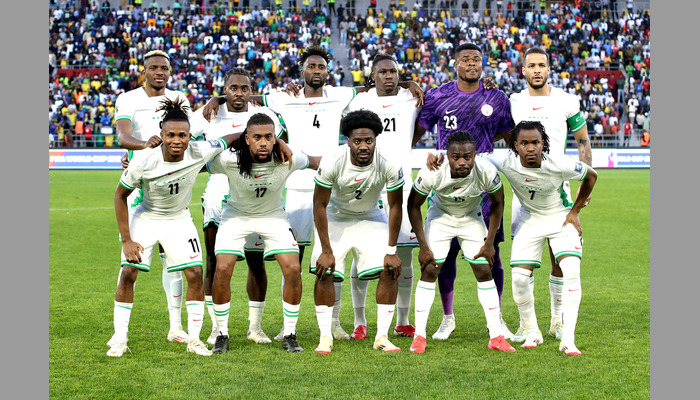
However, the reality is that the Super Eagles are struggling in a group where they would have dictating the pace, Nigeria is fourth in the log behind South Africa, Rwanda, and Benin, with just seven points out a possible 18 points after six matches.
More disturbing is the fact that the team has lost its style of play, and consequently its identity. The Nigerian Super Eagles that were known for their fast-paced, attacking style of football, characterised by skillful dribbling, quick transitions, and a focus on counter-attacking, are today adopting a ‘kick-and-follow’ style of play.

Nigeria’s men senior football team, is known to prioritise scoring goals and often played with a high-energy, attacking approach. But today, the Super Eagles are just not very good anymore, and that boils down to having zero footballing identity.
Since the days of the Green Eagles, Nigeria has always had creative midfielders that feed their prolific strikers; and always operative from the wings to wreck their opponents defence.
Players such as late Mudashuri Lawal, Friday Ekpo, Austin ‘Jay-Jay’ Okoach, and Mikel Obi to mention a few had the team build around them; while wingers such as Segun Odegbami, Adokie Amasiemaka, Finide George, Emmanuel Amuneke, and Tijani Babangida, among others pivoted the attack from the wings, with goal punchers such as Rasheed Yekini, Victor Osinhem, Julius Aghahowa waiting to do the damage.
The truth be told, it is not the fault of the players but of the administrators, who prioritized personal gains to building a sustainable national team.
Read also: Eric Chelle reportedly set to quit as Super Eagles coach

Amaju Pinnick, the former president at Nigeria Football Federation (NFF) seem to had orchestrated the evil wind that stripes off the Super Eagles’ identity when he gave the country Sunday Oliseh as a coach.
Oliseh, a fantastic player in his days, did nothing but building a disunited team plugged into ethnic favoritism and an unattractive style of play. Instead of giving Nigerian football lovers the Pep Guardiola’s style of football which Pinnick claimed he was coming to do, Nigerians were sucked in what the new coach made of team.
The Nigerian Super Eagles that would flow the ball in posession, dominate transitions, and used a creative playmaker as the team’s attacking pivot, alongside two quick wingers who could come into the middle and share the goalscoring burden with the strikers.
Nigerians who wanted to see a replica of Daniel Amokachi, Samson Siasia, Nwankwo Kanu, and Victor Ikpeba, were disappointed, as the team’s football ideology was mutilated.
In what looked like a masterminded election, Pinnick hand over leadership of the glasshouse to Ibrahim Gusau, who looks lost from the appointment of Finidi George to the masterstroke that brought in Eric Chelle, who is reported to be planning to run away like Oliseh did when the chips were down.
It takes with gangsters to win a tournament, and comes with cohesion and strategies. This is the identity the team had under Clement Westerhof, when the Super Eagles’ style of play often took even the European teams by surprise, as they were known for their flair and ability to execute intricate plays.
Winning a football midfield war could be said to guarantees a team of winning a match. Unfortunately, the Super Eagles of today, does not have the creative and visionary midfield which leaves the attackers frustrated.
Imagine, Osinhem and Lookman having the likes of Jay-Jay Okocha, Mikel, and/or Kanu feeding them with tailored passes upfront.
It is not enough to assemble players from different clubs, the real work is in moulding a team. Nigeria is yet to get a team for the World Cup qualification. Having a team of individuals who do not have footballing identity will not take the country far.
The administrators should put on their thinking caps, seek out the secrets of the 1994 Super Eagles and 1996 Atlantic Olympics all conquering Eagles, and their style of play that caught the attention of the world.
After, NFF should get Nigerians a world class coach that has what it takes to transform the team to a winning one.
Nigeria finished the 1994 World as the most entertaining team and was ranked fifth in the world. There is need for NFF to strategically return Super Eagles to the glory days.
After all, football is one thing uniting the country, despite its overwhelming wealth of cultural and religious diversity.