The Senate on Tuesday commenced debate on general principles and Second Reading of the N8.612 trillion 2018 budget estimates, as some senators described the appropriation bill as unrealistic.
While Enyinnaya Abaribe described the proposal as ‘fictitious, imaginary and dead on arrival’, Joshua Lidani called it ‘wishful thinking’.
Debate on the budget commenced on Tuesday, even as the upper legislative chamber is yet to approve the 2018 to 2020 Medium Term Expenditure Framework (MTEF) and Fiscal Strategy Paper (FSP), which contains the key assumptions upon which the budget is based. Chairman, Senate Committee on Finance, John Enoh, had informed his colleagues last week that the fiscal documents would be approved on Wednesday.
READ ALSO: The proposed 2018 budget, will it consolidate?

Speaking at the budget debate, Ben Murray Bruce, said the annual fiscal estimate is ‘a budget of active imagination’.
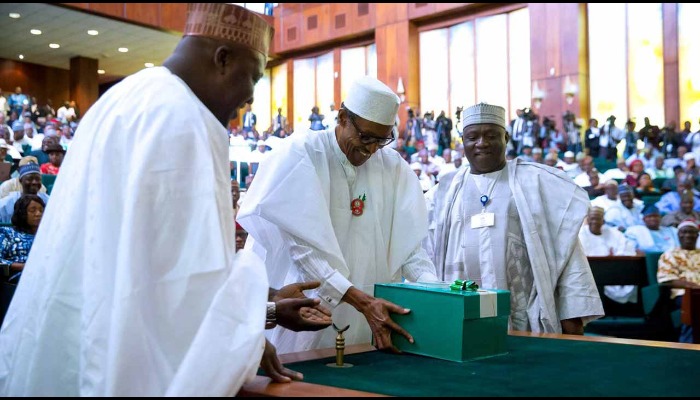
President Muhammadu Buhari had presented a budget of N8,612,236,953,214 to a joint session of the National Assembly on November 7.
Out of this amount, N456,458,654,074 is for statutory transfers, N2,233,835,365,699 for debt service, N3,494,277,820,219 for recurrent (non debt) expenditure, while the sum of N2,427,665,113,222 is for contribution to the development fund for capital expenditure for the year ending on the 31st day of December, 2018.
Senate Leader, Ahmad Lawan, who gave the overview of the budget, noted that in keeping with the administration’s policy, 30.8 per cent (N2,652 trillion) of the aggregate expenditure was allocated to the capital budget.
READ ALSO: Buhari proposes N127bn for capital expenditure in education

The Yobe North lawmaker said that the fiscal operations will result in a deficit of N2,005 trillion or 1.77% GDP.
He reminded his colleagues that the deficit will be partly financed by new borrowing estimated at N1.699 trillion.
While 50% of the borrowing will be sourced externally, the balance is sourced domestically, and the balance of the deficit of N306 billion is to be financed from the proceeds of privatization of some non-oil assets by the Bureau of Public Enterprises (BPE).
Lawan also reminded his colleagues that the budget was predicated on the following assumptions: oil price benchmark $45 per barrel; oil production estimate of 2.3 million barrels per day; exchange rate of N305/USD1; GDP growth rate of 3.5% and an inflation rate of 12.4%.
Hardly had Lawan concluded his overview of the budget estimate when Abaribe took the floor.
He said: “The 2018 budget is designed to consolidate on the achievement of 2016-2017 budgets. What was done in 2017 when less than 15 per cent of that budget was released. Nothing was done. That is why I call it fictitious. I withdraw the word fictitiously and say that it is totally imaginary. Nothing was done in 2017. That is a fact that we all know.
“As of last week, the total receivables that government got was one-tenth of what was stated publicly. Instead of the budget in 2017 of more than N800billion to be received, what was received was N150 billion. In what sense will this 2018 budget be predicated on an assumption that the facts have already been destroyed. You are assuming N11 trillion yet you are getting less than N1trilion.
“This is imaginary. We beg this government to be very specific in the indications of the assumptions underlining this budget. The assumptions are totally wrong and totally off the mark”.
On his part, Lidani said that the performance of the 2017 budget especially as it relates to capital performance is very abysmal.
READ ALSO: Lawmakers staged walk-out over Imo Rep’s defection to APC
Senator Gbenga Ashafa observed that the 2018 budget cannot be effectively discussed without going back to previous budgets and considering how the budgets performed.
Ashafa said that the major problem of the country’s budgets had been poor funding.
He noted that the budget could be big but without money to fund it, it makes no sense.
He stated for instance that only N700 million had been released from the budget of Ministry Transportation out of N11.4 billion.
Ashafa prayed the Senate to work to ensure that enough funds are always released to fund the budget in the interest of the development of the country.
He also sought a speedier procurement process.
Deputy Senate President, Ike Ekweremadu who presided over the session, agreed that “without the revenue, we will have no money to do the expenditure.
Ekweremadu added, “We must point out in the course of the debate how we will reduce the deficit. Ben Bruce has told us that some government agencies that should not be in existence anymore including the Voice of Nigeria (VON) which nobody is listening to. We need to point out some of these MDAs that are of no consequence or adding no value in Nigeria, so that we don’t keep spending money on them because that way we will be able to reduce the ratio between the capital and the recurrent and of course reduce the deficit.
“I hope the government will listen to such exposure and be able to do away with such agencies. If the government fails to remove those agencies from our budget we have a responsibility to Nigerians to bring bills to repeal the laws setting up those agencies and stop wastage of our resources.”
OWEDE AGBAJILEKE, Abuja