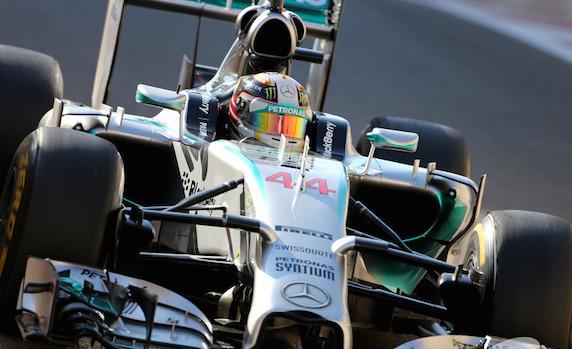
After breaking Sebastian Vettel’s Red Bull dominance, Mercedes will look to begin building a Formula One dynasty in the 2015 Australian Grand Prix season, in Melbourne.
Defending champion Lewis Hamilton led Mercedes to a first constructors’ title last year as he and team-mate Nico Rosberg vied in a season-long battle for the drivers’ championship.
In a season which saw Mercedes’ Silver Arrows – far and away the superior car of the year – dominate their competitors to a degree not seen since Michael Schumacher’s day, Hamilton came up trumps over Rosberg, winning 11 races to the German’s five.

Mercedes hands the best car of 2014, Mercedes is again the favourite to claim the constructors’ championship and for one of its drivers to claim individual honours this year.
In Lewis Hamilton, Mercedes has a defending champion famed for both seering pace and risky strategies down the years, but with the added wisdom of experience and two drivers’ championships to his name.
The steely Nico Rosberg is one of the most intelligent drivers on the circuit and looked like the drivers’ champion in waiting last year before Hamilton scorched into the distance with a string of race victories.
Preseason testing has suggested Mercedes is still well ahead of the chasing pack, clocking more kilometres than their competitors in mostly seamless run-outs in Jerez and Barcelona.
“It has been a great European winter for us,” Rosberg said. “We got off to a running start with not many reliability problems, and have been doing the mileage – which was great and important.”

For Australian audiences, the story of the season belonged to Daniel Ricciardo – freshly promoted from Toro Rosso to Red Bull as Vettel’s number two driver who proceeded to completely overshadow his senior team-mate in an extraordinary year.
Ricciardo won three races in 2014, and much will be expected of him this year after showing the potential of a future drivers’ champion.
His dramatic and painful disqualification from the 2014 Australian Grand Prix, after originally finishing second on the podium, will add extra spice to this year’s event.
But matching last year’s performances will be tougher this time round, with a rejuvenated Ferrari bolstered by Vettel’s arrival, as well as the promising Williams team making serious inroads.
Hamilton expects the usual contenders to jostle for supremacy this year.
“The 2015 cars are going to be evolutions of last year’s cars, so it’ll be the same people that we were racing with last year – Red Bull, Williams – and then you’re hoping that it’s a bit of a better year for those like McLaren and Ferrari, so that we have more people to race. The more the merrier,” he told Laureaus.com.
F1 driver changes for 2015
Fernando Alonso leaves Ferrari for McLaren, replacing Kevin Magnussen. Sebastian Vettel leaves Red Bull for Ferrari, replacing Fernando Alonso.
Daniil Kvyat promoted from Toro Rosso to Red Bull, replacing Sebastian Vettel. Jules Bianchi remains in an indefinite coma since 2014 Japanese GP.
Kevin Magnussen listed as McLaren test driver following Alonso’s arrival.
Team changes
Honda has returned as an F1 engine supplier and will provide McLaren with its V6 engine, ending the team’s two-decade long partnership with Mercedes.
Lotus has changed engine suppliers, swapping Renault for Mercedes, ending a 20-year partnership.
Manor Marussia (formerly Marussia) went into administration in 2014 to miss the last three races of last season. The team has secured new investment and is expecting to be ready to race in Melbourne.
Speculation of a possible driver boycott has dogged the lead-up to the season-opening grand prix after Alonso’s crash in preseason testing, which left him with total memory loss.
Some teams, according to Germany’s Sport Bild publication, reportedly threatened to boycott the Grand Prix in Melbourne due to a lack of clear information released after Alonso’s crash in Barcelona, which will see the McLaren driver miss the season opener.
But Andre Westacott, Australian Grand Prix Corporation’s chief executive insists: “We’re talking to the teams, Formula One and the FIA multiple times every day and a boycott certainly hasn’t been raised or discussed.”
The Albert Park course stretches for 5.3km around Albert Park’s central lake and features a number of signature key corners. The track is also unique for not featuring a single hairpin in its layout.
The biggest changes in F1 this year concern the power units, after last season’s protests from Renault and Ferrari-powered teams, with both companies failing to develop competitive engines for the new formula.
The minimum weight of the cars at all times during an event has been increased to 702 kg. Nose designs have also been amended, making for a more gradual shape than 2014’s “finger” design.
The number of power units a driver may use in a season has been reduced from five to four.
In the aftermath of Jules Bianchi’s accident at last year’s Japanese Grand Prix, a virtual safety car (VSC) has been introduced which will see drivers obliged to reduce their speed to match the one digitally displayed on their steering wheels, when double yellow flags are needed.
Anti-intrusion panels on both sides of the driver’s survival cell have been extended upwards, alongside the driver’s head on the rim of the cockpit. A blanket ban has also been applied to pit-to-car communication on sharing technical data.
Each race’s qualifying procedure has been tailored for different sizes of starting grids. Twenty-four car races will see seven eliminated after each of the first two qualifying segments, while six will be eliminated from those segments in 22-car races. This is scaled down further in the event of smaller starting grids.