|
Getting your Trinity Audio player ready...
|
Everything is almost set for the Edo State off-season gubernatorial election slated for Saturday, September 19, 2020.
Electioneering campaigns of different political parties are in top gear.
The Independent National Electoral Commission (INEC) is currently mounting sensitisation programme to get the cooperation of all stakeholders in the election.
INEC had estimated that about 20,974 of its officials would be on duty during the election, in which about 2,210,534 registered voters are expected to decide the fate of the state for the next four years beginning from early next year.

Festus Okoye, INEC’s national commissioner and chairman of Information and Voter Education, who spoke with BDSUNDAY, said the Commission would soon convene all-stakeholder meeting to address salient issues and would also wield a big stick against those who may be recalcitrant enough to be found on the wrong side of the law before, during and after the election.
The security agencies, particularly the Nigeria Police, are also perfecting plans to ensure the exercise is violence-free.
The election will be contested by candidates of 14 political parties. There are 14 male and two female candidates; the exercise will take place in 192 registration areas/wards, in 2,627 polling units across the 18 local government areas of the state.
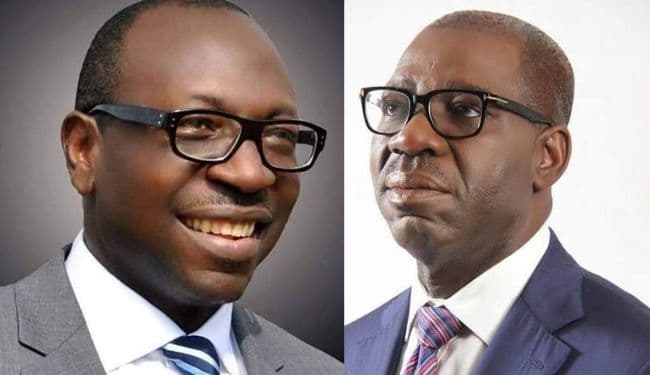
Of the 14 political parties, the candidates of which are jostling for the top job in the state, two parties can be said to be really in the race in a true sense of the word. One of these parties is the People’s Democratic Party (PDP) on the platform of which the incumbent Governor, Godwin Obaseki is seeking re-election. The other is the All Progressives Congress (APC) that is being represented by Osagie Ize-Iyamu.
In the past few weeks since the two major parties launched their campaign, the polity appears to be overheated by the manner of their electioneering and the rhetoric that has caused some goose pimples.

Alarmed at the level of apprehension in the state, the Oba of Benin, Oba Ewuare II last week, urged politicians to place life above ambition.
The Benin Monarch, who said no life is worth the election, appealed to Edo people to eschew election-related violence, and not to sacrifice their lives for greedy politicians.
“All those who want to turn the state into a battleground, the law of karma will visit them one by one, he added.
Why Edo election is interesting
The way the candidates of the two most powerful parties in the state emerged makes the election interesting. The two candidates swapped positions. Whereas Obaseki who contested on the APC platform in 2016 now bears the PDP flag; Ize-Iyamu who was the PDP candidate then is now the APC standard bearer.
Moreover, supporters and arch-rivals have also changed positions, starting with Adams Oshiomhole, who now sells the same project he had variously described as fake in 2016.
When the last gubernatorial election held in Edo, PDP saw Obaseki as an unqualified person to govern the state; they projected Ize-Iyamu and swore that he would be the best thing that could happen to the state if he won. It was with the same eyes that the APC supporters then saw Obaseki and vested their goodwill in him. Today, the candidates have swapped parties, the leadership of the parties and their supporters are singing new songs.
Huge crowds, name-calling and finger-pointing at campaign venues
As expected, the two candidates have continued to draw supporters, with huge crowd at campaign venues. Various groups have also lined up behind the aspirants. As it is also usual in politics and in the spirit of the game, there are many professed supporters, who indeed play double-standard roles- they declare allegiance to Obaseki in the day, but at night they dine and wine with Ize-Iyamu, revealing all the secret strategies of the PDP candidate, and vice versa.
The state is already charged with threats, allegations and counter allegations of planned violence and certain electoral malfeasance. The INEC and the security agencies, particularly the Nigeria Police, have been put on notice. Several groups have tasked parents on the need to prevail on their children not to yield themselves as cannon fodders to politicians and their political parties.
Reports of violent skirmishes have been widespread since the commencement of the state-wide electioneering campaign. The state is so charged at the moment that there are all sorts of interpretations, misinterpretations and imputations of motives; even on sincere and innocuous motives.
Statements made yesteryear are now serving as campaign jingles, and billboards are being made of campaign rallies of 2016 where what was said yesterday, testimonials, endorsements and gyrations have been latched on to shame the opponent and friends of yesterday that have become political arch-enemy today. Edo is on political fire, and what matters most is not integrity but the trophy. The unfortunate principle of “The end justifies the means” appears to be the mantra at the moment. Saturday, September 19 is a deciding moment.
Obaseki vs Ize-Iyamu’s manifestoes
Beyond the tough talks and finger-pointing, Obaseki and Ize-Iyamu are however, wooing the electorate with their individual policies aimed at improving the lots of Edo people.
In 2016, the political manifesto of the incumbent governor, then, on the platform of APC was, ‘Let’s Together Take Edo Further’ while that of Ize-Iyamu was ‘The SIMPLE agenda’. Today, Governor Obaseki’s manifesto has changed to ‘Making Edo Great Again (MEGA), while that of his opponent still remains, ‘The SIMPLE agenda’.
At the unveiling of his programme for his second term bid titled, ‘Making Edo Great Again’ (MEGA) in Benin City, Governor Obaseki said that his second tenure would prepare the state for a post-coronavirus (Covid-19) while focusing on improving governance to transform the lives of the people.
The All Progressives Congress (APC) candidate, Ize-Iyamu on the other hand, described his ‘SIMPLE agenda’ acronym as a manifesto of hope which represents Security and Social Welfare, Infrastructural Development/Urban Renewal, Manpower Development and Training, Public Private Partnership (PPP), Leadership by example and Employment Creation and Social Empowerment Scheme.
In his 12-point agenda crystallised into MEGA, Obaseki said his blueprint for “Making Edo Great Again” is a development-oriented programme of progress for Edo State with an eye on the future.
The governor said the MEGA manifesto is a public declaration of policy for the progress and sustainable development of Edo State.
“I am confident that my re-election for a second-term as the Executive Governor of Edo State from 2020 to 2024 will consolidate the transformation of the state through policies, projects and initiatives aimed at making Edo State an investment hub,’ he said.
According to Obaseki, “This policy document is my present declaration to consolidate the foundation of my first term as Governor from 2016 to 2020 in providing leadership and vision for engagement and consensus building in planning, executing and evaluating state development initiatives and their outcomes.
“We would ultimately create a system that would, at the end of eight years, imbue a strong, indelible Governance Culture that will stand the test of time and make our people proud of their state once more.”
The governor outlined his 12-point MEGA Agenda thus: Social Sector (Education, Healthcare System, Pension and Social Security, Housing, Lands and Surveys), Critical Infrastructure and Energy, Economy and Industralisation, Trade and Investment, Environment and Public Utilities, Peace and Security, Agriculture and Natural Resources, Public Service, Public Finance and Public Revenue, Women, Children, Youth and Sports, Law, Judiciary and Legal Reforms, Chieftaincy and Religious Affairs, Arts and Culture, and Transport.
Social Sector,
Education: To ensure that the EdoBEST policy continues to concentrate on training and retraining of teachers in equipping them for effective learning management systems, which addresses the needs of our children from early childhood up to the Junior Secondary School level. To continuously provide and maintain existing facilities for enhanced teaching and learning in our educational institutions. To continuously encourage science and technology education, including information and communication technology and entrepreneurship, to continue to provide the enabling environment for cutting-edge innovations and technology. Build more technical colleges, and develop and promote technical vocational education to create skills for the emerging Edo State trade and industry. To continuously encourage private sector investment in education at all levels, and the standards for enhanced quality will be maintained by government’s policy.
Healthcare system: The governor pledged to provide world-class medical services infrastructure to make Edo State a medical tourism destination, and continuously improve and expand access to basic primary healthcare. To consolidate on quality and affordable healthcare for all Edo citizens through Edo State Health Insurance Scheme (EHIS).
Pension and Social Security: We will embark on: Continuous alleviation of the plight of pensioners through prompt payment of pension, retirement benefits and gratuities; sustenance of the existing prompt data-capturing of retirees into the pension group; strengthening the existing contributory pension scheme and guaranteeing quick payment after disengagement from the Edo State civil service; promoting and sustaining the social welfare of our retirees through social intervention as senior citizens of the state, and sustaining the on-going special interventions to support the vulnerable groups (people with physical disabilities and special needs in the society).
Housing, Lands and Survey: Development of industrial park, logistic ms park, housing estate, leisure centres across the three Senatorial districts of Edo state. Development of affordable modern housing and increasing access to financing and promoting a residential mortgage market in Edo state. Sustaining and improving the on-going digitalisation in the use of land (EDO’GIS). Proper mapping and survey of community lands to forestall conflicts between communities.
On Critical Infrastructure and Energy, the PDP candidate, said: “In line with the vision to ensure sustainability of our priced hard infrastructure assets, we would empower the Edo State Facility Management Agency, which was recently set up, to maintain the facilities and ensure that they retain their structural integrity for a long time to come.” He also promised to facilitate industrialisation through strategic infrastructure of the Benin port, Gelegele sea port and industrial park. Massive and continuous improving of the network of urban and rural roads across the state. Creating access to clean and safe water supply (as demonstrated in the Uromi water project). Provide access to electricity as seen in the on-going 55MW Ossiomo power project and the 450MW Edo Azura Power Plant.
The governor’s plan on the Economy, Industrialisation, Trade and Investment, is to focus on providing support for the development and growth of local industries; continue to vigorously promote micro, small and medium-scale enterprise through low-priced loans and financing; provide special focus on the ICT sector and aggressively marketing Edo as an outsourcing destination. He also wants to deepen relations with development partners, portfolio investors and long-term investors for the overall transformation of the state, and also attract mass investments in electricity and alternative energy solutions.
Environment and Public Utilities: Intensify awareness and sensitisation of Edo citizens on environmental pollution and clean environment for everyone. Tackle flooding and erosion across the state through legislation and executive order. Beautify and remodel our environment and public space. Develop and build capacity in waste management and facilitate alternative sources of energy and recycling of waste. Conserve public utilities, create amusement parks across the 18 local governments of the state.
Peace and Security: To continue to foster culture of peace by promoting and creating convivial milieux that accommodate our religious, ethnic and cultural preferences/diversity. Continue to tackle insecurity in all rural and urban areas through community watch/policing. Continuously Safeguard lives and properties through upgrade and effective fire service delivery. Sustain and improved Edo State Security Trust Fund to keep up and respond to current security challenges. Guarantee the continuous protection of the vulnerable (women, children, senior citizens and the physically challenged). Boost citizens’ confidence by clamping down on extortion and harassment by law enforcement agents and members of the state-sponsored security agencies. Sustain and expand Wabaizigan, with a state-wide Central Closed-Circuit Television Unit (CCTV) installed to ensure a more robust approach to policing.
Agriculture and Natural Resources: To sustain and expand the aggressive agriculture and agribusiness development programme that has provided over 150,000 jobs for Edo citizens. Replace crude oil with oil palm and make Edo State an oil palm hub in the country and beyond. Further explore our vast forest and solid mineral resources.
Public Service, Public Finance and Public Revenue: To improve public service delivery through continuous civil service reform. Increase commitment to revenue drive and judicious utilisation of tax payers’ money. Pursue professionalism through training and retraining of our civil service.
Women, Youth and Sports: To continue to encourage the participation of women and youth in governance by increasing the number of appointments made to women and youth in government. Improve access to microfinance for women and youth. Encourage girl learning in science, technology, engineering and mathematics disciplines. Continue to engage the youth in meaningful and productive ventures.
Law, Judiciary and Legal reforms: To continue to strengthen the Criminal Justice System with initiatives targeted at promoting a workable system for the interpretation of the law, determination of disputes and punishment of offenders. Continue to give priority to the welfare and well-being of our judges/judiciary to facilitate and enhance speedy dispensation/delivery of justice. Continue to create conducive work environment for judges and judicial workers. Continue to support the strengthening and implementation of the law for crimes against women and girl-child including domestic violence and other legal commitment for social justice.
Chieftaincy and Religious Affairs: To continue to promote cordial relationship between government and traditional institution. Continue to support traditional councils and empower them to carry out their functions in the formulation of general proposal by way of advice to the government, and assisting in the maintenance of law and order. Harmonise the activities of the traditional councils to support preservation of our heritage. Support and assist traditional institutions in promoting local traditional festivals so as to revive the culture of our people. Build on the cooperation and support we have enjoyed from our religious and faith-based organisations in the past four years for continued pace and prosperity for Edo people
Arts and Culture: To continue to promote the development of arts and crafts and raise our artists and craftsmen to international recognition. Conserve cultural heritage sites, reintroduce culture clubs to public schools and advance plans for the development of the Benin Royal museum. Attract and support investors in the development of culture and tourism for the benefit of host communities
Transport Sector: Action on the Benin Central Bus Terminus would be expedited and the accompanying paraphernalia installed to make for a truly modern transportation network. The centrally channelled traffic would ensure that traffic management is well coordinated, even as other forms of transportation are explored for their workability in the state. Comprehensive overhauling and revamping of the Edo transport system. Remodelling and repositioning of the Edo State transport service for efficient service delivery, and building of travel plaza in strategic locations within the state.
Obaseki explained that the post-Covid-19 economy will task his government’s resolve to restart the economy even as he push for economic stimulus package to resuscitate businesses, sustain livelihoods and hold the economy together.
He further explained that under the post-Covid-19 economy, focus would be on supporting businesses with low interest loan facilities; strengthening the productive sector by prioritising the Edo Production Hub Initiative and pursuing more impactful policies in the agricultural sector.
Ize-Iyamu’s SIMPLE agenda
Ize-Iyamu, who said he has never hidden the fact that the primary objective why people are in politics is to access government for the benefit of the people, noted that the people of Edo State are confident that the APC offers the best platform to represent them in a bid to pursue and actualise their interest.
The APC candidate said having analysed the current challenges facing the state, consulted widely across the 18 Local Government Areas, and on the basis of the party’s manifesto, he decided to come up with a robust blueprint to launch Edo State on the path to sustainable prosperity and holistic development.
According to him, “Ours is a genuine road map to transform our state from its present unacceptable condition of underdevelopment to an attractive state with a vibrant economy. We have a blueprint, code-named the ‘SIMPLE’ Agenda.
“Any government that intends to bring real development and prosperity to its citizens must focus on a comprehensive and sustainable development that encompasses several aspects including improvement of infrastructure, health, education, human resource development, job creation, industrialisation, agriculture, security and improvement of municipal services such as the provision of water and electricity.”
Ize-Iyamu further said: “We shall use the ‘SIMPLE Agenda’ to bring economic and social justice to all, irrespective of political, religious or ethnic inclinations.”
He emphasised that the ‘SIMPLE’ policy and programmes are projected to create over 70,500 jobs within a period of four years, noting that if elected governor, the jobs would be created in education, agriculture and rural development, housing, electrification, fire service, industrialisation, waste management system, employment creation and social empowerment, and water supply sector.
The governorship candidate gave the breakdown of the jobs to be created in each sector to include 2,000 direct jobs in electricity-dependent industries and assistance in creating over 1,000 new businesses in rural areas.
He said in water supply, not less than 10,000 new construction jobs would be created and over 3,000 jobs safe-guarded over a four-year period while over 3,000 new jobs would be generated from fire service and 5,000 existing jobs would be safeguarded in the sector.
He posited that in the housing sector 10,000 additional new construction-related jobs are projected to be added to the state economy and 10,000 sustainable new jobs in the education sector.
He further added that a total of 3,000 additional direct jobs and the sustenance of over 5,000 related jobs projected to be added to the state economy through resuscitation and revamping of state-owned moribund industries.
Ize-Iyamu explained that over 10,000 physically challenged and economically disadvantaged persons would be empowered in the first one year in the micro credit scheme to be set up by the government.
On employment creation and social empowerment programme, the APC candidate said over 3,000 direct and 5,000 indirect jobs are projected to be generated by service providers in the waste management system under the Public- Private Partnership industrial schemes.
According to him, the goal of SIMPLE agenda is to generate jobs from programmes, projects and activities in each of the 18 local government areas.
“For the Public-Private Partnership (PPP) industrial schemes in each of the senatorial districts, it is reckoned that each of the clusters should be capable of accommodating up to 10 separate industrial firms and would give direct employment opportunities to well over 3,000 persons and another 5,000 persons indirectly, providing the raw materials, goods and services across the state.
“It is also planned to attract over 5000 persons to the Farm settlement, while at the same time, Youth Empowerment through Agricultural and Farmer’s Support Programme (YETA-FSP) will be established to support 500 youths from each of the 18 LGAs every year.
“Our government will partner with stakeholders, banks and financial institutions to resuscitate and revamp the state-owned industries including the fertilizer plant, Auchi, Cassavita industry, Uromi, Ava cement factory, Akoko-Edo, fruit juice factory, Ehor, Bendel Brewery, Benin City and Ewu flour mill among others,” he said.
He added that in addition to the over 70, 500 jobs, his government will partner with financial institutions, banks, agencies of government and stakeholders to create and support a minimum of 5,000 new Micro, Small and Medium Enterprise (MSMEs) in the economy yearly and 20,000 over a period of four years.
The candidate however, promised to review the Benin Storm Water project to ensure its completion within a reasonable period, to address the problem of perennial flooding in the state capital.
ADC wants to ‘change Edo story’
Mabel Oboh, one of the two female candidates, is contesting on the platform of the African Democratic Congress (ADC). In her manifesto, tagged, ‘Change Edo Story’, she is promising massive industrialisation; Education; massive job creation through investment in Agriculture; youth and women development; healthcare reform; infrastructure development; security- community policing, and culture, creative arts and tourism.