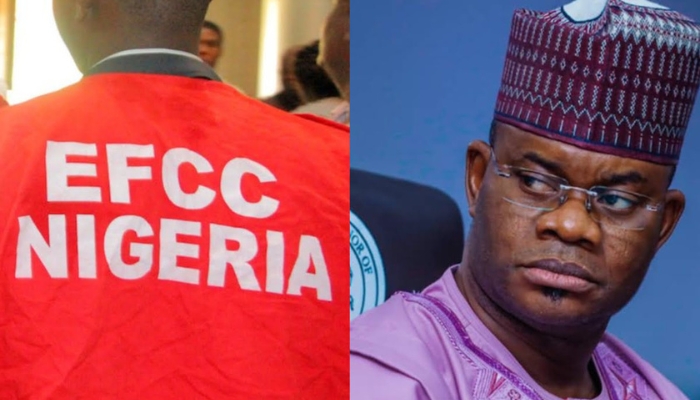
The Federal High Court in Abuja has adjourned the trial of former Kogi State Governor Yahaya Bello to June 26, 27 and July 4 and 5 for ruling on a legal move by the Economic and Financial Crimes Commission (EFCC) to cross-examine its own witness, Nicholas Ojehomon.
Justice Emeka Nwite gave the adjournment after hearing arguments from the prosecution and defence on the propriety of the EFCC’s request, which the defence challenged as inconsistent with legal procedure.
Ojehomon, an internal auditor at the American International School, Abuja (AISA), had previously testified that no payments were received from the Kogi State Government or any of its local government councils for school fees allegedly linked to Bello. He also affirmed that his testimony neither implicated nor cast any aspersions on the former governor.
Following the conclusion of cross-examination by Bello’s counsel, Joseph Daudu, the EFCC’s lead counsel, Kemi Pinheiro, sought to “cross-examine” the witness based on Exhibit 19—a judgment earlier admitted into evidence.

“I am not re-examining him, I am cross-examining him because they brought this document,” Pinheiro told the court.
Daudu objected, arguing that the prosecution could not cross-examine its own witness without first declaring him hostile. “If you want to cross-examine your own witness, you have to first declare him a hostile witness. You cannot cross-examine him based on the document,” he said.
Pinheiro countered, invoking Section 36 of the Constitution on the right to fair hearing. “Fair hearing demands that the complainant too has the right to examine this because Section 36 of the Constitution talks of fair hearing,” he said.
Justice Nwite then asked, “Do you have any provision of the law to support this?”
After listening to both sides, the judge ruled against allowing a cross-examination and insisted the prosecution could only re-examine the witness. “You can re-examine him on that but not to ask questions that will show cross-examination,” he ruled.

However, as Pinheiro began re-examination, his line of questioning again appeared to veer into cross-examination territory.
Daudu raised another objection, prompting the court to demand formal addresses from both parties on the legal propriety of the prosecution’s approach.
“The procedure that is being sought by the prosecution… amounts to a strange and unknown procedure not covered by the Evidence Act,” Daudu stated.
In response, Pinheiro cited precedent, arguing that in the case of Amobi v. Amobi, the Supreme Court had faulted a trial judge for refusing to allow re-examination on an exhibit introduced by the defence.
“Having brought it in now… particularly during the cross-examination of PW-3, your lordship should not allow them to shut us out as that would amount to the court allowing them to blow hot and cold,” Pinheiro said.
Justice Nwite reserved ruling and adjourned the trial to June 26, 27 and July 4 and 5.