



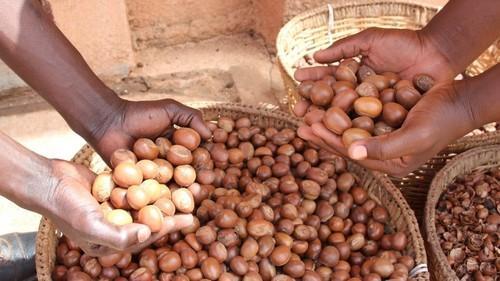
Nigeria’s recent temporary ban on shea nut exports has triggered several reactions across the industry.
With prices falling by 33 percent and stakeholders split over the move’s impact on the economy and livelihoods, experts say that some will be gainers and losers.
While local processors see new opportunities in job creation, stronger value chains and reduced raw exports, the aggregators and exporters warn of crippling losses, with billions of naira already tied up in unsold stock.
“The local processors with installed capacity and those already involved in packaging are the big winners,” said Oluwatoyin Akintayo, global exports director at Wetin Dey Global.

“For years, they’ve been competing with exporters. But with the current ban, they’ll be able to secure local supplies,” he added.
However, experts warn that he policy may impact small businesses.
“Sheanut pickers, farmers, and small businesses or aggregators are not likely to benefit from this ban,” Akintayo noted.
Aggregators, who act as middlemen between pickers and exporters, are bearing the brunt.
In Benue State, for instance, Tsekohol Denison, an aggregator, said he is now stuck with unsold stock as prices dropped from N1,300 to N700 per kilogram within days.

“I have incurred huge losses within days,” he told BusinessDay. “I have over twelve 100kg bags of shea nuts and I can’t sell them at the current price,” he added.
The National Shea Products Association of Nigeria (NASPAN), endorsed the ban but flagged concerns over its sudden timing, noting that it was imposed during peak trading season.
“The decision is valid and justifiable, with huge potential for boosting local processing, curbing informal trade, and empowering women pickers,” said Mohammed Kontagora, NASPAN’s president.
The association also appealed for a 90-day grace period to cushion the impact on traders already tied to export contracts and loans.
“Although the ban is a welcome development, we solicit that aggregators be given a 90-day window to clear ongoing contracts to prevent huge losses they might incur as a result of the sudden ban,” Kontagora said.
Opportunity
Since the European Union (EU)’s 2012 approval of shear butter as a substitute for cocoa butter, global demand has surged, according to Pearlmutual’s 2023 report.
With 70 percent of Nigeria’s arable land suitable for shea cultivation, the sector’s growth potential is immense, analysts say.
Curtis Akunfu, CEO of Duapa Agriculture, one of Africa’s leading agribusiness firms, underscored the economic promise of shea processing across the continent.
“Shea butter fetches five times more profit than raw nuts. Also, there’s high demand for traceable organic products globally,” he noted.
“The ban will protect local processors, create jobs and increase value,” he added.
Akintayo, earlier quoted, emphasised the window of opportunity the ban presents for investors.
“For investors, there is room to set up mini refineries close to supply, finance cooperatives with storage, and build partnerships with global food and beauty brands,” he noted.
Aderemi Apatira, administrative secretary of NASPAN, echoed similar sentiments. She encouraged investors to take advantage of declining shea nut prices by tapping into storage and processing opportunities.
“Investors can cash in on the low price of shea nuts, buying into storage to sell or export later at international market rates, which is more than three times the current prices,” she explained.
“They can also invest in processing facilities that guarantee the quality expectations of the international market and focus on producing butter, which is not banned for exports,” she added.
Read also: Stakeholders say raw shea nut export ban a win for Nigeria, West Africa
Numbers behind the story
Before Nigeria’s export ban on raw shea nuts, a metric ton sold for between N800,000 and N900,000 (approximately $521 to $586).
A ton of Grade A unrefined shea butter commands a significantly higher price, ranging from N3.5 million to N4 million or $2500 to $3600 as of August 2024, a recent data by Tridge says.
Despite producing over 40 percent of the world’s shea nuts, Nigeria captures less than 1 percent of the $6.5 billion generated annually by the global shea industry, according to reports cited by the BBC.
Nigeria produces around 350,000 metric tons of shea nuts annually. Niger State, home to Salid Agriculture—Africa’s largest shea nut processing company—accounts for 60 percent of this output. Other major producing states include: Kwara, Kebbi, Oyo, Kogi, Benue, Nasarawa, Kaduna, and Taraba.
The shea industry is a major employer, engaging more than 2.2 million women in Nigeria and over 16 million women across West Africa, according to the World Trade Organization (WTO) and NASPAN reports.
“It is estimated that women make $237 million in direct income from shea annually,” the WTO report noted.
Women also account for up to 95 percent of shea nut pickers in Nigeria, sources say.
To boost local value addition, NEXIM Bank has supported at least seven processing plants nationwide, NASPAN noted.
However, the recent ban on raw shea nut exports has had an immediate economic impact. Just days after the policy took effect, prices plummeted by 33 percent, according to Bloomberg, which noted: “Exports kept the market vibrant, as local demand lags far behind supply.”
Nigeria and the world
Nigeria is the leading sheanut producer globally, accounting for over 40 percent of total supplies, while generating billions of naira.
However, Ghana leads globally in shear butter exports, generating over $92 million in 2022, according to the WTO reports. Other shear butter exporting countries include: Mali, Ivory Coast and Netherlands.
Nigeria’s sheanut exports value declined by 21.5 percent between the last quarter (Q4) of 2024 to the first quarter (Q1) of 2025, according to recent trade data.
Besides owning the largest share of sheanut trees (57 percent) globally, Nigeria’s sheanut trees have the highest stearin content , making it a highly sought after commodity globally.
About 90 percent of these shearnuts are exported while only 10 percent is processed locally, leaving other countries capture the real value, experts say.
Other countries like Burkina Faso, Togo, Ghana, Mali and Ivory coast have also imposed bans on raw sheanut exports.
China is the leading importer of sheanuts globally.





