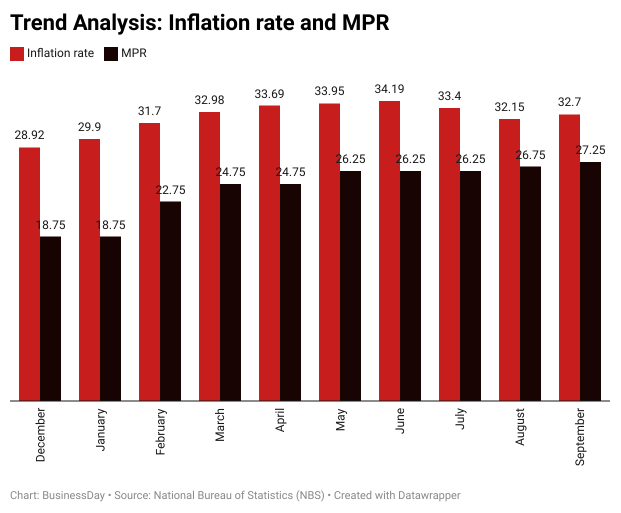
With inflation reaching 32.7 percent in September 2024, Nigeria’s economic challenges are becoming harder to ignore. The Central Bank of Nigeria (CBN) has responded with an aggressive series of rate hikes, increasing the Monetary Policy Rate (MPR) by 850 basis points this year. Yet, the impact on inflation has been limited, raising concerns about the effectiveness of this strategy.
Despite these drastic measures, inflation remains stubbornly high. While there was a brief dip in July and August, prices have continued to rise, especially for essentials like food and fuel. This raises critical questions about whether relying solely on interest rate hikes is the right approach.
Many Nigerians are feeling the squeeze. Higher borrowing costs and rising living expenses are pushing more people into financial hardship. Is there a better way to manage inflation that addresses the root causes without placing the burden primarily on ordinary citizens?
Inflation and the Nigerian reality

Nigeria’s inflation crisis is evident in the everyday struggles of its citizens. Soaring prices, especially for essential goods like food and fuel, have strained household budgets, while wages remain stagnant. The CBN has raised the MPR—the rate at which banks lend to one another—in the hopes that making borrowing more expensive will reduce spending and ultimately curb inflation.
This strategy, while theoretically sound, has had severe consequences. For a country where many already struggle to make ends meet, higher borrowing costs have stifled both individual and business growth.
Small and medium-sized enterprises (SMEs), in particular, find it harder to access loans, leading to reduced investments and hampering their ability to expand. The average Nigerian also faces higher borrowing costs, deepening financial strain.
A Business Expectations Survey (BES) conducted by the CBN between September 9 and 13, 2024, sheds light on the challenges Nigerian enterprises face.
From the 1,750 businesses surveyed, 98 percent reported significant difficulties. Among the major hurdles were insecurity, high interest rates, multiple taxes, and unclear economic regulations.

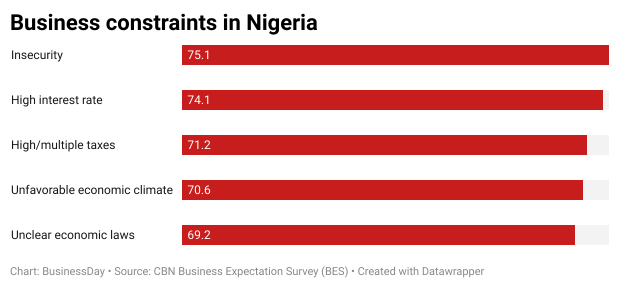
The high cost of borrowing, in particular, was seen as a significant barrier, complicating efforts to boost business activity and ultimately undermining efforts to combat inflation.
The limits of monetary policy
“Nigeria’s approach to raising the MPR was deliberate, with incremental adjustments aimed at avoiding economic shocks,” explains Abdulbasit Shuaib, a finance expert. “While this approach was meant to curb inflation, it has placed a heavy burden on ordinary Nigerians and small businesses.”
Shuaib advocates for a more balanced approach that goes beyond monetary policy. According to him, combining interest rate adjustments with supply-side interventions could offer more sustainable results.
Investing in infrastructure would reduce production and transportation costs, easing inflationary pressures. Additionally, modernising the agricultural sector and addressing insecurity in farming areas could stabilise food prices, further easing inflation.
Structural issues driving inflation
Despite the aggressive interest rate hikes, inflation persists. As Oyekan Idris, a capital market analyst, points out, structural issues—such as flooding, low productivity, insecurity, and the removal of energy subsidies—are contributing to inflation more than the money supply alone.
“The CBN’s 12 consecutive MPR hikes, from 11.5 percent in March 2022 to 27.25 percent in September 2024, have had mixed results. While month-on-month inflation figures have shown some progress, year-on-year inflation remains high, suggesting that merely raising interest rates isn’t enough,” Idris explains.
He warns that if the CBN continues with this course, it could do more harm than good. Higher interest rates may fuel cost-push inflation, where businesses pass higher borrowing costs onto consumers, further exacerbating the inflation crisis.
A new path forward
Experts argue that a more comprehensive strategy is needed. Instead of relying solely on rate hikes, Nigeria could benefit from a consolidation of monetary and fiscal policies. For instance, adopting a countercyclical fiscal policy could help the government manage its budget deficit and rising debt levels.
Additionally, improving agricultural productivity through better security and subsidising agricultural inputs would boost food production and ease inflationary pressures.
Increased oil production and improved security in the Niger Delta would also alleviate pressure on the naira, boosting foreign exchange earnings and stabilising the currency.
Learning from other countries
Nigeria isn’t alone in facing inflationary pressures. Several countries have adopted innovative strategies to tackle inflation while safeguarding their economies. By looking at these examples, Nigeria could develop a more comprehensive approach.
United States
In the U.S., the Federal Reserve has employed interest rate hikes while balancing fiscal measures to control inflation. As of October 2024, the federal funds rate stands at 4.75 percent -5 percent, following a 50 basis point reduction in September.
Alongside this, the U.S. government has made significant infrastructure investments and introduced stimulus packages to support economic growth while controlling inflation, which currently stands at 2.4 percent. The U.S. model shows how targeted fiscal measures can complement monetary policy to sustain economic recovery.
India
India has effectively combined monetary policy with supply-side interventions. The Reserve Bank of India (RBI) has maintained its repo rate at 6.5 percent as of October 2024, while the government has invested in agricultural infrastructure and reforms to increase productivity. Inflation in India is relatively low at 5.49 percent, demonstrating the importance of addressing the structural drivers of inflation in tandem with interest rate adjustments.
Kenya
Kenya’s approach to inflation control has focused on protecting its most vulnerable citizens. As of October 2024, Kenya’s inflation rate stands at 5.7 percent, largely due to the government expanding social safety nets, including cash transfers for low-income households.
By directly supporting those most affected by inflation, Kenya has managed to stabilise living costs while implementing broader economic measures.
A call for broader economic reforms
Nigeria’s inflation problem cannot be solved through interest rate hikes alone. The country needs a broader, more comprehensive strategy that balances monetary policy with structural reforms and targeted fiscal measures. These reforms should aim to boost productivity, ease business constraints, and stabilise the economy in the long term.
Addressing insecurity, improving infrastructure, and enhancing agricultural productivity are crucial steps in this process. At the same time, the CBN should work closely with the government to implement policies that support growth while keeping inflation in check.
While the CBN’s interest rate hikes may have slowed the growth of inflation, they are not a long-term solution. A more holistic approach is needed—one that takes into account the structural factors driving inflation and provides relief for businesses and households struggling to cope with rising prices. Only through coordinated efforts can Nigeria hope to achieve economic stability and protect its citizens from further hardship.
Oluwatobi Ojabello, senior economic analyst at BusinessDay, holds a BSc and an MSc in Economics as well as a PhD (in view) in Economics (Covenant, Ota).