Nigerians living in Canada experience the dilemma between the overwhelming longing for home, and a desire for better economic opportunities.
With that in mind, their relocation into a country such as Canada comes with its own set of challenges; for example, the change in weather, culture shock and the economic responsibilities can be more challenging than anticipated.
Notably, Canada affords migrants numerous opportunities which includes access to quality education, healthcare and a safe environment. In search of this lifestyle, most Nigerians have taken advantage of the Canadian government’s immigration-friendly policies such as Express Entry which draws in skilled workers and students alike.
The top five motivating ‘push factors’ for Nigerians seeking migration opportunities to Canada are, “the search for better career opportunities (75 percent), heightened insecurity and violence (60 percent), the desire to provide a better future for their children (55 percent), for further education (40 percent), and perceived poor governance in Nigeria (35 percent),” states the AFI report.

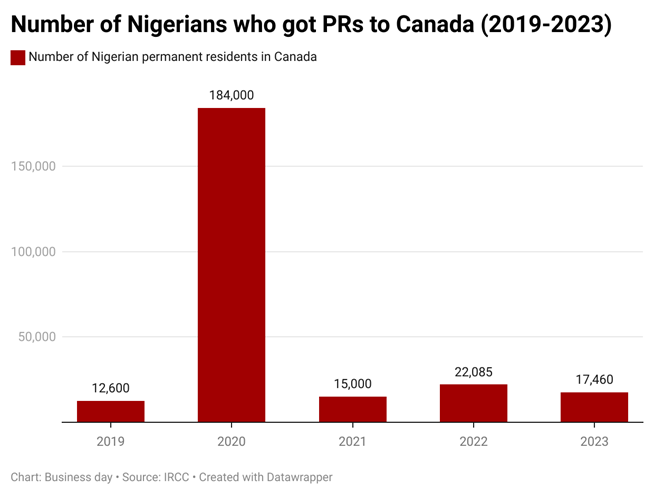
According to data from Immigration Refugees and Citizenship (IRCC), in 2019, 12,600 Nigerians obtained permanent resident (PR) status in Canada. Due to COVID-19 restrictions on travel in 2020, 184,000 Nigerians were granted PR status. In 2021, over 15,000 Nigerians were accepted as immigrants to Canada on the basis of PR status. By 2022, Nigeria was the fourth largest source of immigrants to Canada with 22,085 new Nigerian immigrants. In 2023, Canada gave out 17,460 new PRs to Nigerians. In the first quarter of 2024, 4,690 PRs were granted to Nigerians.
Figures for Q1 2024, indicates that 4,690 Nigerians obtained PR.
Why Nigerians relocate to Canada
Many individuals relocate to Canada to enhance their standard of living, as the country secured third place in both quality of life and overall best country rankings. These rankings are bolstered by factors such as its economic stability, income equality, job market health, safety, political stability, and the quality of the education and public health systems.
From December 2022 to April 2023, Canada’s unemployment rate remained steady at 5 percent, reflecting a robust job market. The country’s employment prospects are particularly strong in sectors like healthcare, education, engineering, construction, and agriculture, which face acute labour shortages.

In terms of safety, Canada ranks as the seventh safest country globally and is placed twelfth on the Global Peace Index 2022.
Healthcare in Canada is publicly funded and managed at the provincial or territorial level, covering routine check-ups and essential medical treatments. Residents may need to pay out-of-pocket for non-essential procedures, medications, vision, and dental care, often through private insurance or employer plans.
Public schooling is free for children aged five to eighteen, while permanent residents and citizens benefit from subsidised tuition fees in higher education institutions, in contrast with international students.
Canada has a robust social services system, including the Employment Insurance (EI) programme, which provides temporary financial support to individuals who have lost their jobs or are unable to work due to circumstances such as pregnancy or illness.
The reality of life in Canada
However, the reality of life in Canada can be harsher than expected, as the cost of living in Canada is notably high and can vary depending on the city, family size, and lifestyle. For many, it represents a considerable increase from the average living expense in Nigeria.
A Nigerian man who relocated back to Nigeria from Canada, had this to say,
“Canada was enjoyable, but there’s freedom and happiness here in Nigeria. I went to Canada with my wife and two children….Going back to Nigeria was the best decision for our future”.
“People often believe living in Canada means success, but the reality can be different. If you compare everything you spend with your income, you’ll find yourself struggling to meet both your family’s needs and wants. You can’t live the same way as you did back home”.
“Do you have more peace of mind in Canada or Nigeria? I recently told a friend I’ve been sleeping well for the past three days, not realising how much sleep I needed. In Canada, you often sleep tired and wake up tired”, he said.
Stories of Nigerians facing homelessness and financial struggles are not uncommon. The high cost of living, especially housing, can be a significant burden. This economic hardship can lead to feelings of isolation and longing for the familiarity and support of home.
A significant portion of Canadians allocate between 30 and 50 percent of their monthly income towards accommodation-related expenses. In Toronto, for instance, the average rent for a one-bedroom apartment can reach up to $2,500, while a two-bedroom apartment might average around $3,300 as of April 2023.
For instance, according to Pearson’s student guide, here is the average cost of accommodation::
| City | On-campus housing cost (CAD) | One-bedroom apartment cost (CAD/month) |
| Toronto | $6,500-$20,500 for 8 months | $2,100 |
| Vancouver | $10,700-$13,850 for two terms | $2,050 |
| Montreal | $9,700-$12,700 for academic year (without meal plan) | $1,300 |
| Halifax | $8,130-$9,450 for academic year (with meal plan) | $1,400 |
| Waterloo | $6,700-$7,000 for fall and winter term (not including meal plan) | $1,500 |
Income tax in Canada is collected at both the federal and provincial levels, with federal tax rates ranging from 15 to 33 percent. Provincial tax rates for residents in the highest income brackets can be as high as 25.75 percent. The higher one’s income, the greater the tax liability.
For example, someone residing in Ontario with a pre-tax income of $85,000 per year would have an estimated tax liability of $17,400 (20.4 percent) for 2023.
Another issue is the weather. Nigerians in Canada have expressed mixed feelings about the country’s extreme cold weather. Canada is renowned for its severe, snowy winters, with temperatures below zero degrees Celsius common across most parts of the country. In many cities, temperatures often drop to -20 degrees Celsius. This in itself can cause moodiness, depression and loneliness.
For newcomers, certain comforts and conveniences that are more affordable back home, such as cleaners, nannies, hairdressing services, or handyman services, can be quite expensive in Canada.
While there are many opportunities in places like Canada, there are the irreplaceable aspects of living in Nigeria.