…As nation joins others to mark 2025 World Teachers Day
Amidst crumbling infrastructure, meagre salaries, overwhelming workloads, and a lack of professional support, Nigerian teachers continue to carry the weight of the country’s future on their shoulders.
Despite their critical role in shaping minds and driving national development, they are often treated as afterthoughts in policy and public discourse.
In the 2025 budget, President Bola Tinubu allocated N3.52 trillion to education; and earmarked N1.64 trillion for personnel costs, teacher salaries included.

However, that was not enough, because to meet the requirement of paying all 2.3 million registered teachers at a N70,000 minimum monthly wage, the government would need about N1.93 trillion just for salaries.
That leaves a shortfall of N290 billion, which simply suggests the government intentionally had planned that some teachers would not be paid fully and/or on time.
Many teachers receive salaries that are not commensurate with their workloads or qualifications; there are reports of months of unpaid salaries. Some teachers are paid a monthly salary as low as N25,000 to N50,000, in a country where the national minimum wage is N70,000 and the cost-of-living-crisis has deepened and made a nonsense of the minimum wage.
Worst still, these teachers live in societies where the cost-of-living is at 20.12 percent as shown in August CPI numbers. A loaf of bread is at N1,500 in many Nigerian cities, and house rents have tripled, among other cost-of- living crises.
Jessica Osuere, chief executive officer at RubiesHub Educational Services, reflecting on the fate of teachers in Nigeria, said, despite the many challenges teachers continue to demonstrate resilience, creativity, and an unwavering commitment to their students.

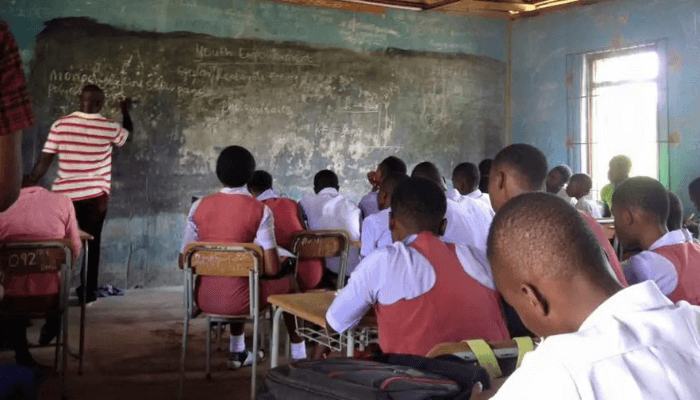
Unfortunately, she emphasised that many teachers still work under very difficult conditions, such as low pay, poor welfare support, overcrowded classrooms, and limited opportunities for professional growth.
Gift Osikoya, a teacher, said October 5, being World Teachers’ Day is a reminder of how central teachers are to the progress of any nation; but in Nigeria, this noble profession is often undervalued.
Read also: Side hustles Nigerian teachers can engage in amid biting economic crisis
“Teachers are nation-builders, they shape young minds, instill values, and equip future leaders with the knowledge and skills to thrive.
“Unfortunately, the reality for many Nigerian teachers is discouraging. Low remuneration, delayed salaries, overcrowded classrooms, lack of modern teaching aids, and limited opportunities for career growth have weakened the profession and, in turn, our education system,” she said.
Similarly, Isaiah Ogundele, a school administrator, describes teaching in Nigeria as discouraging due to the government and societal attitudes towards the profession.
“The government is not paying teachers well, and they’re not recongised as professionals like doctors, lawyers, and engineers, among others, unlike in advanced countries where teachers are held in high esteem,” he noted.
In 2023, UNICEF reported an average pupil teacher ratio of 124:1, especially in states such as Borno, Yobe, and Adamawa. In many public primary schools in Ogun State, the average pupils’ teaching ratio exceeds the national average.
Many primary schools in Nigeria, especially in rural communities suffer teaching input deficits as only about 54.8 percent of primary schools have the minimum teaching materials, 38.2 percent of pupils had a Mathematics or English textbook. About 38.3 percent had accessible toilets, 27.4 percent had clean ones.
Teachers’ roles in sustainable development
Experts believe that Nigeria needs to enhance its education quality in order to achieve sustainable development goals in 2030. And to achieve that, teachers’ roles cannot be overemphsised.
Ogundele had this to say, “Teaching job is the root of all other professions in the world. Teachers should maintain their dignity; they should not get involved in corruption.
“Besides, the government should prioritise teachers’ welfare and treat them like doctors and lawyers.”
The way forward
Experts believe that the government should prioritise teachers’ welfare, and continuous training, among other things.
Elizabeth Ohaka, a school owner, speaking on the need for teachers’ welfare, said, “A happy teacher builds a happy student; it is a wholesome teacher who will build a wholesome student. If a teacher is not satisfied with her job, her output will be below average, and when it is below average, it will tell on the output of the students; they won’t be able to be the best.”
Mary Udenta, a teacher, emphasised the need for continuous professional development and retraining for teachers in a fast-changing world. “Access to modern tools from digital resources to well-equipped classrooms, would make teaching more effective.
“Beyond welfare, there must be a cultural shift where teachers are respected, celebrated, and given the honour they deserve,” she said.
She said that for Nigeria to achieve a sustainable educational system that produces graduates with the requisite skills to tackle challenges with its economy, more attention needs to be paid to teacher training.
Chris Nmeribe, a teacher, said, “Training gives teachers the greatest chance of success and sustains them in the face of new challenges. Education is a learning cycle without an end. It is not going to stop after graduation and starting a career. Continuing training helps individuals to continually improve their skills and become more professional at their work.”
A number of other concerned Nigerians who spoke with BusinessDay on condition of anonymity said that the government must endeavour to change the age-long demeaning aphorism that “teachers’ reward is in heaven.”
“We grew up to hear people say that teachers’ reward was in heaven. That cliché as I can call it has continued in Nigeria up till now. Until the government takes a deliberate step to change that, the nation’s education would continue to totter,” a woman, who introduced herself simply as Rhoda, said.