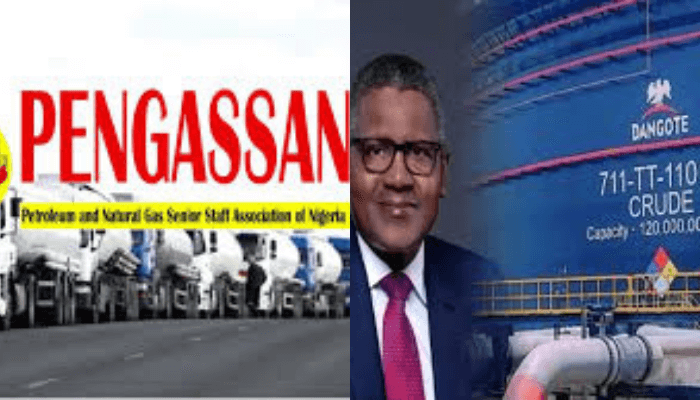
The federal government, through the Ministry of Labour and Employment, began the reconciliation meeting on Monday to resolve the dispute between Dangote Refinery and Petroleum and Natural Gas Senior Staff Association of Nigeria (PENGASSAN).
The meeting was chaired by Muhammad Dingyadi, minister of Labour and Employment, and had leadership of PENGASSAN, Dangote Petroleum Refinery, Minister of Finance and key directors of the Nigerian Upstream Petroleum Regulatory Commission (NUPRC) and the Nigerian Midstream and Downstream Petroleum Regulatory Authority (NMDPRA) in attendance.
In his remarks, Dingyadi said that the meeting was crucial to ensure that the dispute did not have adverse effects on the Nigerian population.
He also expressed shock that the association’s strike was ongoing, leaving oil and gas institutions under lock.

He said, “This is the realisation of the fact that what is happening today is cherished to this country, very dear to our economy. We have been informed that PENGASSAN is on strike, and a very serious one for that matter, because I never knew that they have closed NNPC itself, and other subsidiaries of oil and gas industry.
“I don’t want to make any judgment, but we didn’t know that this is the magnitude of the strike.
“We know that PENGASSAN are very peaceful, and we know for a very long time and we consider them as friends, and people who wish this country well. We also have the same feeling for the Dangote Group as they have been contributing to the economy of this country. They have been doing very well in terms of business relationship with the government of this country.
Read also: Dangote–PENGASSAN tensions may spark new economic threat
“So, we want to make sure that what is happening now is not extended negatively to the people of this country. So, that’s why we are taking urgent steps to ensure that we come in as people who are in the middle of this journey to see how we can resolve this issue.

“We want to resolve these issues amicably, for the good of everybody, for the good of our economy, for the good of the security of our nation, and for the good of our workers, and for the good of our employers as well.”
Impact of rift
The strike action commenced on Monday, affecting activities in some oil and gas institutions, including the NUPRC, NMDPRA, and the Nigerian National Petroleum Company Limited (NNPCL).
Staff confirmed to BusinessDay that they were denied access into their offices upon resumption.
Some filling stations were shut, while Nigerians scrambled to buy gas.
“I bought a litre of gas at N1,250 in Ejigbo as against N1,000 two weeks ago. I could only see gas at only one filling station,” Waheed Odutola, a civil servant, said.
Resolution impact
Sources said the government intervened in the rift to free petrol and gas to households and firms.
Already, petrol and gas were scarce in some areas in Lagos, Port Harcourt, Abuja and other parts of the nation as of Monday.
The nation cannot afford petrol scarcity at this time as it could cripple the economy.
More so, the disruption of petrol supply could trigger imports, pushing marketers to the foreign exchange market.
This could put pressure on the naira and erode recent gains.
The naira on Monday reached an all-time high of N1,476.34 per dollar since the commencement of the Electronic Foreign Exchange Matching System (EFEMS) via the Bloomberg BMatch platform in December 2024.
Between December 2024, when the EFEMS was introduced, and yesterday, the naira appreciated by N184.78, representing a 12.5 percent gain compared to N1,661.12 per dollar at the time of its rollout.