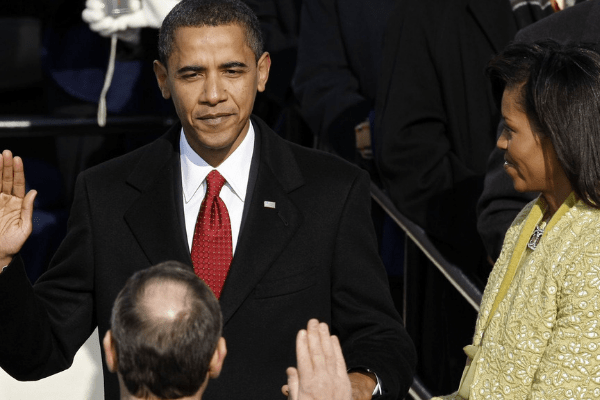
Late in this book of biographical essays, David Runciman discusses how Barack Obama took consolation from the thought that each of us is but a blip in human history. Runciman finds this “a little disappointing”. I would go further — it is a devastating thought that even a man bestowed with such gifts as the former US president might search world history for comfort in his own triviality. What was it all for?
It is also a well-chosen insight in a book full of them, and captures nicely its overall theme: what gnaws at those at the top are not the bad decisions but a stifling sense of impotence. As US President Harry Truman said of his successor, Dwight Eisenhower: “He’ll sit here, and he’ll say, ‘Do this! Do that!’ And nothing will happen.” In Runciman’s words: “the power they had imagined was illusory”.
As a recently departed adviser in Downing Street, these words cut deep. When I took the job, a former colleague teased me about the lack of levers I would have to pull. I spent two years learning what he meant: outside of war, no politician can just order their policies into existence. There are layers of people, laws, money and custom to wade through before anything starts to change. When you take power, you think the point is to have smart ideas; when you leave, all your praise is for the rare officials who just know how to get things done.
So I picked up the book eager, like Mr Obama, for some comforting perspective on failure. Standing above all is the question of character. With a 10,000-year stare, maybe politics can be subsumed into massive impersonal forces but, up close, it is all about personality. This is why political biographies are so avidly read — to find the character flaws behind the events of the day.

Runciman, a professor of politics at Cambridge university with a popular podcast, has read and reviewed many himself. Ranging across leaders from Lyndon Johnson to Donald Trump, he gnaws away at the theory of character as destiny. His book is relentlessly iconoclastic, determined to puncture myths about its subjects’ characters. For example, former British prime minister Margaret Thatcher, far from the unswerving possessor of timeless principles, was made of rather supple stuff, as shown by how quickly she ditched monetarism in the face of a spiralling recession. The lady who claimed she was “not for turning” in fact wobbled between fear of the inflationary disease on one side, and hatred for the high interest rate medicine on the other.
Frequently, our political leaders are found to be in denial about their own virtues. Tony Blair kids himself that he achieved a mastery of delivery in government; the cerebral Gordon Brown, that being bad at Twitter cost him popularity. Even the virtues themselves are doublesided. The legendary intelligence of Bill Clinton led him into pointless explorations of energy deregulation or the minutiae of Israeli elections. Mr Obama’s coolness under pressure morphs into a world-weary acceptance of defeat in the face of a rising populist tide.
Ultimately, the book fails as a dissection of impotence. The author is an unforgiving critic — there are no heroes in these pages — but nevertheless does not display enough failure to sustain a theory.
Between LBJ and Mr Obama, Harold Wilson and David Cameron, we saw the civil rights act, the defeat of inflation, the privatisation revolution, a doubling of spending on the UK’S National Health Service, a Great Depression averted and Osama bin Laden dispatched. This was not all dumb luck. One might pick any number of lenses through which to view the personalities involved, but “people who could not get things done” would be an odd choice.
But this is a niggle in what is otherwise a fantastic read. Furthermore, readers have the benefit of hindsight to judge essays that were written over 10 years. Our standards have shifted in that time. Now, the impotence these politicians felt looks more like a noble failure of high expectations. The people in these pages, until the last chapter, were mostly trying to do the right thing, and sometimes they succeeded. By the standards of today, facing a pointlessly ruinous Brexit on one side of the Atlantic and a needless trade war on the other, that is pretty good.