When Nigerians talk about moving, they rarely start with GDP or budget figures. They talk about roads that do not collapse in the rains, schools where teachers show up, taps that run without generators, and the simple relief of feeling safe after dark.
The 2025 State Performance Index (SPI), published by Phillips Consulting, captures these everyday concerns. Beyond tables of revenue and governance, it asks a blunt question: if you could leave your state, where would you go and where would you avoid? The answers sketch a map of opportunity and neglect across the federation.
Where Nigerians want to live
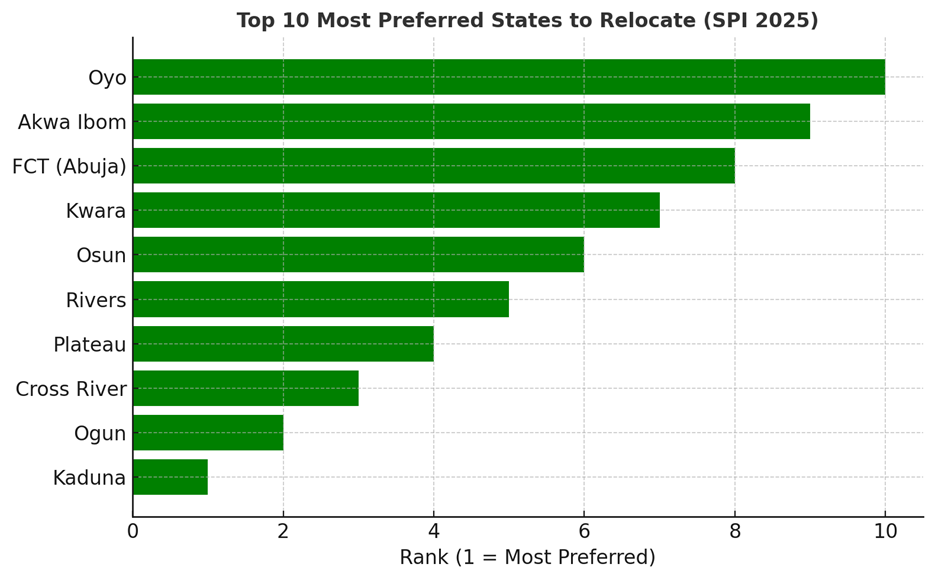
At the top of the rankings sits Oyo, anchored by Ibadan, a city of sprawling suburbs and deep cultural heritage. For many, Oyo offers the space and pace of life that Lagos cannot, while still keeping close to the commercial capital.

Akwa Ibom follows close behind, praised for tidy streets, coastal calm and a government that invests in public works. Abuja, the Federal Capital Territory, retains its appeal through federal jobs and more reliable services, though the cost of living is high.
Other states round out the top ten for different reasons. Kwara and Osun are seen as safe and affordable. Rivers remains an oil-fuelled hub of opportunity in Port Harcourt. Plateau draws families with its cool climate, while Cross River appeals with its greenery and tourism.
Ogun benefits from its industrial estates on Lagos’s doorstep. Kaduna, long a northern powerhouse, keeps its place through roads, schools and relative accessibility.
What unites these states is not size or wealth but a degree of livability. They promise functioning schools, visible infrastructure and a sense of order that Nigerians increasingly value.
Where they don’t


At the bottom of the table sits Zamfara, where violence and weak institutions have made relocation unthinkable. Anambra follows, its commercial clout overshadowed by poor roads and fragile governance. Bayelsa, despite its oil revenues, faces flooding, poor services and high costs.
Borno and Yobe, scarred by insurgency, remain associated with insecurity even as reconstruction efforts continue. Kogi’s central location has not offset its poor services. Abia’s industrious Aba traders work against the odds, but infrastructure drags the state down.
Benue’s fertile land is marred by conflict. Ekiti’s well-educated population struggles with joblessness. Ebonyi, though reforming, still carries a weak reputation.
The thread running through the bottom ten is simple: insecurity and poor services trump resources. Oil wealth or fertile land cannot compensate for roads that fail and hospitals that do not heal.
The Lagos paradox
Perhaps the biggest surprise is Lagos, which ranks 15th. Nigeria’s economic engine dominates the SPI on internally generated revenue and fiscal independence, but it is absent from the top ten relocation destinations.
For many, Lagos is a place to work, not to live. Congestion, pollution, flooding and rising rents erode its appeal. The SPI highlights a sharp truth: growth does not always equal livability.
A federation of contrasts
The rankings expose Nigeria’s regional divides. The southwest dominates the top list, with Oyo, Ogun, Osun and Kwara all featuring. Coastal states such as Akwa Ibom and Cross River win for lifestyle and infrastructure. In the north, Kaduna and Plateau make the cut, while Zamfara, Yobe and Borno anchor the bottom.
The contrast is stark: where security and basic services are present, people are willing to relocate. Where they are not, the answer is a resounding no.
What it all means
For families, the relocation index is about daily choices of where to send children to school, where to retire, and where to find work without fear. For businesses, it signals where talent is prepared to go. For governments, it is a warning that revenue projections mean little if people do not want to live under your watch.
The SPI makes clear that development is not an abstract figure in a budget line. It is water that runs, schools that function, and streets that feel safe. Nigerians know this instinctively, and their choices show which parts of the country are working and which are being left behind.