



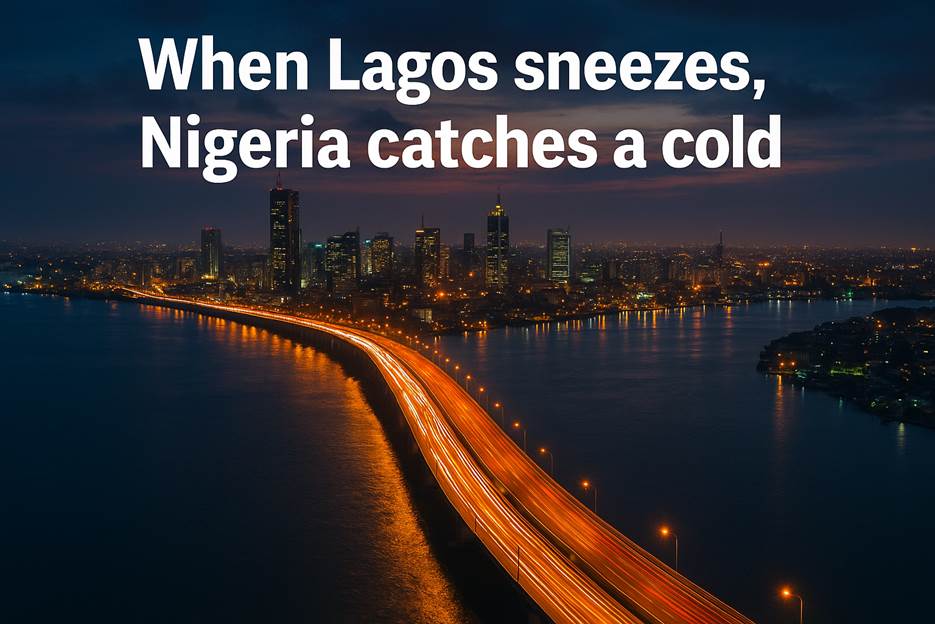
Lagos is more than a namesake of towns in Portugal, France or Greece. It is by far the largest of them all, with a metropolitan population of between 17 million and 22 million, according to UN and World Population Review data.
That size places it among the world’s 15 biggest urban centres and by far the most economically powerful in Africa outside Cairo.
For all its chaos and contradictions, Lagos has become Nigeria’s indispensable engine. Over the past five years, its economy has nearly doubled, with GDP rising from N29.7 trillion in 2020 to an estimated N55.7 trillion in 2024, according to Lagos Bureau of Statistics (LBS) data.
The challenge is whether this pace of expansion can be sustained without straining the city’s fragile foundations.

The answer matters well beyond the city’s borders. Lagos accounted for 22.4 percent of Nigeria’s total output in 2024, more than any other state and more than most countries in West Africa.
As one Lagos-based economist put it: “If Lagos slows, Nigeria slows. And if Lagos fails, it ripples through the region.”
Growth at full tilt
Trade, the lifeblood of Lagos, expanded from N12.8tn in 2021 to N23.5tn in 2024, powered by its ports, sprawling markets and digital platforms that have turned consumer demand into a continental force.
Information and communication technology more than doubled in three years to N11.3 trillion, while construction surged on the back of megaprojects such as metro lines and new commercial towers that constantly reshape its skyline.

The breadth of this expansion is deliberate. The 2025 Lagos Economic Development Update outlines ambitions to match Cairo as Africa’s other dominant urban economy, with a $1tn GDP target by 2052. Reforms in tax digitisation, infrastructure finance and targeted subsidies have helped maintain momentum.
Fragile foundations
But Lagos’s rise has exposed its vulnerabilities. Inflation, though easing nationally, remains stubbornly high in the city, eroding household incomes. Food insecurity has deepened, driven by climate shocks and insecurity in Nigeria’s food belt.
Manufacturing has been battered by high borrowing costs and currency swings, with food and beverage output contracting sharply in 2024.
Global risks could magnify these cracks. Oil price swings, capital flow reversals or rising seas that threaten coastal infrastructure could undo fiscal gains. As the IMF recently warned in a note on sub-Saharan Africa, “urban economies that drive national growth are also those most exposed to external shocks.”
The politics of plenty
History suggests economics alone will not decide Lagos’s trajectory. With national elections due in 2027, fiscal prudence may bend to political expediency.
Lagos already allocates heavily to infrastructure 68 percent of its late-2023 budget went to capital projects but recurrent demands from wages and services are rising fast.
Election cycles in Nigeria have traditionally loosened fiscal discipline, with higher spending stoking demand, inflation and debt. The challenge for Lagos will be to keep borrowing sustainable while maintaining its investment drive.
Investor signals
For investors, the Lagos story is as much about credibility as scale. The city still dominates Nigeria’s capital inflows, attracting $650 million in the third quarter of 2024, though much of it was short-term portfolio money.
Longer-term investment will depend on whether inflation stabilises, infrastructure bottlenecks ease and energy deficits are bridged.
“The fundamentals are attractive, but the risks are equally clear,” said a West Africa economist at Renaissance Capital. “Lagos can keep pulling capital if it shows discipline, but it cannot rely on liquidity alone.”
What’s at stake
Lagos is living through a high-stakes experiment. If it succeeds in stabilising food systems, closing its energy gap and aligning education with labour market needs, it could become a case study in emerging-market durability. If it fails, Nigeria’s broader reform story risks being derailed.
The durability of Lagos’s resilience will shape not just Nigeria’s future but the fortunes of West Africa as a whole.





