In Nigeria’s commodities market, volatility is no longer the exception; it is the rule. What began as a cyclical mismatch of harvest seasons and rainy months has evolved into a storm of global shocks, forex distortions, weak supply chains, and inconsistent policy.
As the country stares down its post-reform future, a new understanding is emerging: survival will depend not just on growing or trading commodities, but on intelligence, agility, and real-time strategy.
“Grains like maize, rice, and sorghum show strong co-movement, particularly in sectors like animal feed.”
A new report by Meristem Wealth Management paints a detailed picture of this transformation. It follows years of market disruption, first by macroeconomic shocks in 2016–2018, followed by temporary stability buoyed by subsidies and FX controls, and then by a structural reset in 2023, when fuel subsidies were scrapped and the naira was floated.

These reforms, while lauded for their long-term potential, have sent shockwaves through Nigeria’s commodity-dependent industries. The cost of energy and transport has surged, squeezing margins and tripling input costs for producers.
Exporters briefly benefited from a weaker naira, but the same depreciation widened import gaps and revealed just how vulnerable local supply chains had become.
Read also: Falling commodity prices may ease inflation risks, trade tensions – World Bank
When demand always outpaces supply
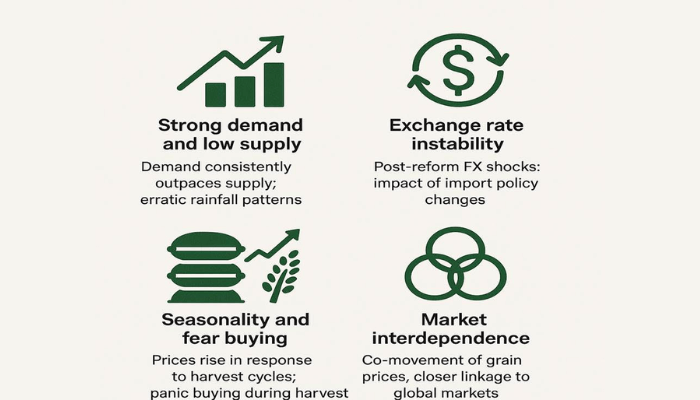
Demand has become a relentless force. Whether driven by consumer staples, livestock feed, or industrial processors, Nigerian commodity buyers now face an environment where demand almost always exceeds supply.
This imbalance, coupled with erratic rainfall patterns and minimal irrigation investment, has created steep seasonal price swings.

Meristem’s analysis confirms what many procurement officers already know: prices fall during harvest (typically October to December) and rise during the off-season. But the data also reveals new twists.
In recent years, firms have begun panic-buying during harvest, driven not by scarcity, but by fear. In maize and soy markets, companies overpaid in 2021, 2022, and again in 2024, spooked by memories of inflation and disruptions. This “recency bias,” the report argues, is distorting basic supply-demand signals.
When maize prices spiked in late 2024, we had to renegotiate every contract,” said Dele Adeoye, a Lagos-based livestock feed processor. “The market moved faster than we could adjust.”
Commodity prices now move in packs
One of the more striking findings is how commodity prices are now moving in clusters, not in isolation. Grains like maize, rice, and sorghum show strong co-movement, particularly in sectors like animal feed.
This interdependence means a shock to one commodity can quickly spill into others. Correlation is no longer just a statistical term; it’s a supply chain risk.
On the global front, the story has changed as well. For years, Nigeria insulated its domestic markets through import bans and protectionist policies. That shield is cracking. With recent policy shifts allowing imports of maize, wheat, and rice, domestic prices are now more directly influenced by global movements.
While this may cool inflation temporarily, Meristem warns it could decimate local producers who can’t compete with subsidised imports from countries like the U.S., Brazil, or Ukraine.
Read also: FCCPC gives retailers one-month ultimatum to reduce commodity prices
Intelligence is the new commodity
The broader message is clear: old strategies no longer work. One procurement strategy per season is a recipe for failure. Teams must now operate with flexibility, guided by granular data and scenario testing.
Contracts, too, must evolve, reflecting not just current prices but built-in mechanisms for adjustment as conditions shift.
Even more critically, Meristem calls for stronger industry participation in shaping policy. “The stakes are too high to leave decisions only to the government,” the report notes.
With global risk increasing from geopolitical tensions to climate shocks, Nigerian firms must co-create frameworks that protect both producers and consumers.
A sector at a crossroads
What emerges from Meristem’s research is not simply a forecast; it’s a call to action. The Nigerian commodities market, long shaped by unpredictability, is entering a new era. Price signals are no longer clean. Risk is structural, not seasonal. And the best-performing players will be those who treat information as a resource as valuable as grain or oilseed.
In a market where volatility is the only constant, intelligence, not optimism, may be the safest bet.
Oluwatobi Ojabello, senior economic analyst at BusinessDay, holds a BSc and an MSc in Economics as well as a PhD (in view) in Economics (Covenant, Ota).