Market sentiments suggest that the Nigerian capital market has got its tempo back. In 2019, the Nigerian capital market closed at -14.60 percent, and thus emerged as one of the worst performing equity markets in the world. With the developments in the few days of trading, the story has changed, albeit, temporarily, following the optimism that some leading listed companies such as banks, oil companies, cement manufacturers, and food and beverages might release impressive full year results, out of which significant dividends will be paid to shareholders.
After the ten days of trading on the Nigerian Stock Exchange (NSE) in 2020, the All Share Index (ASI) has returned to the positive territory, with year-to-date returns of 9.59 percent. The NSE Industrial index gained 19.50 percent; NSE Meri Value Index, 17.24 percent; NSE AFR Div Yield Index, 14.81 percent; NSE Premium Index, 14 percent; Lotus Index, 12.51 percent; NSE AFR Bank Value Index, 11.43 percent; NSE Banking Index, 10.83 percent and NSE 30 Index, 10.95 percent, all have outperformed the market year to date.
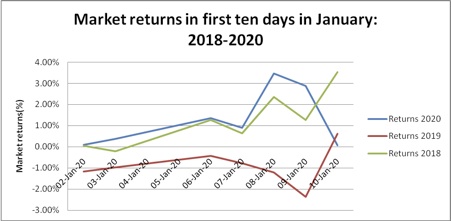
The first 10 days trading of 2020 appeared to be the inverse of the first 10 trading days of 2019, with the graphs of the market returns appearing like pincers curve, implying a trade-off between two periods. In 2019, returns of the first ten days of that year oscillated in the negative territory, but the negative trend of that period’s first ten days changed on the tenth day of the period which ended in the positive territory.
Analysing the same trading period in 2018 shows a complete course for the market activities. In that period, the market followed an upward trajectory with the highest daily returns of 3.54 percent on the 10th of January 2018.

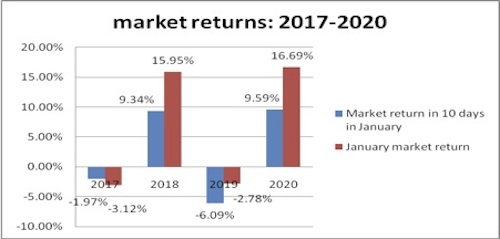
What can we gained from the analysis above? In January 2017, the first ten days of the New Year at ended at -1.97 percent, just as the equity market closed at -3.12 percent in January 2017. In the first ten days of 2018, the equity market closed at 9.34 percent, and market sentiment became stronger explaining why the Nigerian equity market ended January 2018 at 15.93 percent.
In the first ten days of January 2019, the Nigerian equity market closed at -6.09 percent, following that trend, the nation’s equity market closed in the red by the end of January 2019 at -2.78 percent. In the first ten days in January 2020, the market return is 9.59 percent, and based on the observed trend, we are projecting a 16.69 percent market returns for January 2020. This gives us the impression that the nation’s capital market has the tendency to close higher in January 2020.
This projection is not without a caution. In its 2020 Economic Outlook, United Capital opined that the continuous sale of high yield OMO bills would keep foreign interest in Nigerian equity tepid amid fear of devaluation.
“For equities, the continued auction of high yield OMO bills to FPIs may keep foreign interest in local equity market tepid amid fears of a naira devaluation and confidence deficit in the economy. Again, FPIs are likely to continue their flight to safety by swapping/selling equities for low-risk OMO bills.

“Yet, our outlook for stocks in 2020 is anchored on developments in the domestic and global economy with monetary policy as the biggest factor to watch. From all indications, the only justification for an uptick in the equities market is the lower yield environment, supported by increased local currency liquidity. However, this will not be enough to trigger a major rally in the absence of the demand from FPIs. Overall, our base case scenario sees equities market return at +5.3% in 2020, driven by local demand for high-quality dividend-paying stocks and increased system liquidity”, United Capital said.
Year to date, 52 stocks have appreciated in prices which price appreciation ranging from 0.5 percent to 28.9 percent. However only 24 stocks managed to outperformed the market. Cornerstone Insurance sustained its momentum of last year as it topped the gainers’ table with 28.9 percent year to date price appreciation. It is followed by FBN Holdings which has gained 24.4 percent. Dangote Cement, gained 21.1percent; ETI, 20 percent, while Presco, appreciated by 19.8 percent, year to date.
Others top ten outperformers are UACN, 19.2 percent; Okomu, 18.7 percent; Livestock Feeds, 18 percent; UBA, 17.5 percent, and Zenith Bank, 17.5 percent.
The decliners year to date are Seplat, -10.4 percent; Fidson, -12.9 percent; GSK, -13.1 percent; Unilever, -13.6 percent and Thomas Wyatt, -91.8 percent.