Nigeria’s maritime market remains heavily dominated by foreign players, a reflection of long-standing dependencies that have stifled local capacity. Although the government pledged a revival through the disbursement of the Cabotage Vessel Financing Fund (CVFF) this year, progress has been scarce. In this interview, James Jolapamo, a maritime consultant and founder of Ship2Ship Solutions, speaks with Bethel Olujobi about the idea behind NMS-BEAP25 and his plan to reclaim Nigeria’s lost maritime capital. Excerpts:
What is the NMS-BEAP25 programme?
NMS-BEAP25 is a 10-year national programme designed to reverse an estimated $120 billion annual economic leakage. Our goal over the next two years is to realign and leverage the Cabotage Vessel Financing Fund (CVFF). Instead of a 100 percent disbursement model that benefits a few without GDP impact, we propose using CVFF as financial leverage to build a sustainable ship-management ecosystem. This approach allows us to extend the commercial value of vessels from the usual 10-year profit cycle to a 100-year sustainability plan.
What inspired this?

It started with a memoir write-up I shared on a WhatsApp group that sparked intense discussion around the Blue Economy and the CVFF. People questioned why countries like China and other Asian economies have managed to harness trillions of U.S. dollars in GDP and trade through their maritime sectors, while Nigeria has yet to reach even a billion dollars despite our strategic sea-going corridors and resources.
The debate led us to develop a business case, which about four months later evolved into a comprehensive economic case report. We relied heavily on data-driven insights from the Nigerian Ports Authority (NPA), NIMASA Cabotage Vessel Register and other maritime databases.
What specific incentives or regulatory reforms will attract private investors into the maritime value chain under this programme?
The NMS-BEAP25 framework proposes a clear exemption regime for qualified maritime assets especially Nigerian-flagged and locally operated vessels alongside tax harmonisation across Customs, NIMASA, and Finance. I believe the most critical reform area is our current Customs import duty interpretation.
Presently, vessels carrying goods consignments above >500 or 1,000 gross registered tonnes (GRT) are often subjected to import duty assessments, as though they were consumer goods rather than capital infrastructure.

This approach is both illogical and economically counterproductive. You won’t find such practice anywhere else in the maritime world, not in the United States, Europe, or Asia because vessels financed through asset-backed debt structures are not treated as taxable imports; they are national productive assets.
Incentivising investment means correcting this foundation. We also advocate for accelerated capital allowances, duty waivers on critical spares and dry-docking equipment and VAT exemptions on ship acquisition and charter transactions.
This is all quite ambitious. How do you plan to finance it?
We’re modelling an EIB-style mortgage financing system, where vessels are treated as long-term, low-interest assets—“real estate on water.” Our framework focuses on three fundamentals. One. Long Tenor Facilities (12–15+ years), Two. Reasonable Interest Rates (<10%). We aim to create a blended rate environment by combining DFI-backed capital with local sub-custodian banks. Three. Grace Period and Cash-Sweep Features: Each facility will include a 12–24 month moratorium and performance-linked cash-sweep provisions. This allows vessels to stabilise operationally in their early years without choking under debt pressure.
President Bola Ahmed Tinubu has laid the groundwork with his Renewed Hope reforms, but we need a sense of urgency to consolidate progress. Current moves by NNPC/Caverton, the NCDMB “Nigeria First” initiative, and NUPRC’s licensing reforms all signal readiness.
We have had several maritime plans in the past that fell short of full implementation. What safeguards are built into NMS-BEAP25 to avoid the same fate?
I believe the chief of all hurdles has always been political will, and closely following that is the technical mismatch. We are proposing an Executive Implementation Directive at kick-off to capture the low-hanging fruits within the first six months. This will codify key levers such as the CVFF leverage mechanism, not merely tied to a custodian fund, but to real GDP-impacting projects.
Within that, to formalise the Cabotage Joint Task Force (CJT), led by an indigenous interest group in partnership with NIMASA, the Nigerian Navy. Also, Charter Party obligations involving national operators like NNPC and 2nd- tier energy firms anchoring firmly on the Nigeria-First Policy. Second, is strategy and transparency.
A Flag Watch List will be maintained and updated continuously under a RACI matrix, tied directly to verifiable KPIs such as vessels inducted, Nigerian time-charter hours, seafarer deployment hours and certifications achieved.
The Cabotage Fund has long been criticised for opacity. How will your proposal ensure transparency and equitable access, especially for indigenous operators?
The guiding philosophy is what I call “adaptive continuum” – a living balance that honours history but drives forward innovation, in the true spirit of the Cabotage principle. We’re “rethinking the CVFF” approach-not as a mere disbursement fund, but as a strategic leverage instrument. It must become a win–win mechanism, one that restores the faith of the early contributors while empowering new players to build a more inclusive maritime economy.
In terms of societal impact, can you explain and quantify how this project will create direct or indirect jobs for Nigerians over its implementation period?
For Fleet Induction, we’re targeting between 150 and 200 vessels across cabotage, offshore support and logistics operations. Altogether, that translates to roughly 12,000–18,000 direct seafaring roles at steady state. Under Shipyards & Maintenance – Dry-dock expansions and recurring classing or repair cycles will support another 20,000–30,000 technical and trades jobs – including welders, electricians, NDT inspectors, painters, and production planners.
The multiplier effect extends to pilots, mooring crews, chandlers, bunkering, haulage, ICT and security services an additional 35,000 – 55,000 jobs. With Training & Certification – Under our Whitelist System and the James Jolapamo Professional Offering, developed in collaboration with Elkins Marine US, we will roll out specialised, ISM /ISPS training pipelines supported by simulators and certification programs creating 5,000–8,000 professional and instructional roles. On conservative estimates, NMS-BEAP25 can catalyse between 130,000 and 200,000 total jobs over the decade.
How have the responses been to this?
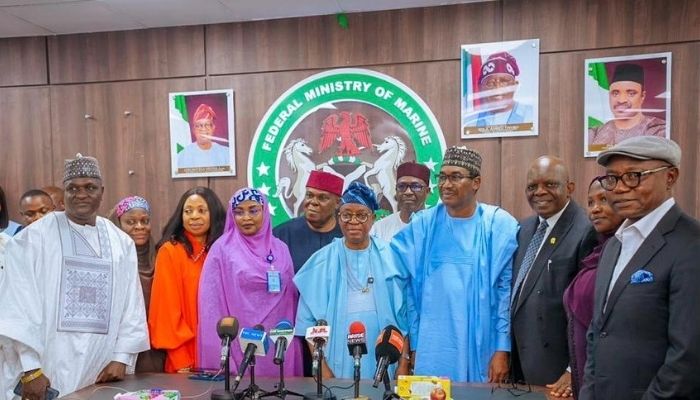
The response has been very encouraging. The Minister and his technical team have shown strong commitment to the Blue Economy agenda. We’ve already mapped out major stakeholders and are securing buy-in ahead of our engagement with the Presidential level. Key industry figures such as Tope Sonubi, Kola Adesina, Kola Gbadamosi, Prince Femi Akinruntan, and former NIMASA DGs Temisan Omatseye and Dakuku Peterside, along with Greg Ogbefun, are already part of the early frontier discussions.
Given Nigeria’s history of policy discontinuity, how do you intend to secure bipartisan and institutional buy-in so this plan survives beyond the current administration?
In essence, it’s a sovereign continuity clause—a mechanism that compels successive administrations to honour existing commitments tied to national economic interests. Any deviation or unilateral termination could trigger international scrutiny. I believe the precedent set by this current administration—much like what we’ve seen in Lagos State—shows that Nigeria can institutionalise public-interest programmes beyond politics.
You’ve often mentioned the “four wheels” concept. Could you explain that analogy?
Certainly. I liken the maritime sector to a vehicle: for it to move effectively, all four wheels must function together. These four wheels are ship acquisition, dry-dock and maintenance capabilities, Environmental Vessel Recycling and safety operations, professional management and skilled mariners. When these operate in harmony, the Blue Economy will thrive sustainably. With the right infrastructure, such as Suezmax-capacity dry docks, Nigeria’s crude and product operations will become far more efficient.
What’s next for NMS-BEAP25?
Within the next month, we’ll proceed with wider stakeholder engagements and final reviews. Our firm, Jolapamo & Associates, is positioned to lead the implementation phase, including the draft MoU and conditional Term Sheet, which will feed into the Presidential Cabotage Committee. The NMS-BEAP Cabotage Forum officially kicks off this week.